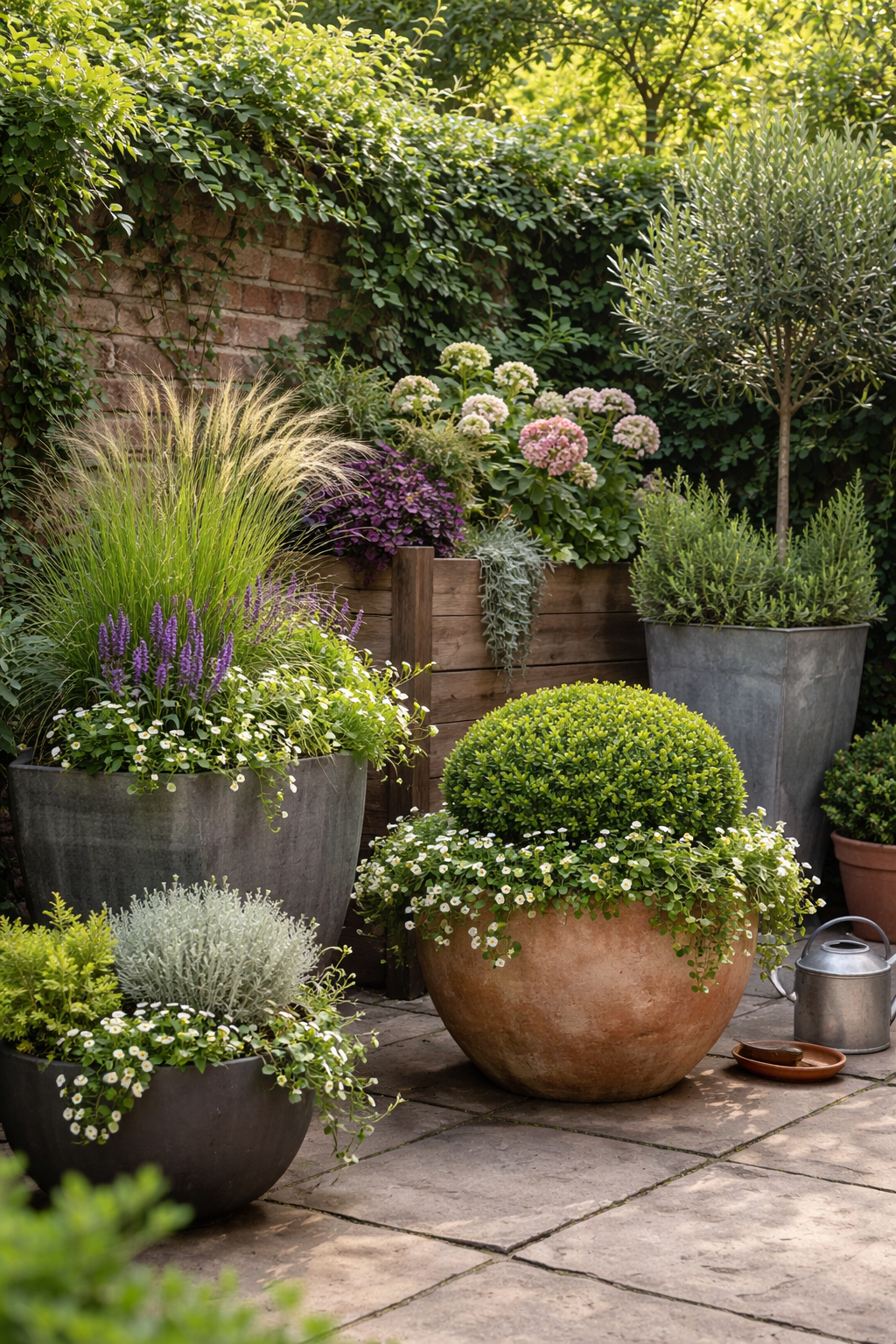
| A container garden is subtly subversive, suggesting movement in a discipline defined by rootedness. A pot can be lifted, turned, rearranged, or removed. Gardening becomes a negotiation. The soil is finite. Boundaries are clear. Signs of neglect appear quickly. In town gardens, containers are no longer just decorative afterthoughts but structural elements. I now see them as small, self-contained ecosystems sitting on brick, stone, decking, and concrete surfaces that once resisted growth—quietly insisting that soil can exist anywhere. It is important to note: containers are not miniature borders. This is the first key contrast to address. Unlike borders, containers behave differently, demand different care, and are less forgiving. While a border might cope if you are distracted for a month, a pot will immediately show neglect through leaf scorch and droop. That is not a complaint. It is simply the nature of containment. The Discipline of Volume When I began gardening professionally, I treated pots as scaled-down beds, but this approach did not suit container gardening. I used standard compost, watered often, and expected proportional results. They responded with mediocrity. Volume is fundamental in container gardening. Soil depth controls moisture, temperature, and nutrient availability; larger containers offer greater stability, while smaller ones heighten extremes. Recent summers with sudden heat, without gradual acclimatisation, highlight the performance gap between container sizes. A small terracotta pot can dry to dust within hours. In contrast, a large wooden planter maintains a cooler core even in direct sun. Neither is better or worse; rather, the contrast lies in how scale affects resilience. Containers reward generous soil depth, root room, and feeding. Frugality in volume often leads to more labour later. Choosing a larger container brings a psychological shift: planting becomes less seasonal, more architectural. One thinks in years, not months. Compost Is Not Soil The term “potting soil” unsettles me. What we use in containers isn’t living soil. It’s a substrate—a managed medium designed to hold moisture and nutrients. In a border, soil is alive beyond our understanding, regulated by fungi, bacteria, worms, and structure. In a pot, that complexity is reduced. We must supply what would otherwise occur naturally. I deliberately mix compost rather than rely solely on bagged blends. Grit improves drainage. Well-rotted organic matter adds weight and slow-release nutrition. Occasionally, a little garden soil—sieved and used sparingly—adds microbes. Some debate soil in pots. Context matters: in small containers, soil can compact; in larger ones, especially for woody plants, it adds stability. Attention to container needs is more important than rigid formulas. A common myth is that gravel improves drainage. In reality, it can trap water above the stones. True drainage requires the right compost structure and open holes, not gravel. Containers teach humility. They expose shortcuts. Watering as Observation Watering a pot is about attention, not routine. Schedules are convenient but blunt. Weather, exposure, plant type, and container material all affect results. In a south-facing courtyard, dark pots absorb heat and boost evaporation. Against a shaded wall, moisture lingers longer. Grouped pots create a microclimate, reducing wind and slowing transpiration. Deep watering—enough to let water pass fully through the compost—encourages roots to grow downward. Light, frequent watering keeps roots near the surface, exposing them to fluctuations in temperature and moisture. This is a simple observation, not a dramatic theory. Withholding water sometimes—not out of neglect, but to build resilience—prevents problems caused by constant dampness. Container plants signal stress quickly—curled leaves, dull colour, paused growth—requiring responsive care absent in borders. Feeding the Finite Nutrients in containers do not replenish themselves through rain filtering through layers of earth. They are used up and depleted. Feeding containers require timing and restraint. Use slow-release and liquid feeds as needed, not just products. Overfeeding causes weak growth; underfeeding brings pallor and stagnation. Both extremes stand out more in pots than in borders. A quiet satisfaction in container gardening is seeing a plant respond to nourishment within days. The feedback is swift, reminding us that plants are living systems in dynamic exchange with their environment. Structure Before Season My main shift: favouring long-term container structure over fleeting seasonal displays. There is nothing wrong with summer bedding. But replacing an entire display twice a year can contrast immediate spectacle with long-term resilience, and may become more a performance of abundance than cultivation. Now I prefer building containers around a core—an evergreen shrub, a small grass, or a reliable perennial. Seasonal plants are added lightly, woven through but not dominating. This has practical benefits. Roots establish more deeply. Watering stabilises. The container shifts from a temporary arrangement to a miniature landscape. This approach reflects gardening as stewardship, not endless reinvention. The Constraint as Creative Force Container constraints sharpen design: proportion matters. A small plant can dominate, and delicate species may fade unless paired well. I see containers as conversations between height, mass and movement. An upright element gives a spine. Surrounding plants soften edges. A trailing plant draws the eye downward, blurring the line between pot and ground. But even here, rules are flexible. Windy gardens call for sturdier forms. Shaded courtyards favour foliage over bloom. The context determines the balance. One common assumption is that containers are mainly for colour. I find this limiting, especially when contrasted with the enduring appeal of texture, leaf shape, and subtle tonal variation. These features not only last longer but also require less intervention than the repeated use of flowering annuals. Containers can be contemplative spaces as much as vibrant ones. The Question of Mobility A pot’s mobility changes our interaction with garden space. In a new courtyard, you can experiment. A grouping may feel unbalanced and be adjusted. A struggling plant can be relocated. This adaptability is valuable when structural changes are costly. However, mobility has limits. Large containers are heavy. Mature root systems resist disturbance. There is a point at which a container becomes semi-permanent. Repeatedly moving pots can stress both plants and gardeners. Observe and wait before choosing a placement. Climate and Containment The UK climate is considered temperate, but it is less predictable than it used to be. Heavy rain, sudden frost, and prolonged dryness affect containers more acutely. In winter, roots in pots are more exposed to freezing temperatures than those in open ground. Elevating containers allows drainage before frost. In summer, grouped pots reduce heat stress. There is also a subtle environmental benefit. Containers allow for more efficient rainwater harvesting, encourage careful water use, and can turn impermeable surfaces into biologically active zones. Each container material has trade-offs: peat-free compost dries out, plastic is less durable, and terracotta can crack. There is no pure solution. Only considered choices. What Containers Reveal Container gardening demands daily attention, inviting the gardener into continual engagement with plants. In town settings, containers soften edges, interrupt hard lines, and create a threshold between built and grown. Yet they require commitment. A container garden is not maintenance-free; it concentrates the labour, which is both visible and immediate. That visibility brings quiet satisfaction. Watering early, checking leaves, adjusting a group—it becomes a small ritual. Over time, containers develop character: moss gathers, a shrub thickens, and compost settles. They gain patina. Containment does not diminish life. It refines it. A Gentle Challenge One idea worth reconsidering is the belief that container gardens are easier than traditional beds. Some aspects are simpler—no deep digging, fewer weeds. Yet this contrasts with the consistency containers demand from gardeners. A border forgives. A pot remembers. For gardeners who value responsiveness and close observation, containers can be deeply rewarding. For those seeking distance, they may prove frustrating. Neither is superior. They ask different things of us. Closing Reflections When I look at a well-established container arrangement, I no longer see decoration. I see a negotiation between limits and growth. Soil volume is fixed, yet roots adapt. Water is finite, yet life persists. The gardener intervenes more directly, yet the plant retains its own rhythm. That may be the quiet lesson containers offer. Within constraints, there is still expansiveness. Within boundaries, there is still movement. A container garden, at its best, is not a compromise for lack of space. It is a deliberate act of placement. It asks us to notice more closely, to tend more thoughtfully, and to accept that scale alters responsibility. In a world of shifting climates and shrinking plots, that feels less like a trend and more like a conversation worth continuing. |
| About our writing & imagery Most articles reflect our real gardening experience and reflection. Some use AI in drafting or research, but never for voice or authority. Featured images may show our photos, original AI-generated visuals, or, where stated, credited images shared by others. All content is shaped and edited by Earthly Comforts, expressing our own views. |
 Earthly Comforts