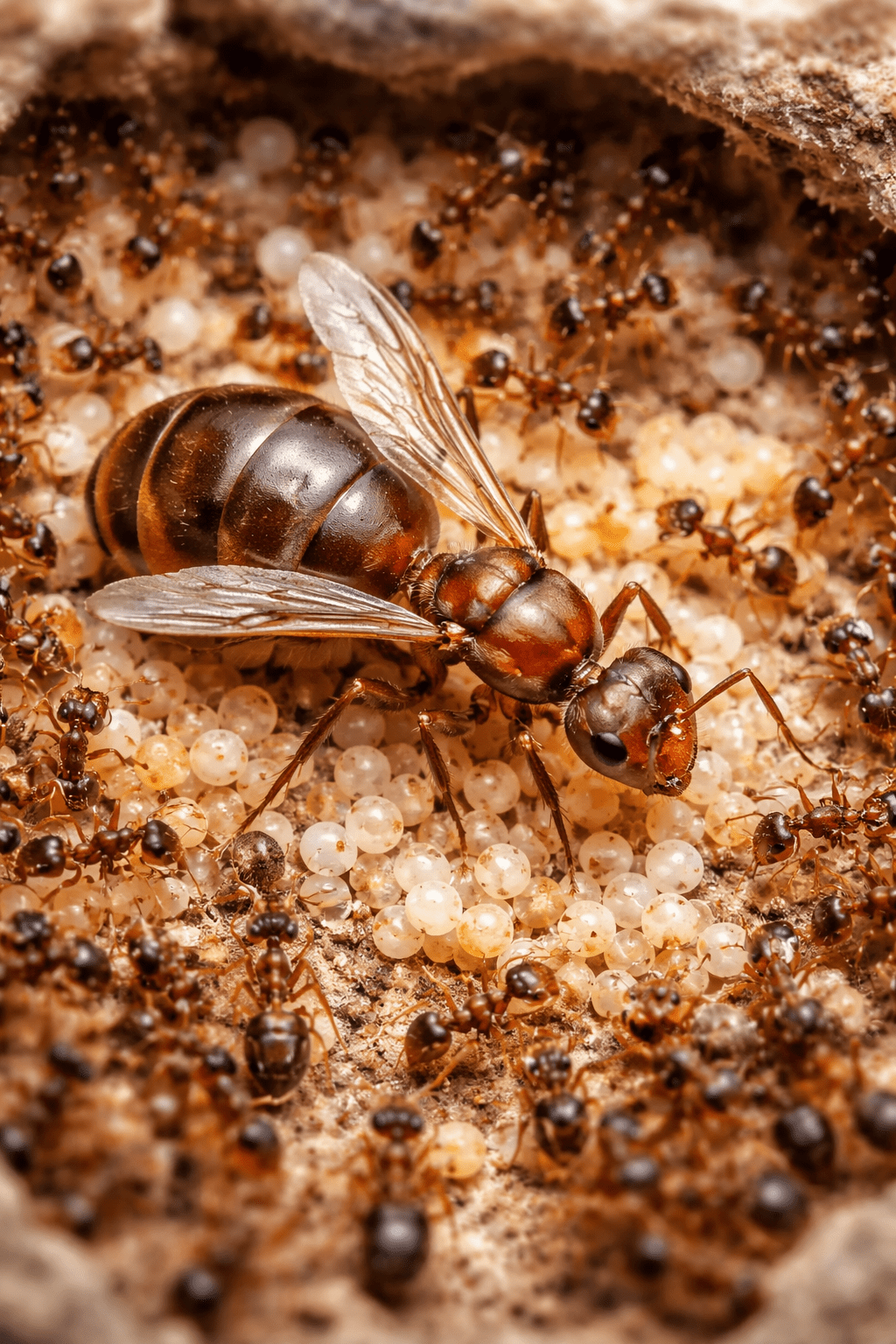
| How queens shape entire colonies When people think of insect colonies, they often imagine chaos: thousands of bodies moving at once, driven solely by instinct. But spend time observing ants, bees, wasps, or termites, and a different picture emerges. These societies are not disordered at all. They are highly structured systems, built around one central figure: the queen. The queen insect is not a ruler in the human sense. She doesn’t issue commands, enforce rules, or oversee daily work. Her influence is quieter, deeper, and more fundamental. She shapes the colony simply by existing, reproducing, and signalling her presence. Without her, the colony loses direction, cohesion, and ultimately its future. At the most basic level, the queen’s role is reproduction. She is the primary, and often sole, egg-layer in the colony. Every worker tending the nest, every soldier defending it, every forager venturing out into danger exists because the queen laid an egg that became them. In this way, the queen is not just part of the colony; she is the colony’s continuity. But reproduction alone does not explain her influence. Queens also produce chemical signals—pheromones—that permeate the nest. These signals do not shout; they whisper constantly. They tell workers that a fertile queen is present, that the colony is stable, and that it should continue functioning as it is. As long as those signals are strong and consistent, workers remain workers. They do not attempt to reproduce themselves. Order holds. Remove the queen, and things change quickly. Workers may begin laying unfertilised eggs. New queens may be raised. The colony’s behaviour shifts from steady maintenance to urgent reorganisation. What was once a balanced system becomes reactive and uncertain. This alone shows how deeply the queen’s presence shapes collective behaviour. In many species, the queen also defines the colony’s character. Her genetics influence how aggressive the workers are, how they respond to threats, how efficiently they forage, and how resilient the colony is under stress. Two colonies of the same species can behave very differently depending on the queen at their centre. One may be calm and methodical; another, volatile and defensive. The difference often traces back to her. It is also worth noting what the queen does not do. She does not forage. She does not build. She does not defend the nest. In many species, once she is established, she never leaves the heart of the colony again. Her power comes not from action, but from stability. By remaining constant, she allows everyone else to specialise. This division of labour is one of the great efficiencies of insect societies. Workers can focus entirely on their tasks because the colony’s future—its reproduction—is already secure. The queen frees the colony from internal competition. There is no scramble for dominance, no uncertainty over lineage. Everything flows outward from a single reproductive centre. Queens also anchor colonies through time. Some queens live for years, even decades, far outliving any worker. While individual workers are born, labour, and die, the queen remains. She becomes a living memory of the colony’s founding, carrying its genetic line forward season after season. The colony around her changes, but she provides continuity. Interestingly, queens themselves are shaped by the colony. They are fed differently as larvae, often receiving richer or specialised nutrition that triggers their development into reproductive adults. In this sense, the queen is not born powerful; she is made by the collective. The colony creates the queen it needs, then organises itself around her. This relationship—where the group creates the leader, and the leader stabilises the group—is one of the most elegant feedback loops in nature. It shows that power does not always sit at the top issuing instructions. Sometimes it sits quietly at the centre, holding everything together simply by being consistent and biologically reliable. When we look closely at queen insects, we see a lesson in systems rather than individuals. Colonies succeed not because of dominance or control, but because roles are clear, signals are steady, and energy is not wasted on internal conflict. The queen is the fixed point that allows complexity to exist without collapse. Insect societies remind us that leadership need not be loud to be effective. Sometimes the most influential force is the one that creates stability, continuity, and trust in the future. The queen does not run the colony. She enables it. And in doing so, she shapes everything. |
Unless stated, featured images are my own work, created independently or with the assistance of AI.
 Earthly Comforts