
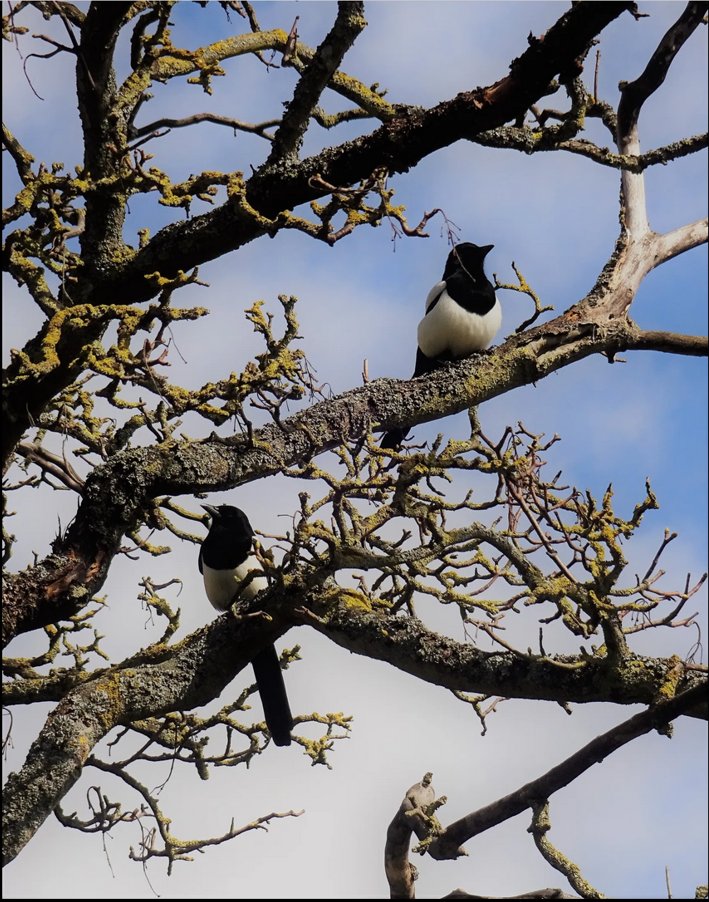
| The Clever Watcher at the Garden Gate Few birds in the UK provoke such strong reactions as the magpie. Loved by some, mistrusted by others, and surrounded by centuries of folklore, the magpie is one of Britain’s most recognisable and misunderstood garden residents. With its striking black-and-white plumage, metallic sheen, and unmistakable call, the magpie is impossible to ignore once you learn how to notice it. This bird thrives in close proximity to people, adapting easily to gardens, farmland, parks, churchyards, and even busy urban streets. To understand the magpie is to better understand how wildlife learns, survives, and coexists with us in modern Britain. |
| What Exactly Is a Magpie? The magpie most familiar in the UK is the Eurasian magpie. At first glance, it appears simply black and white, but closer observation reveals iridescent blues, greens, and purples shimmering through the black feathers, particularly in good light. This sheen is structural rather than pigmented, meaning it comes from the way light refracts through the feathers rather than from colour alone. Magpies are members of the crow family, a group renowned for intelligence, adaptability, and complex social behaviour. They have long legs, a strong beak, and a long tail, giving them an elegant, almost theatrical silhouette in flight. A Bird of Intelligence and Memory One of the most remarkable things about magpies is their intelligence. They are capable of problem-solving, long-term memory, and learning through observation. In gardens, this might look like a magpie remembering where food was previously available, or quickly learning which areas are safe and which are not. Magpies can recognise individual human faces. Studies and real-world observation suggest they remember people who have threatened them and respond differently to those who have not. This ability partly explains why some gardeners feel “watched” by magpies—because, in a very real sense, they are. Their calls are varied and purposeful. Magpies use different vocalisations for alarm, social contact, territorial defence, and mate communication. Once you become familiar with their sounds, you can often tell what is happening before you even see the bird. Territory, Pairs, and Social Structure Magpies are fiercely territorial birds, especially during the breeding season. Most adult magpies form long-term pair bonds, often lasting for life. These pairs defend a defined territory year-round, chasing away rival magpies and sometimes other birds that venture too close. Outside of breeding season, younger magpies often form loose groups known as “magpie parliaments.” These gatherings allow juveniles to learn social rules, foraging strategies, and survival skills. Despite their reputation for aggression, magpies are highly social animals with complex relationships. Their territorial nature is one reason magpie numbers appear stable rather than overwhelming in any one area. A single pair can control a surprisingly large patch of land. The Famous Nest: Engineering in the Trees Magpie nests are among the most distinctive in the British countryside. Large, domed, and often built high in trees or dense hedgerows, they look more like fortified structures than simple bird nests. Constructed from sticks, mud, grass, and lined with softer materials, these nests provide excellent protection from predators and harsh weather. The dome, complete with a small entrance hole, is particularly unusual among British birds. It reflects the magpie’s cautious and strategic nature. Nest building begins early in the year, sometimes as early as February, and can take weeks to complete. A breeding pair will usually lay between five and eight eggs. Not all chicks survive, but those that do are fiercely protected by both parents. Diet: Opportunist, Not Villain Magpies are omnivores and highly opportunistic feeders. Their diet includes insects, worms, berries, seeds, carrion, small mammals, and yes, occasionally eggs or chicks of other birds. This last point is where much of the magpie’s bad reputation comes from. However, it is important to keep perspective. While magpies do take some eggs and chicks, there is no strong evidence that they cause widespread declines in songbird populations. Habitat loss, pesticide use, and climate change play far larger roles. In gardens, magpies are often drawn to scraps, pet food, fallen fruit, and bird feeders. They are quick to exploit new food sources, which makes them highly visible and sometimes unwelcome—but also fascinating to watch. Magpies and Gardens: A Complex Relationship For gardeners, magpies can feel like both allies and antagonists. On the one hand, they help control insect populations and clean up carrion. On the other hand, they may disturb soil, steal food, or intimidate smaller birds. The key thing to understand is that magpies are responding to opportunity. They are not malicious, nor are they “targeting” gardens out of spite. Providing dense planting, layered habitats, and varied food sources helps smaller birds coexist more successfully alongside them. Magpies are also creatures of routine. If they learn that a garden offers nothing of interest, they tend to move on. Conversely, consistent feeding or accessible waste will encourage regular visits. Folklore, Superstition, and the One for Sorrow Rhyme Magpies have occupied a powerful place in British folklore for centuries. The famous rhyme—“one for sorrow, two for joy”—has been passed down through generations, with variations across regions. Seeing a single magpie has long been considered unlucky, leading some people to salute, greet, or even bow to the bird to ward off misfortune. These superstitions likely stem from the magpie’s intelligence, watchful behaviour, and stark appearance. A lone magpie, silently observing, can feel uncanny if you are predisposed to symbolic thinking. Interestingly, many cultures outside the UK view magpies positively, associating them with good fortune, protection, or cleverness. This contrast highlights how deeply cultural storytelling shapes our relationship with wildlife. Seasonal Behaviour and What to Notice Magpies change noticeably with the seasons. In winter, they are more visible as trees lose leaves and food becomes scarcer. In spring, territorial displays and nest-building dominate. Summer brings fledglings, often noisy and clumsy, still reliant on their parents. Autumn sees renewed foraging and preparation for colder months. If you take time to observe magpies throughout the year, you begin to notice individuals rather than “just magpies.” Their personalities, habits, and even preferences become surprisingly clear. Living Alongside Magpies The magpie is a survivor. It has adapted to farming, urban expansion, traffic, noise, and human presence with remarkable success. Rather than trying to control or exclude them, learning to coexist is often the most practical and rewarding approach. A healthy garden ecosystem can accommodate magpies alongside smaller birds, insects, and mammals. Balance, diversity, and observation are key. Magpies are not a sign of ecological failure—they are a sign of adaptability. A Bird Worth Reconsidering To dismiss the magpie as a nuisance is to miss the point. This is one of Britain’s most intelligent, resourceful, and socially complex birds. It challenges us to look beyond simple labels and consider how wildlife responds to the environments we create. The next time you see a magpie perched quietly at the edge of a garden or hopping confidently across a lawn, pause for a moment. You are not just being watched by a bird—you are being noticed by one of nature’s sharpest minds. |
 The Earthly Comforts Journal
Ah, corvids – extraordinary birds…Love ’em! (https://www.youtube.com/watch?v=_fPbWEa1cyg&list=FLfcyrmjcXpYzZ2VracsE0Mg&index=116)
LikeLiked by 1 person
Hi Grace, yes me too, the maggies and the jackies especially. Wonderful watch, thank you.
LikeLiked by 1 person
Authors are magpies, echoing each other’s words and seizing avidly on anything that glitters. — Bergen Evans
LikeLiked by 1 person
So true 🙂
LikeLiked by 1 person
😊
LikeLiked by 1 person