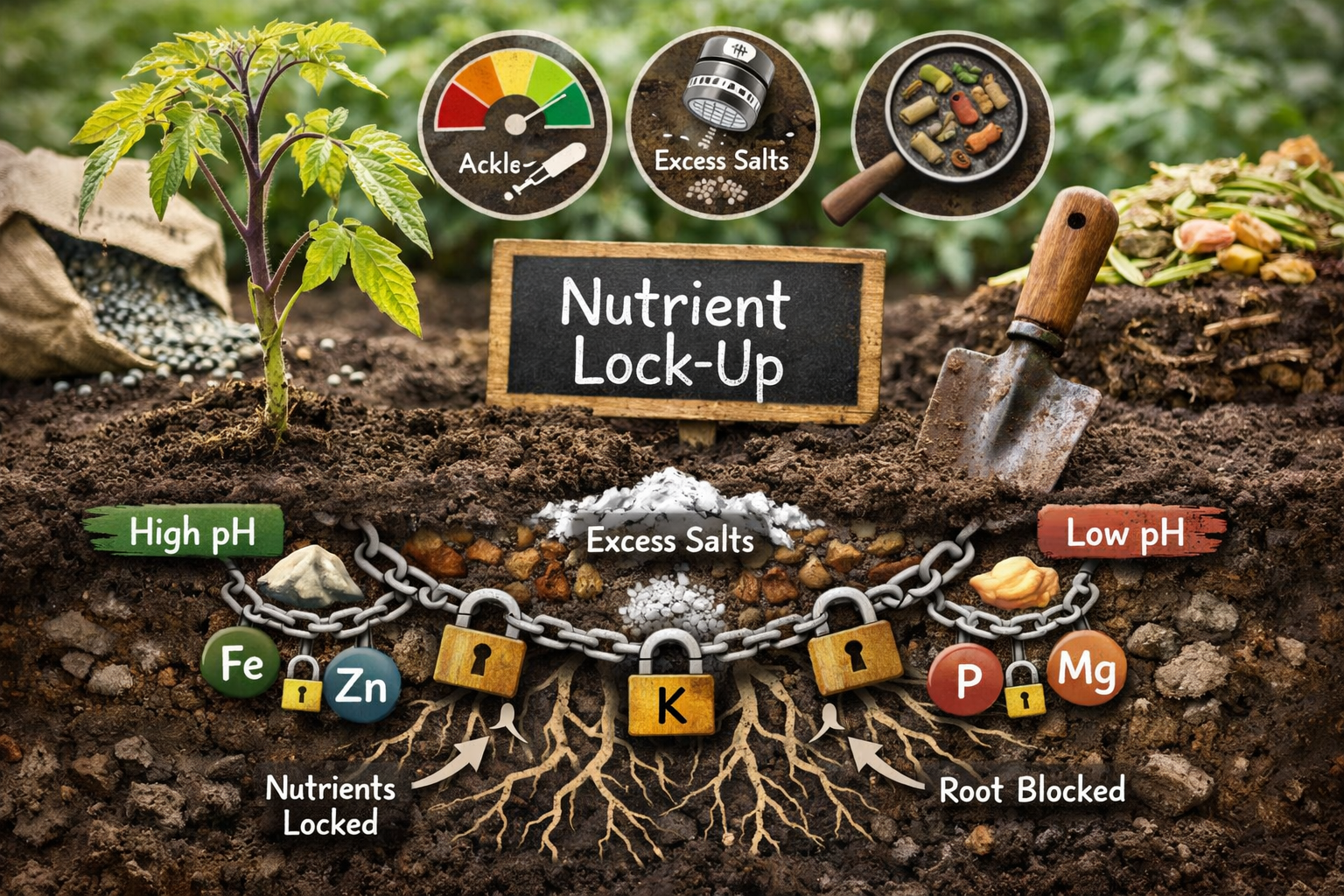
| What It Is, Why It Happens, and How to Fix It Nutrient lock-up is one of the most misunderstood problems in gardening. It often shows up as poor plant growth, yellowing leaves, weak flowering, or crops that never quite thrive, even though the soil has been fed and fertilised. Gardeners frequently respond by adding more nutrients, which can actually make the situation worse. Understanding nutrient lock-up helps you work with your soil rather than fight it. At its simplest, nutrient lock-up occurs when nutrients are present in the soil but unavailable to plants. The nutrients exist, but plant roots cannot absorb them in a usable form. This is not a nutrient deficiency, but a chemical or biological blockage that prevents uptake. The most common driver of nutrient lock-up is soil pH. Every nutrient has a pH range in which it is most accessible to plants. When soil becomes too acidic or too alkaline, certain nutrients bind to soil particles or change chemical form. Iron, magnesium, calcium, phosphorus, and trace elements are especially sensitive to pH imbalance. A plant may be sitting in nutrient-rich soil yet behave as though it is starving. Overfeeding is another major cause. Repeated applications of fertiliser, especially synthetic or high-salt feeds, can overwhelm soil chemistry. Excess nutrients compete for uptake at the root surface. For example, too much potassium can suppress magnesium absorption, while excess phosphorus can lock up iron and zinc. The plant suffers not because it lacks nutrients, but because the balance is wrong. Soil structure also plays a crucial role. Compacted soil restricts root growth, reduces oxygen availability, and impairs microbial activity. Without oxygen, beneficial soil organisms struggle, and nutrient cycling slows down. Poor drainage can create waterlogged conditions that push soil chemistry in the wrong direction, encouraging both lock-up and root stress. Organic matter is often discussed as a solution, but it can contribute to lock-up if misused. Fresh, undecomposed material such as wood chips or straw can temporarily tie up nitrogen as soil microbes break it down. This process, known as nitrogen immobilisation, is not harmful in the long term but can cause short-term nutrient shortages if not properly planned for. Microbial imbalance is another overlooked factor. Healthy soil relies on bacteria, fungi, protozoa, and other organisms to convert nutrients into forms that are plant available. When soils are repeatedly disturbed, over-tilled, or exposed to chemical inputs, microbial populations can crash. Without them, nutrients remain locked in forms plants cannot access. The symptoms of nutrient lock-up often mimic deficiency, which is why it is frequently misdiagnosed. Yellowing between leaf veins, purple stems, poor fruit set, stunted growth, and weak root systems are common indicators. The key difference is that adding more feed does not improve the plant and may worsen symptoms. Diagnosing nutrient lock-up starts with observation rather than immediate action. Look at patterns across the garden rather than single plants. If multiple species show similar stress despite feeding, lock-up is likely. Soil testing can be helpful, but even simple pH testing provides valuable insight. Many garden soils drift over time due to rainfall, compost inputs, or repeated fertiliser use. Correcting nutrient lock-up requires patience and restraint. The first step is to stop feeding. Continuing to add fertiliser compounds the imbalance. Instead, focus on restoring soil conditions that naturally make nutrients available. Adjusting pH is often the most effective intervention. Lime can be used cautiously to raise pH in acidic soils, while sulphur or organic matter can help moderate alkaline soils. Changes should be gradual, as rapid shifts can shock plants and soil life. The goal is balance, not perfection. Improving soil structure unlocks nutrients by improving root access and microbial activity. Aeration, reduced compaction, and the use of mulches all support healthier soil processes. Avoid working on soil when it is wet, as this compresses air spaces and damages the structure. Organic matter should be added in stable, well-decomposed forms. Finished compost, leaf mould, and mature manure support microbes without causing nitrogen tie-up. These materials act as buffers, helping stabilise pH and moisture while feeding soil life rather than forcing nutrients into the system. Encouraging microbial recovery is essential. Reducing chemical inputs, minimising disturbance, and keeping soil covered all help rebuild the underground ecosystem. Healthy microbes steadily and safely convert locked nutrients into plant-available forms, preventing boom-and-bust feeding cycles. In some cases, foliar feeding can offer short-term relief. Spraying nutrients directly onto leaves bypasses the soil temporarily, giving stressed plants a chance to recover while soil conditions improve. This should be used as a support measure, not a replacement for proper soil care. Long-term prevention of nutrient lock-up comes down to balance and observation. Feeding little and often, rather than heavily and infrequently, reduces the risk of imbalance. Matching fertilisers to actual plant needs and seasonal growth stages avoids unnecessary accumulation in the soil. Gardens thrive when soil is treated as a living system rather than a storage container for nutrients. When structure, biology, and chemistry work together, nutrients flow naturally from soil to plant. Nutrient lock-up is not a failure of feeding, but a signal that the soil needs attention rather than more input. Understanding this shifts gardening from reactive problem-solving to long-term stewardship. Once you recognise nutrient lock-up for what it is, many persistent garden problems begin to make sense—and more importantly, become solvable. |
Nutrient Lock-Up in Gardening
 Earthly Comforts
Interesting information, and I’ll pass it on to my hubby. Thank you for sharing, Rory.
LikeLiked by 1 person
Pleasure Eugenia, hopefully Hubs will find something beneficial.
LikeLiked by 1 person
😊
LikeLiked by 1 person