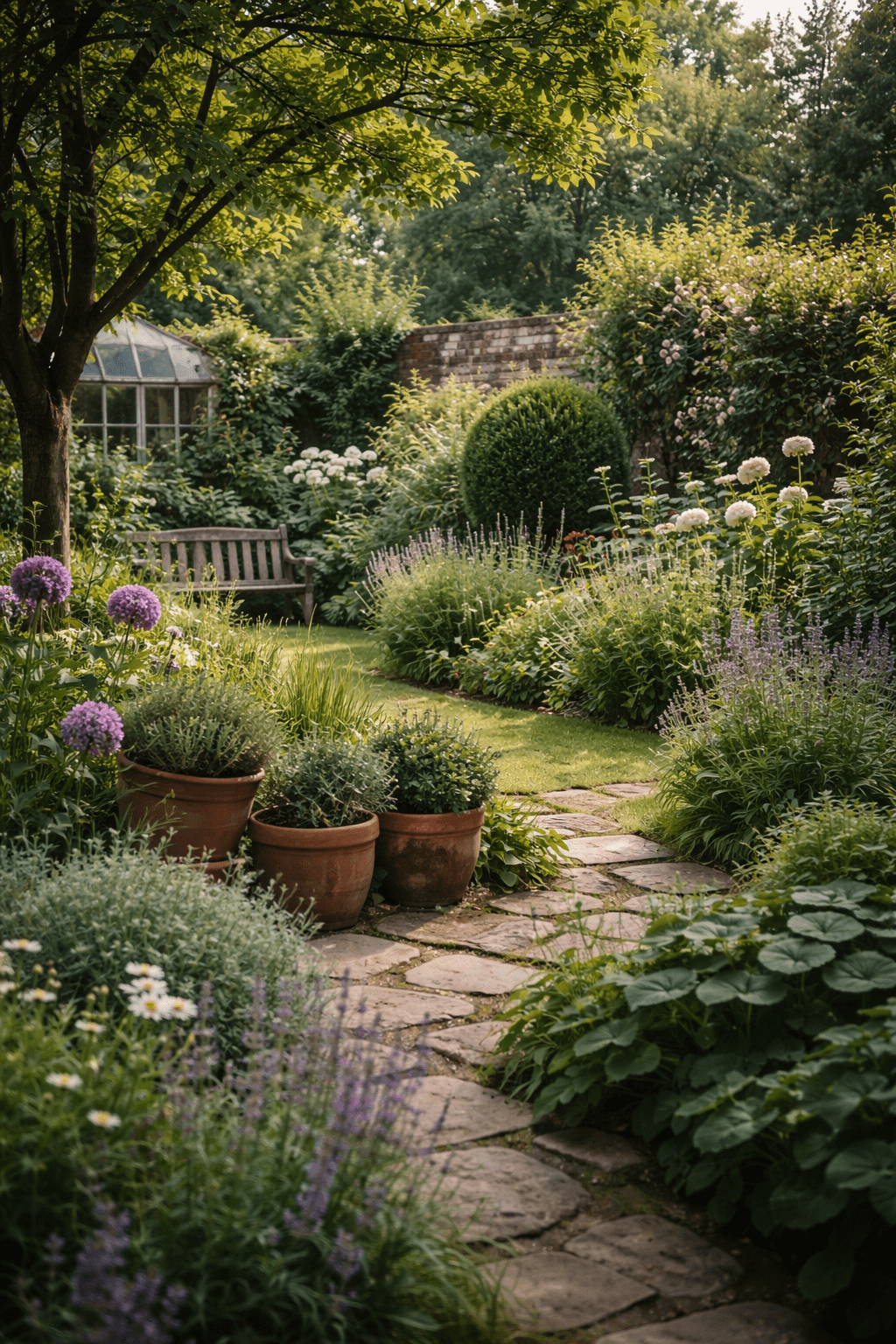
| This piece reflects the working philosophy that underpins Earthly Comforts — how we think about gardens, responsibility, and long-term care. |
| There is a particular kind of garden work that never photographs well. It happens quietly, often without witnesses, and rarely announces itself with dramatic before-and-after moments. Nothing is stripped bare. Nothing is suddenly “transformed”. In fact, if it’s done properly, very little looks changed at all — at least not at first glance. This kind of work doesn’t rush to tidy what looks untidy. It waits. It observes. It asks a different set of questions: not what looks wrong today, but what is trying to happen here over time. I’ve come to trust this quieter approach more than any other, largely because gardens themselves seem to prefer it. Most gardens don’t fail because they are neglected. They fail because they are misunderstood — managed too tightly, corrected too quickly, or constantly pushed to conform to an idea of neatness that has very little to do with plant health, soil resilience, or long-term stability. What follows isn’t a set of instructions or a philosophy in the abstract. It’s a reflection on the kind of work that happens when you stop trying to control a garden and start taking responsibility for it instead. The Difference Between Attention and Intervention There’s a persistent assumption that good gardening is visible gardening. We’ve been trained — by television, magazines, and well-meaning advice — to equate value with action. Cut it back. Clear it out. Neaten the edge. Replace what isn’t performing. There’s comfort in decisiveness, especially when time is short and expectations are high. But attention and intervention are not the same thing. Attention is slow. It involves noticing things that don’t require immediate action: a slight shift in leaf colour, the way water sits after rain, which plants lean into space and which withdraw. Intervention, by contrast, is often reactive. It answers appearances rather than processes. One of the most valuable skills I’ve learned as a gardener is knowing when not to act — and being able to justify that decision calmly, without defensiveness. There are moments when stepping back does more for a garden than stepping in and allowing organic material to remain where it falls—letting a plant recover rather than replacing it prematurely and leaving a structure intact because it supports something unseen — soil life, insects, or simply the garden’s own internal rhythm. This doesn’t mean doing nothing. It means doing less, deliberately. Responsibility Looks Different Over Time Responsibility in a garden isn’t about keeping everything looking controlled. It’s about staying present long enough to understand what stability actually requires. Short-term neatness can be achieved quickly. Long-term health takes patience, memory, and continuity. A garden changes gradually, and the most important shifts are often subtle: compaction building year by year; moisture patterns altering as surrounding growth matures; species quietly outcompeting one another below the threshold of apparent failure. If you only see a garden occasionally, it’s tempting to treat each visit as a standalone event. You respond to what’s visible that day. But when you’re involved over seasons and years, the work becomes less about fixing and more about supporting trajectories. You start to recognise patterns. You remember how something behaved last summer, or after the previous winter. Decisions stop being isolated and start forming a narrative. That’s when gardening becomes closer to stewardship than maintenance. The Myth of Constant Improvement There’s a widely held belief that gardens should constantly be improving. Bigger plants. Better structure. More flowers. Less mess. Less effort. In reality, gardens fluctuate. They plateau. They retreat before they advance. Periods of consolidation are not failures; they’re often necessary pauses while systems rebalance. One of the quietest mistakes I see is the impulse to “fix” a garden that is simply resting. Plants that appear to stall are sometimes establishing root systems. Beds that look sparse may be recovering from years of over-amendment. Wildlife presence often increases when human activity decreases, even if the visual cues feel unfamiliar. Improvement, when it’s genuine, is rarely linear. It’s cyclical. It includes phases that feel unresolved. Accepting this requires trust — in the garden, and in the person caring for it. Working With What Is Already There There’s a tendency to import solutions into gardens rather than looking first at what already exists. New compost. New plants. New structures. New ideas. Sometimes those additions are necessary. Often they’re not. Organic material already present in a garden carries information. It reflects local conditions, microbial communities, and the history of that particular space. Removing it too quickly — especially in the pursuit of cleanliness — strips away context and nutrients. Reusing material, allowing it to break down in place, or repositioning it thoughtfully can support soil health far more effectively than bringing in something generic. This approach isn’t about being purist or dogmatic. It’s pragmatic. It reduces disruption, conserves energy, and respects the garden’s existing systems rather than overriding them. Over time, gardens managed this way tend to become calmer. They ask for less correction because they’re not constantly being destabilised. The Role of Observation Observation is a form of work that rarely gets credited. It doesn’t produce instant results. It can’t be itemised on an invoice. And yet it underpins every good decision a gardener makes. Observation means noticing how a garden behaves when you’re not actively shaping it. What fills space naturally? What struggles quietly. Where boundaries soften and where they hold firm. It also means recognising limits — of time, of soil type, of exposure, of what a particular garden can reasonably sustain given how it’s used. Not every space wants to be expressive. Some gardens function best when they’re restrained, steady, and predictable. Others thrive on looseness and variation. The mistake is assuming one approach fits all. Caring for People Without Managing Them Gardens don’t exist in isolation. They sit inside people’s lives — alongside work, health, family, and change. One of the less-discussed aspects of good garden care is understanding how much involvement a person wants and how much responsibility they’d rather not take on. Some clients enjoy being hands-on. Others want the garden to work simply in the background. Neither is wrong. The problem arises when clients are expected to manage complexity they never asked for: remembering schedules, making decisions they don’t feel equipped to make, or overseeing work they’d rather trust to someone else. Quiet, thoughtful garden care often includes removing that cognitive load, holding the details, and remembering what was done and why—ensuring continuity without asking for constant attention. In that sense, the role extends beyond plants. It becomes about making space in people’s lives, not just in their borders. Continuity Without Fragility Gardens are long-term projects by nature. People’s availability, health, and circumstances are not. One vulnerability in traditional gardening arrangements is the amount of knowledge that can rest with a single individual. When that person is absent, continuity breaks. Decisions are repeated. Context is lost. Over time, I’ve come to see that no garden truly benefits from being held entirely by one person. A shared approach — where multiple gardeners observe, remember, and care within the same philosophy — gives a garden depth rather than dilution. Different eyes notice different things, and shared responsibility strengthens understanding instead of weakening it. In that sense, team-based care isn’t a compromise; it’s part of what makes a garden genuinely well supported. A more resilient approach spreads responsibility. Knowledge is shared. Standards are consistent. The garden isn’t dependent on one pair of hands to remain understood. This isn’t about efficiency for its own sake. It’s about reducing fragility — ensuring that care continues smoothly even when life intervenes. Gardens respond well to this steadiness. They benefit from memory that isn’t easily erased. Doing Less, at the Right Time There’s a particular satisfaction in well-timed restraint. Leaving something intact because it’s serving a purpose that isn’t immediately obvious. Allowing a plant to respond to conditions rather than forcing it to comply. Accepting that an intervention can sometimes be avoided entirely. This kind of judgment doesn’t come from rules. It comes from experience — from having intervened too early in the past and learning what that cost. Gardens teach patience whether we like it or not. The more we listen, the less they resist. A Different Measure of Success Success in a garden isn’t always visible. Sometimes it shows up as absence: fewer problems, fewer emergencies, fewer moments where something has gone sharply wrong. It shows up in stability. In gardens that don’t demand constant correction. In spaces that feel settled rather than tightly managed. This kind of success doesn’t announce itself. It accumulates quietly. And that, I’ve found, is often the most reliable sign that the work is doing what it should. Letting the Meaning Emerge Holistic gardening isn’t a technique. It’s an orientation. It asks different questions. It values continuity over spectacle, understanding over control, and care over urgency. It accepts that gardens are living systems with their own pace — and that good work sometimes means stepping back enough to let that pace be felt. Over time, this approach doesn’t just change gardens; it changes lives. It changes how people relate to them. The space becomes less demanding, more supportive. Less something to manage, more something to live alongside. And in a world that increasingly values speed and certainty, that quieter relationship feels worth protecting. |

| About our writing & imagery Most articles reflect our real gardening experience and reflection. Some use AI in drafting or research, but never for voice or authority. Featured images may show our photos, original AI-generated visuals, or, where stated, credited images shared by others. All content is shaped and edited by Earthly Comforts, expressing our own views. |
 Earthly Comforts
Nice post. Also, Reminds me I need to put some work into my garden!
LikeLiked by 1 person
Many thanks Kaya 🙂
LikeLike