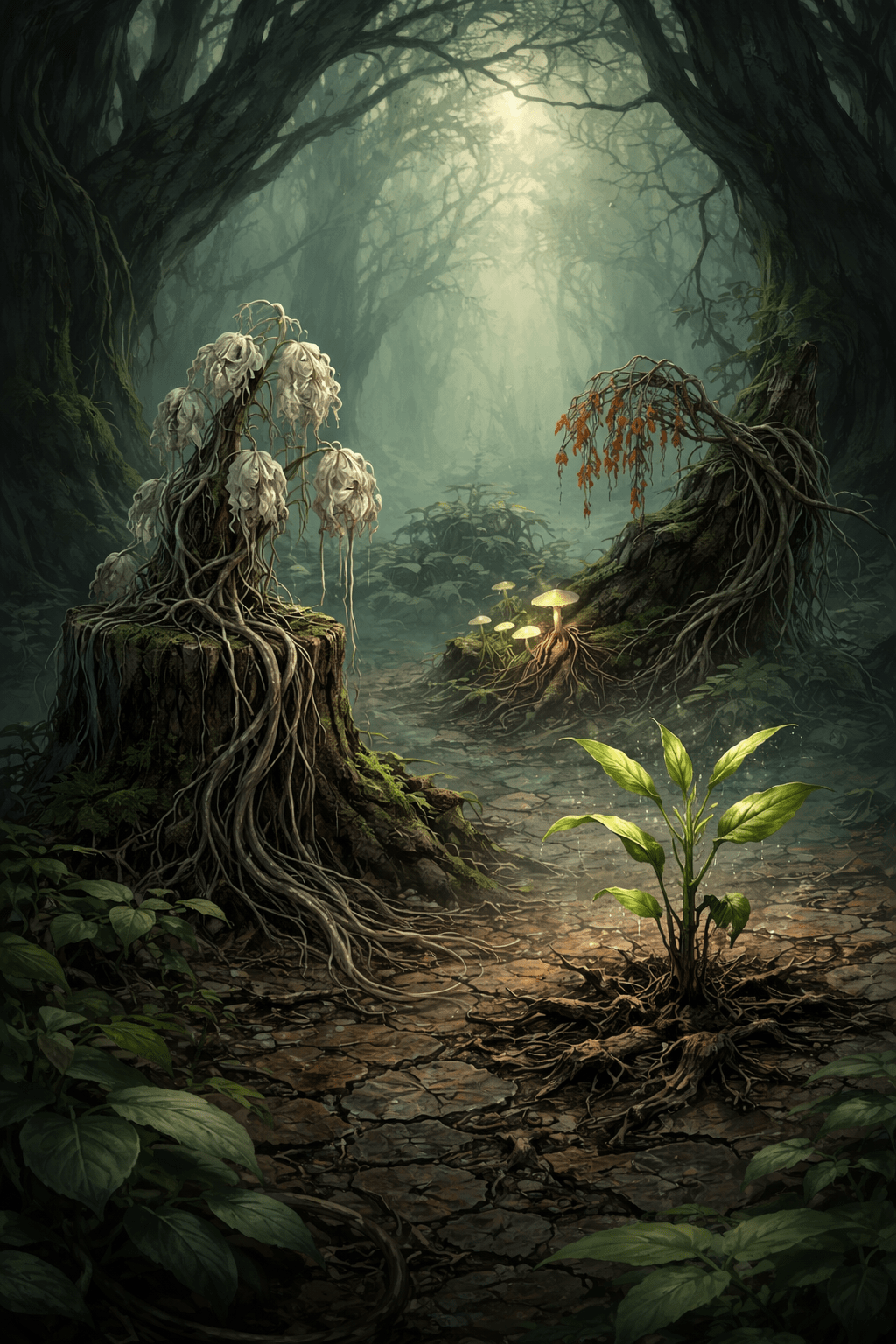
| The Living Dead of the Plant World The phrase “zombie plants” might sound like something dreamed up for a horror film, but in the plant world, it refers to something far more subtle, fascinating, and quietly unsettling. Zombie plants are not monsters rising from the soil, but organisms that exist in a strange in-between state: technically alive, yet no longer functioning in the way we expect life to function. They persist without growth, reproduction, or full independence, lingering on through mechanisms that challenge our basic definitions of what it means to be alive. In plants, life is usually measured by growth, photosynthesis, seasonal responses, and reproduction. Zombie plants disrupt this picture. Some have lost the ability to photosynthesise entirely. Others survive only by siphoning energy from neighbouring plants or fungi. A few can appear dead for years, then reawaken when conditions are right. Rather than thriving, these plants endure, hovering at the edge of survival in ways that feel eerily resilient. One category of zombie plants includes parasitic species that no longer make their own food. These plants attach themselves to hosts and extract sugars, nutrients, and water directly from another organism’s vascular system. Over time, they may lose leaves, chlorophyll, and even roots, becoming little more than a conduit for survival. From the outside, they can look lifeless or ghostly, emerging briefly to flower before retreating back into dependency. They are alive, yet stripped of autonomy, surviving through biological borrowing rather than self-sufficiency. Another form of plant zombification occurs through dormancy taken to an extreme. Some plants can shut down almost all visible activity in response to drought, cold, fire, or nutrient deprivation. Leaves shrivel, stems collapse, and metabolism slows to a near standstill. To the untrained eye, these plants look dead, sometimes for years at a time. Then, with moisture or warmth, they revive. Cells rehydrate, photosynthesis resumes, and growth continues as if nothing happened. These plants are not undead in a fictional sense, but they occupy a liminal state where life is paused rather than ended. There are also zombie plants created by manipulation rather than adaptation. Certain fungi, bacteria, or viruses can hijack plant hormones and signalling systems, forcing the plant to grow in distorted ways that benefit the invader. Infected plants may produce excessive shoots, swollen stems, or deformed flowers that serve no reproductive purpose for the plant itself. Instead, these growths act as factories or shelters for the organism controlling them. The plant remains alive, but its behaviour is no longer its own; it functions as a biological puppet. What makes zombie plants so compelling is that they expose life as a spectrum rather than a switch. We tend to think in binaries: alive or dead, growing or dying. Zombie plants exist in the grey space between. They remind us that survival does not always look vigorous or productive. Sometimes survival is quiet persistence, energy conservation, or reliance on others. In a world obsessed with constant growth, these plants tell a different story about endurance. Zombie plants also challenge our emotional responses to plants themselves. We often view plants as passive background life, but zombie plants force us to confront plant agency, vulnerability, and even exploitation. A parasitic plant draining its host, or a fungus steering a plant’s growth, raises questions about control and consent in the natural world. These interactions are not moral, but they are complex, layered, and deeply interconnected. From an ecological perspective, zombie plants play important roles. Parasitic species can regulate dominant plants, preventing monocultures and increasing biodiversity. Dormant species stabilise ecosystems by surviving extreme events and repopulating landscapes after fires or droughts. Even pathogen-controlled plants can influence insect populations and nutrient cycles. What appears unnatural or disturbing often turns out to be essential to ecological balance. Zombie plants also have lessons for human resilience. They demonstrate that life does not always move forward in a straight line. Sometimes it waits, borrows, adapts, or withdraws. In times of stress, slowing down or depending on others can be a valid survival strategy rather than a failure. These plants embody patience and adaptability at a cellular level. As climate instability increases, zombie-like strategies may become more common in the plant world. Extended dormancy, parasitic relationships, and extreme energy conservation could offer clues about how ecosystems will cope with harsher conditions. Studying these plants may help us understand not only how life survives adversity, but how it reshapes itself in response to long-term change. Zombie plants are not errors of nature or evolutionary dead ends. They are reminders that life is inventive, persistent, and willing to blur boundaries when necessary. They live without thriving, endure without growing, and survive without independence. In doing so, they expand our understanding of life itself, proving that even in stillness, dependency, or apparent death, there can be a quiet, stubborn pulse of survival beneath the surface. |
Zombie Plants
 Earthly Comforts