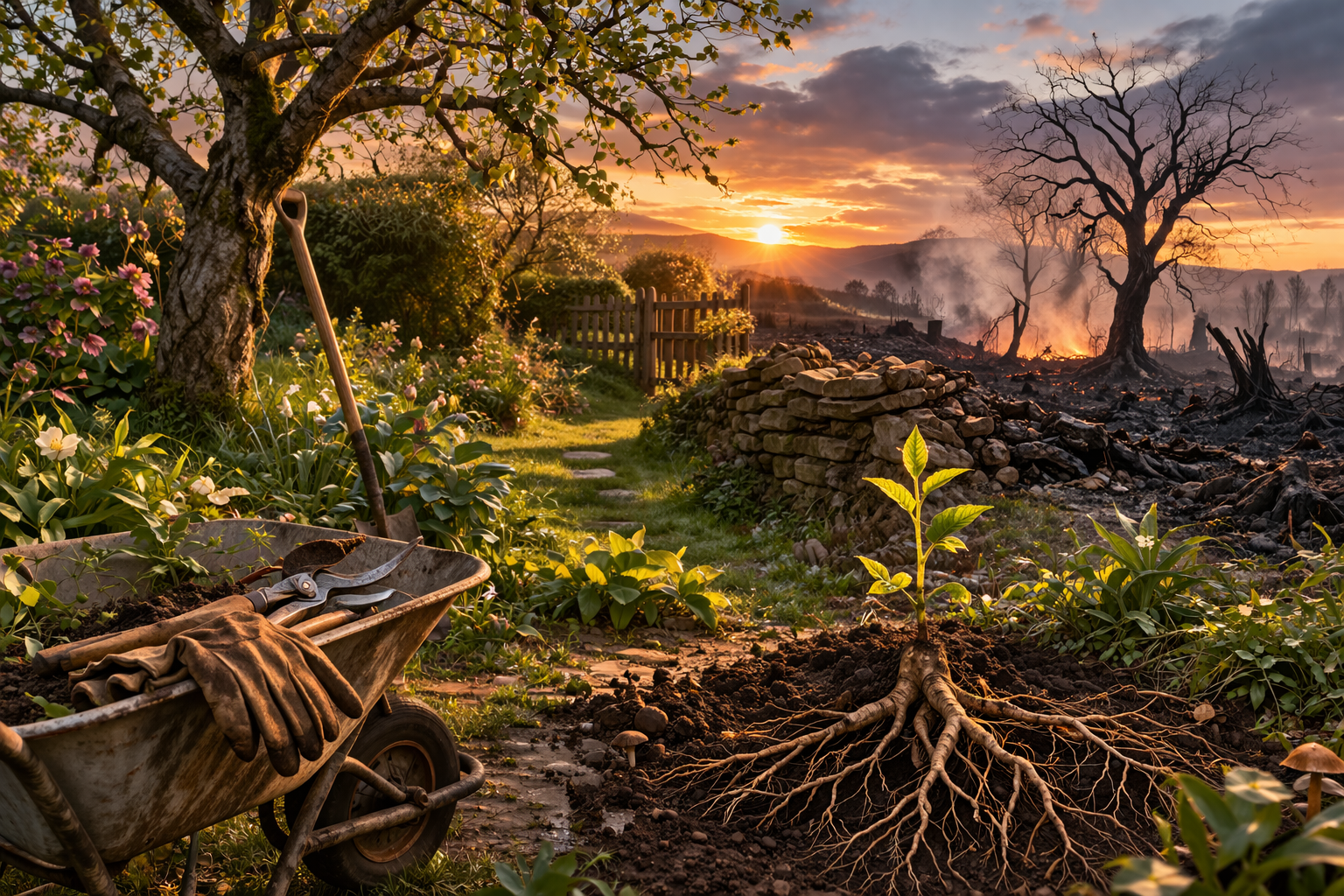
| I was working in a garden the other day, just doing a seasonal tidy-up—edging the lawn, pulling back early growth, clearing what winter left behind. The job wasn’t urgent; my hands moved while my mind drifted elsewhere. Lately, the wider mood is hard to ignore. Conversations are heavy—full of conflict, threats, and finality. It lingers, even in places meant to feel distant from it. Standing there, looking across the garden, I found myself thinking about fire—not the physical phenomenon of burning, but as a metaphor for sudden, consuming change and destruction. Fire as a metaphor has a particular kind of certainty. Like a sudden upheaval, it pays no attention to what existed before or the time invested in growing it. It ignores hidden complexity, moves rapidly, consumes everything apparent, and leaves behind an emptiness that can seem like a definitive ending. But gardens, and landscapes more generally, do not operate on that logic. What is visible above ground is only ever a fraction of what is actually present. Beneath the surface, roots extend, systems form, and relationships develop over time. Much of what holds a space together exists quietly, without drawing attention to itself, and only becomes apparent when it is disturbed. You can strip a garden aggressively. Clear it hard, remove large sections, and it might seem reset—blank, ordered, controlled. Yet this finality is misleading. Soon, shoots appear, established plants return, and dormant seeds find a chance. This process is neither dramatic nor immediate, but it is consistent. The comparison is difficult to ignore. There is a way of thinking—often expressed in bold, absolute terms—that assumes enough force can bring something to a definitive end. It rests on the belief that what is visible represents the whole, and that removing it removes the underlying system as well. In practice, this is rarely how things behave. Gardens teach a different lesson. Continuity is rarely on the surface. It’s in the structure beneath, the effects of time, and the gradual development of relationships. When disruption does occur, the result is not a clean resolution. Instead, it creates an imbalance. Anyone who has cut too hard at the wrong time will recognise this. Growth becomes uneven, certain elements take advantage, and the space’s overall stability is temporarily lost. What follows is not peace, but a period of adjustment, often unpredictable in its outcome. This is where the misunderstanding becomes most apparent. The idea that force can produce a lasting, orderly result does not align with how natural systems function. Lasting structures, whether in a garden or elsewhere, are built slowly. They rely on continuity, on balance, and on the quiet accumulation of time. They cannot be rushed into existence, nor can they be neatly concluded through sudden disruption. Even after damage, a garden is rarely lost. Given time, it returns. It may not be identical, and might take longer than expected, but the process continues. Gradually, new growth emerges, and something familiar takes shape. This return happens without announcement. It is not dramatic, and it does not seek attention. It simply follows the same steady principles that governed the space before it was disturbed. Spending time working in these environments tends to reinforce that perspective. It becomes clear that what takes years to establish cannot be meaningfully undone in a single moment, no matter how decisive that moment may appear. The surface may change quickly, but what sits beneath it moves to a different rhythm altogether. |
| About our writing & imagery Many of our articles are written by us, drawing on real experience, reflection, and practical work in gardens and places we know. Some pieces are developed with the assistance of AI as a drafting and research tool. Featured images may include our own photography, original AI-generated imagery, or—where noted—images kindly shared by other creators and credited accordingly (for example, via Pixabay). All content is shaped, edited, and published by Earthly Comforts, and the views expressed are our own. |
 Earthly Comforts