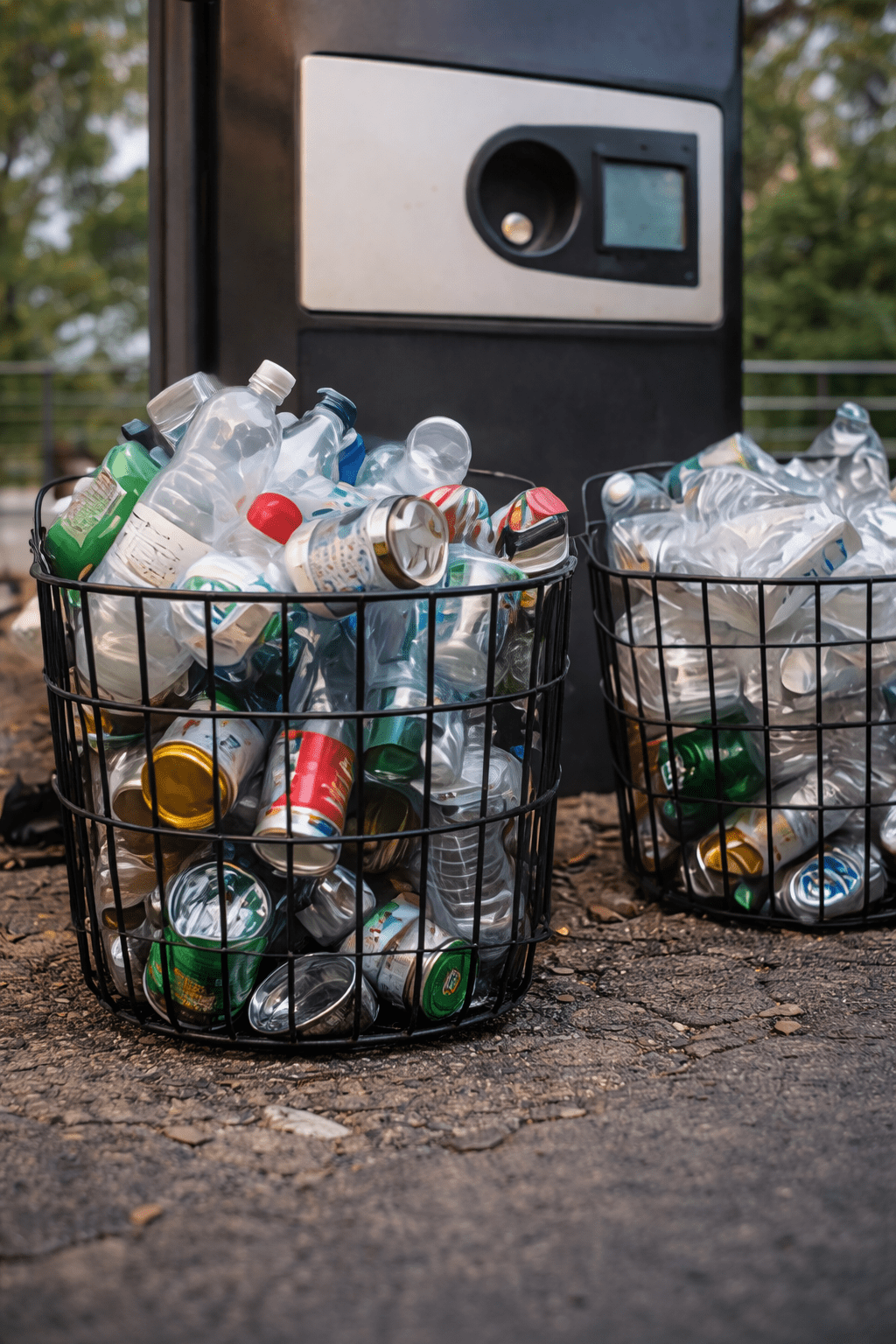
| … Between Policy and Habit There’s a particular optimism baked into schemes that rely on small incentives. The idea is simple enough: attach a value to something that was previously worthless, and behaviour will follow. People will return bottles. Litter will fall. Systems will loop neatly back on themselves. Deposit return schemes sit squarely in that logic. They are tidy on paper, appealing in theory, and morally uncontroversial. Who could object to getting a few coins back for doing the right thing? But, like most things that deal with human behaviour, the reality is less uniform than the diagram suggests. What gardening teaches you, quickly, is that behaviour is shaped by convenience long before it’s shaped by principle. People compost when it’s easy. They don’t know when it’s awkward. They reuse pots when they have space to store them. They don’t when they don’t. Systems succeed or fail not on intention, but on how they fit into daily routines. Deposit schemes assume a fairly even landscape of access. Places to return containers. Time to do it. Space to store empties until you can. That assumption holds in some settings and frays badly in others. City centres, rural villages, temporary events, shared housing — each bends the system in its own way. One of the quieter myths around litter is that it’s primarily caused by apathy. In practice, it’s often caused by friction. A bin that’s full. A return point that’s closed. A container that’s accepted in one place but refused in another. When the system hesitates, waste slips through. From an outdoor working perspective, you see this most clearly in public and semi-public spaces. Parks after weekends. Lay-bys. Paths near shops. The material changes, but the pattern doesn’t. Waste accumulates where responsibility becomes ambiguous — where it belongs to everyone and no one at the same time. Deposit return schemes do alter behaviour. That’s not in doubt. Containers gain value. People notice them. But value alone doesn’t guarantee care. Items left out in the open become targets for collection, sometimes damaging bins or creating a mess. What was once simple litter can become a contested resource. There’s also a labour dimension that rarely makes the headlines. Returned containers don’t vanish; they move. Someone handles them. Stores them. Sorts them. Maintains the machines. Deals with breakages and disputes. These roles are part of the system, even if they sit out of sight of the policy documents. None of this makes deposit schemes a bad idea. It makes them a human one. Effective, but imperfect. Dependent on context. Shaped by habits that don’t change just because the rules have. The temptation is to frame these schemes as solutions. In reality, they are tools — useful in some places, blunt in others. They work best when paired with thoughtful design, clear communication, and an acceptance that behaviour will always lag slightly behind intention. In the garden, you learn to work with habit rather than against it. Paths form where people walk, not where you tell them to. Systems that respect that truth tend to endure. Deposit return schemes will succeed not because they are clever, but because they are adjusted, iterated, and grounded in how people actually live. |
| Companion Fact Box — Deposit Return Schemes (Neutral Reference) What a Deposit Return Scheme (DRS) is A system where a small deposit is added to the price of drink containers. The deposit is refunded when the empty container is returned to an approved collection point. Materials typically included Plastic bottles Metal cans In some schemes, glass bottles Intended outcomes Increase recycling rates Reduce litter Improve the quality of collected materials. Operational considerations Return point availability varies by location. Storage space is required before return. Reverse vending machines require maintenance and monitoring. Behavioural effects Containers gain monetary value. Informal collection may increase in public spaces. Participation depends on convenience and clarity. UK context Deposit return schemes are planned across the UK with differing scopes and timelines. Alignment between nations affects labelling and returns. Further information (UK) Department for Environment, Food & Rural Affairs — policy overview Scottish Environment Protection Agency — scheme administration Zero Waste Scotland — scheme design and public information Local Government Association — local authority implications |
| About our writing & imagery Many of our articles are written by us, drawing on real experience, reflection, and practical work in gardens and places we know. Some pieces are developed with the assistance of AI, used as drafting and research tools rather than as a voice or authority. Featured images may include our own photography, original AI-generated imagery, or—where noted—images kindly shared by other creators and credited accordingly (for example, via Pixabay). All content is shaped, edited, and published by Earthly Comforts, and the views expressed are our own. |

