| Part 3 |
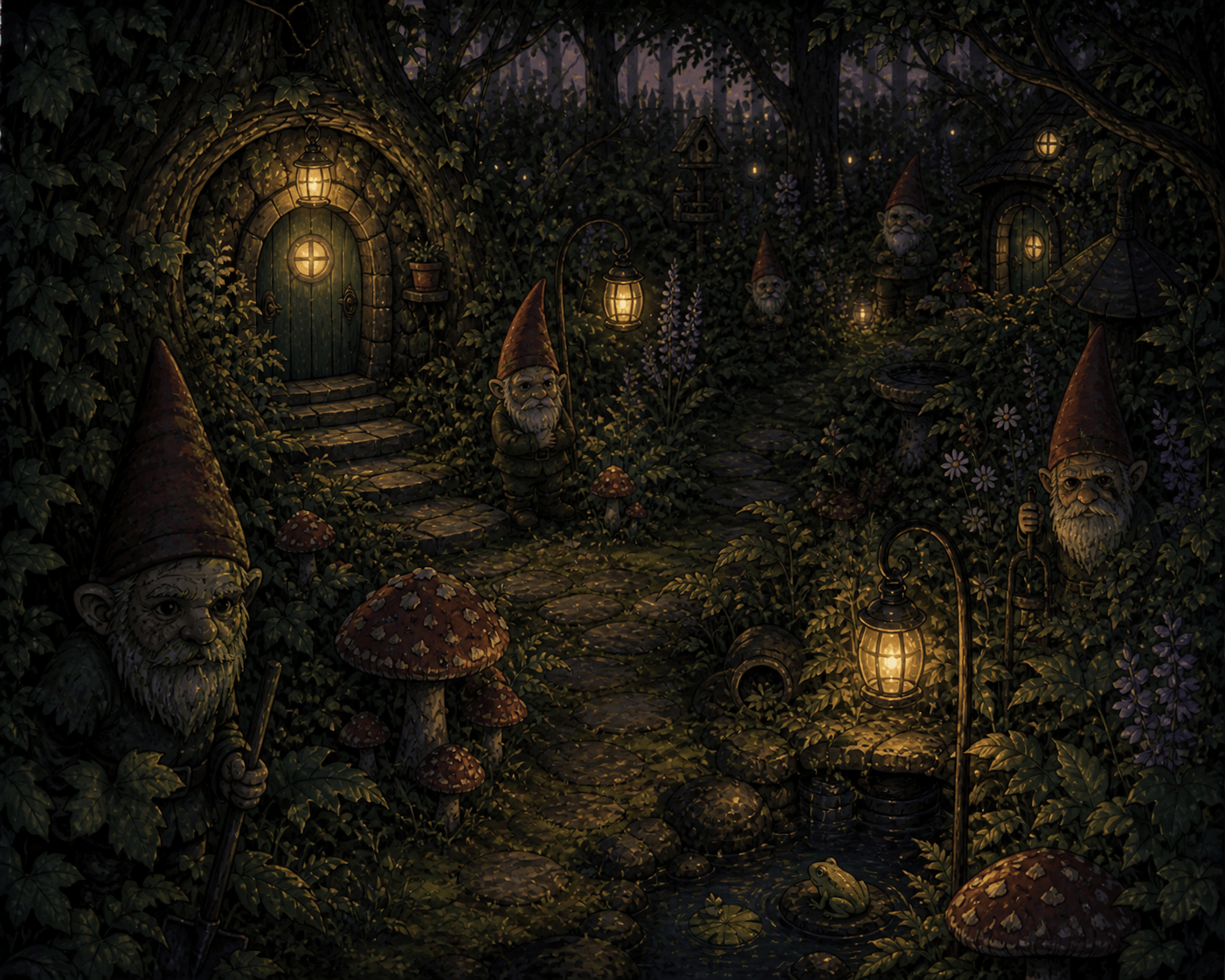
| There’s a point, usually later in the day, when a garden changes. It’s not dramatic. Nothing obvious happens. The light drops slightly, colours flatten, and the space begins to feel less like something you’re working in and more like something you’re moving through. That’s often when the gnomes stand out. Not because they move, or change, or do anything at all. Quite the opposite. It’s their stillness that becomes more noticeable. During the day, they sit within the garden—just another object among many. But in that quieter light, when the work slows and the edges of things soften, they seem to separate from the rest. You become aware of them. And once you’ve noticed them, properly noticed them, it’s difficult to unsee. When objects stop being neutral Most things in a garden are functional, even when they’re decorative. A bench is for sitting. A pot contains a plant. A trellis supports growth. Even ornaments, in most cases, are placed with a sense of balance or symmetry in mind. Gnomes don’t always follow that logic. They’re often positioned slightly off. Not quite aligned with anything. Facing a direction that doesn’t correspond to a path or a focal point. Sometimes half-hidden, sometimes fully visible but not integrated in a way that feels entirely deliberate. At first, that reads as casual placement. But over time, it starts to feel more like observation. Not in a literal sense, but in the way the object interacts with your awareness. It’s there, fixed, unchanging, but somehow not passive. That’s where the discomfort begins—not overtly, but subtly. The familiar, but not quite There’s a reason certain figures feel slightly unsettling, even when they’re designed to be friendly. Gnomes are shaped like people, but not proportioned like people. The features are exaggerated—large heads, small bodies, and fixed expressions. They sit somewhere between human and object, which makes them difficult to categorise. That ambiguity matters. In most cases, we’re comfortable with clear distinctions. Something is either alive or it isn’t. Either expressive or inert. Either part of the environment or separate from it. Gnomes sit just outside that clarity. They resemble something familiar, but they don’t behave like it. They appear to have intention—through posture, expression, orientation—but no capacity to act on it. That creates a quiet tension. Time and weather What really changes the feel of these figures isn’t their design, but what happens to them over time. A new gnome, fresh paint, and clean lines are easy enough to accept. It sits within the garden as an addition, a deliberate choice. But gardens don’t preserve things in that state. Paint fades. Surfaces crack. Moss begins to form in crevices. Dirt collects in the folds of clothing, around the eyes, along the base where the figure meets the soil. And then something shifts. The gnome stops looking like something that was placed there and starts looking like something that has always been there. Partially embedded. Slightly obscured. Less defined. That’s when it begins to feel different. Not more real, exactly—but less temporary. The problem with stillness In a garden, most things move, even if only slightly. Leaves shift in the wind. Plants grow and change. Insects move through the space. Light alters the appearance of surfaces throughout the day. There’s a constant, low-level sense of motion. A gnome does none of that. It remains exactly as it is, regardless of conditions. Rain, wind, frost—it registers on the surface, but the figure itself doesn’t respond. That stillness, in a space defined by change, makes it stand out. It becomes a fixed point in an otherwise fluid environment. And fixed points, when they resemble something that should perhaps move, draw attention in a particular way. Working around them From a practical perspective, gnomes are just another element to work around. You move them when you need access. You clean around them, trim planting near them, and occasionally reposition them if they’ve shifted. But there’s a pattern to how they’re treated. They’re rarely removed entirely, even when the rest of the garden is being significantly altered. They might be relocated, grouped differently, or temporarily set aside, but they tend to return. Clients have attachments to them that aren’t always explained. They’ve been there a long time. They were given as gifts. They belong to a previous version of the garden. Or sometimes, there’s no clear reason at all. They just feel like part of the place. That persistence gives them a different status from other objects. They’re not just features. They’re fixtures. The edge of the garden Where gnomes are placed also contributes to their effect. They’re rarely in the centre of a lawn or the main focal point of a border. More often, they sit at the edges. Near hedges, under shrubs, at the base of trees, or along less-used paths. Transitional spaces. Areas where the garden meets something less defined. Those are the parts of a garden that tend to feel slightly different anyway. Less controlled, more layered, sometimes darker, depending on planting and light. Placing a human-like figure in those spaces amplifies that quality. It draws attention to the boundary without fully explaining it. A quiet contradiction There’s a contradiction at the heart of these objects. They are meant to be light. Playful. Whimsical. And in many cases, they are. But they are also, however loosely, based on older ideas of things that were not entirely benign. That original context—of earth-dwelling beings, of hidden presences, of something operating beneath the visible—doesn’t disappear entirely. It lingers, even if only as a faint impression. So you end up with something that sits between two interpretations. A friendly figure, placed in a garden for enjoyment. And an echo of something older, less defined, slightly harder to place. Most of the time, that tension goes unnoticed. But occasionally, in the right light, or the right moment, it surfaces. The gardener’s perspective From where I stand, working in these spaces, there’s no need to lean too far into either interpretation. You don’t have to treat gnomes as anything more than objects. They don’t affect how the soil behaves, how plants grow, or how the garden develops in any measurable way. But at the same time, it’s worth acknowledging the effect they have on how a space feels. Gardening isn’t just about function. It’s about experience. The way a garden is perceived—the atmosphere it creates, the way it draws attention or holds it—matters. It shapes how people interact with the space, maintain it, and value it. And gnomes, whether intentionally or not, contribute to that. They introduce a point of focus that isn’t entirely explained. Challenging the idea that they’re just decorative It’s easy to say that gnomes are simply decorative, and in a literal sense, that’s true. But that explanation doesn’t fully account for their persistence, or the way they’re treated within gardens. If they were purely decorative, they would be replaced more frequently, moved more casually, and discarded when styles change. That does happen, but not as often as you might expect. Instead, they tend to remain. They accumulate history. They become part of the garden’s continuity. And that suggests they carry something more than surface value. Not necessarily meaning in a symbolic sense, but weight. Presence. When the garden quiets The moments when this becomes most apparent are usually the quieter ones. Late afternoon, early evening. The work is done or nearly done. Tools are put away. There’s a pause before leaving. That’s when the garden shifts from a place of activity to a place of observation. And that’s when the gnomes tend to register differently. You notice where they are. The direction they’re facing. The way they sit within the planting. Not because you’re looking for them, but because they’re suddenly easier to see. There’s less distraction. Less movement. More space for the fixed elements to stand out. Closing reflections There’s no need to overstate it. Gnomes are not watching anything. They’re not active participants in the garden in any literal sense. But they are not entirely neutral either. They sit in a space between function and suggestion, between object and representation. They carry a faint trace of older ideas, filtered through modern design and further altered by time and weather. And occasionally, under the right conditions, that combination creates something that feels slightly off. Not enough to disrupt the garden. Not enough to change how you work in it. But enough to notice. Enough to pause, briefly, and see the space a little differently. |
| About our writing & imagery Most articles reflect our real gardening experience and reflection. Some use AI in drafting or research, but never for voice or authority. Featured images may show our photos, original AI-generated visuals, or, where stated, credited images shared by others. All content is shaped and edited by Earthly Comforts, expressing our own views. |

