| When Reading Became Orientation |
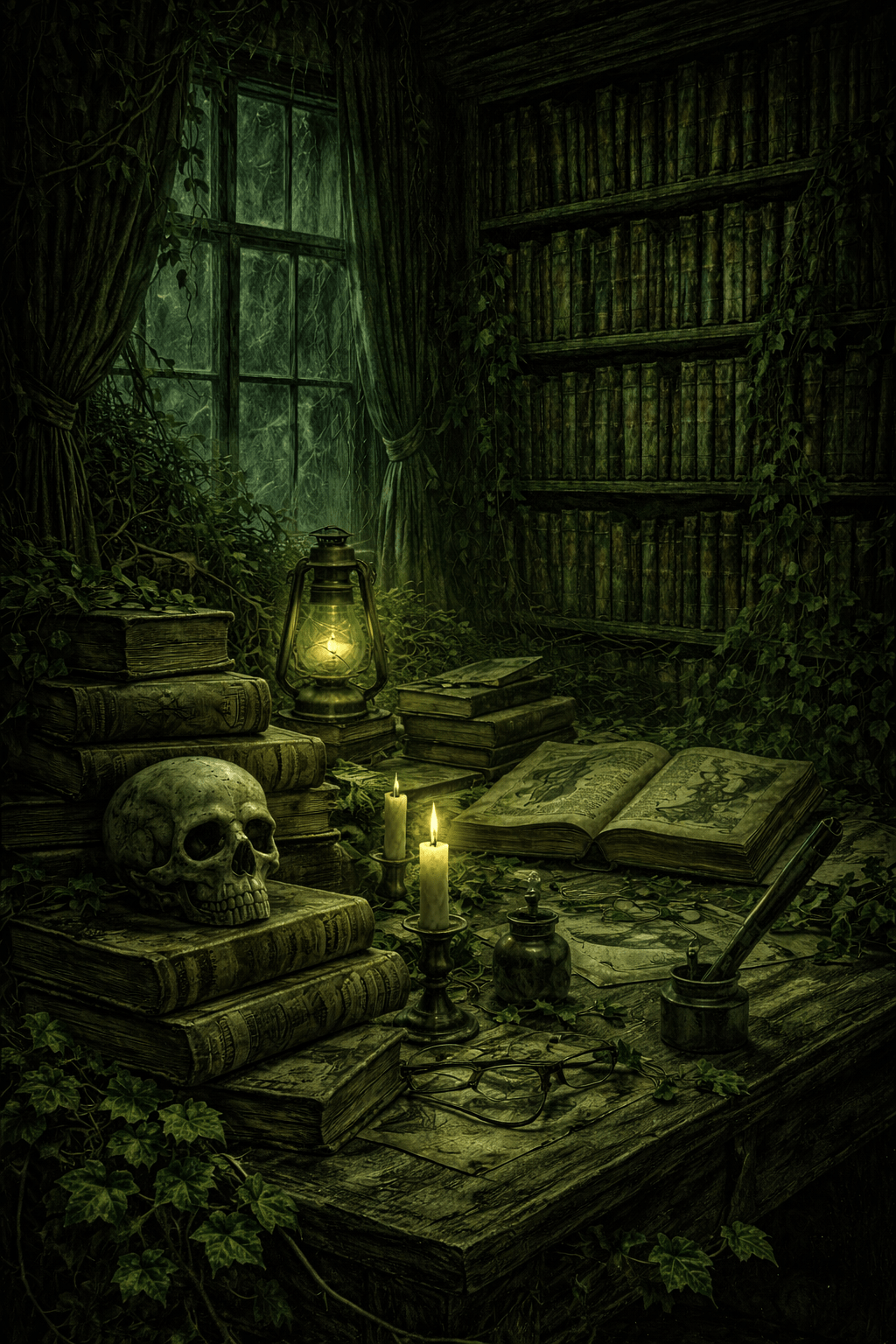
| By the time the collection reached its height, I was nineteen and the owner of roughly 2,500 books. That detail matters — not as a claim to excess or precocity, but because it explains the density. At that age, attention is rarely casual. You don’t skim. You absorb. You build internal systems quickly, sometimes without realising that’s what you’re doing. You expand until you encounter limits. The number itself sounds dramatic when stated plainly. It shouldn’t. It wasn’t accumulation for its own sake, and it certainly wasn’t confined to a single genre. Horror was the entry point, not the boundary. The shelves held writing on the supernatural, the occult, ghost stories, folklore, strange theologies, belief systems that sat just outside accepted doctrine, and speculative attempts to explain what might exist beyond the visible. Mysteries in the older sense of the word. Questions that did not expect tidy answers. What unified these books was not darkness, but seriousness. They took the unseen seriously. They treated fear, belief, and uncertainty as legitimate subjects of inquiry rather than weaknesses to be dismissed. They allowed doubt to remain intact. That mattered more to me than tone. From the outside, this kind of reading can look unbalanced. My parents certainly thought so. They saw the titles, the quantity, and the subject matter and reached a conclusion that never quite matched the reality. Morbid. Excessive. Strange. There was concern there, though rarely articulated with precision. I did not argue. Partly because I did not yet have the language to explain what I was doing, and partly because I did not feel defensive. I was not cultivating darkness as an identity. I was not withdrawn or theatrically gothic. I liked dark writing. That distinction mattered to me, even if I could not always articulate why. Dark writing, at its best, is not about mood. It is about permission. Permission to look directly at subjects polite conversation avoids: death, belief, fear, meaning, and consequence. These things exist whether we acknowledge them or not. The writers I gravitated toward were willing to remain with them longer. There is a common assumption that teenagers drawn to this material are seeking rebellion or shock. That was not my experience. I was not rebelling. I was orienting myself. The books offered frameworks — not doctrines, but ways of thinking. They presented competing explanations for the same questions and allowed them to coexist without insisting on resolution. Occult texts sat near theological speculation. Ghost stories brushed against philosophy. Horror fiction lived alongside attempts to catalogue the unexplainable. Reading across that range created density rather than confusion. Instead of hardening into certainty too quickly, I learned to recognise recurring patterns: how cultures externalise anxiety, how myths evolve to fill explanatory gaps, how horror borrows from theology, theology from folklore, folklore from lived experience—different languages describing overlapping concerns. This was not an academic study. It was immersion. Immersion compresses distance. It places ideas in proximity until their similarities and tensions become unavoidable. From the outside, that can look like excess. From the inside, it felt like integration. The sheer volume of reading compressed time. Decades of thought sat within reach. I could move from a nineteenth-century ghost story to a twentieth-century occult treatise in an afternoon. The contrasts were instructive. So were the continuities. Again and again, different traditions circled the same questions using different vocabularies. No single book answered them. But together they created a kind of pressure — not to resolve, but to endure. The effect was not revelation, but resilience. This is where the idea of reading as orientation becomes essential. I was not reading to escape the world. I was reading to understand how people had tried — and often failed — to make sense of it. The darker the subject matter, the less inclined it was to offer easy reassurance. That seriousness felt grounding. It is also worth noting what this reading did not produce. It did not make me fearful in daily life. It did not cultivate paranoia or despair. If anything, it had the opposite effect. By encountering fear symbolically, repeatedly, and within structure, it reduced its volatility elsewhere. Fear became legible. That legibility is often mistaken for fixation. People see shelves of books about ghosts and the occult and assume a gloomy atmosphere. They rarely consider that engagement can produce clarity. Explaining this rarely proved useful. The assumption ran deep, and it was easier to let it stand. The collection was private. It did not need endorsement. It did not need to be performed. Over time, the boundaries between genres softened. Horror stopped feeling separate from philosophy. Ghost stories read like meditations on unresolved memory. Theological speculation echoed cosmic horror, just framed differently. Occult systems mirrored psychological ones—different vocabularies describing internal states. This was not synthesis in the grand sense. It was recognition. A sense that multiple traditions were pointing toward similar tensions. That recognition altered the hunger that had driven the hunt. Acquisition began to lose urgency. The pressure to expand eased. The focus shifted from territory to coherence. What mattered was no longer filling gaps on shelves, but understanding how the pieces already present related to one another. This is often where retrospective narratives turn writing into inevitability. That was not my experience. Writing did not arrive as a calling or destiny. It arrived as a by-product. After reading that much, silence became insufficient. The patterns needed articulation — not for an audience, but for testing. Writing became a way of seeing whether the connections I perceived could withstand exposure. Even before writing took hold, however, the shift had occurred. Reading was no longer an intake. It was integration. Integration sharpened awareness of difference. I became aware that my approach to these subjects was not widely shared. The same books that felt grounding to me felt unsettling to others. The difference lay not in the material, but in the posture brought to it. This did not create alienation. It created separation. A recognition that not every interest needs to be communal. Some forms of attention thrive precisely because they remain unperformed. The collection did not require validation. It required space and continuity. Looking back now, I can see how fortunate that period was. To have access, at that age, to such a breadth of serious inquiry. To be allowed — even if not entirely understood — to pursue it without interference. It cultivated tolerance for ambiguity. The books did not provide answers. They provided stamina. They taught me how to sit with questions without demanding closure. How to recognise that uncertainty is not failure. How to understand that systems are rarely singular, and that coexistence is often more stable than dominance. That, more than anything, is what that period established. Not allegiance to a genre. Not identity built on darkness. But a way of engaging with complexity that allowed contradiction and depth to coexist without panic. The shelves are gone now. The books are dispersed. But the orientation remains. It does not announce itself. It simply continues to do its work. |
| About our writing & imagery Most articles reflect our real gardening experience and reflection. Some use AI in drafting or research, but never for voice or authority. Featured images may show our photos, original AI-generated visuals, or, where stated, credited images shared by others. All content is shaped and edited by Earthly Comforts, expressing our own views. |

