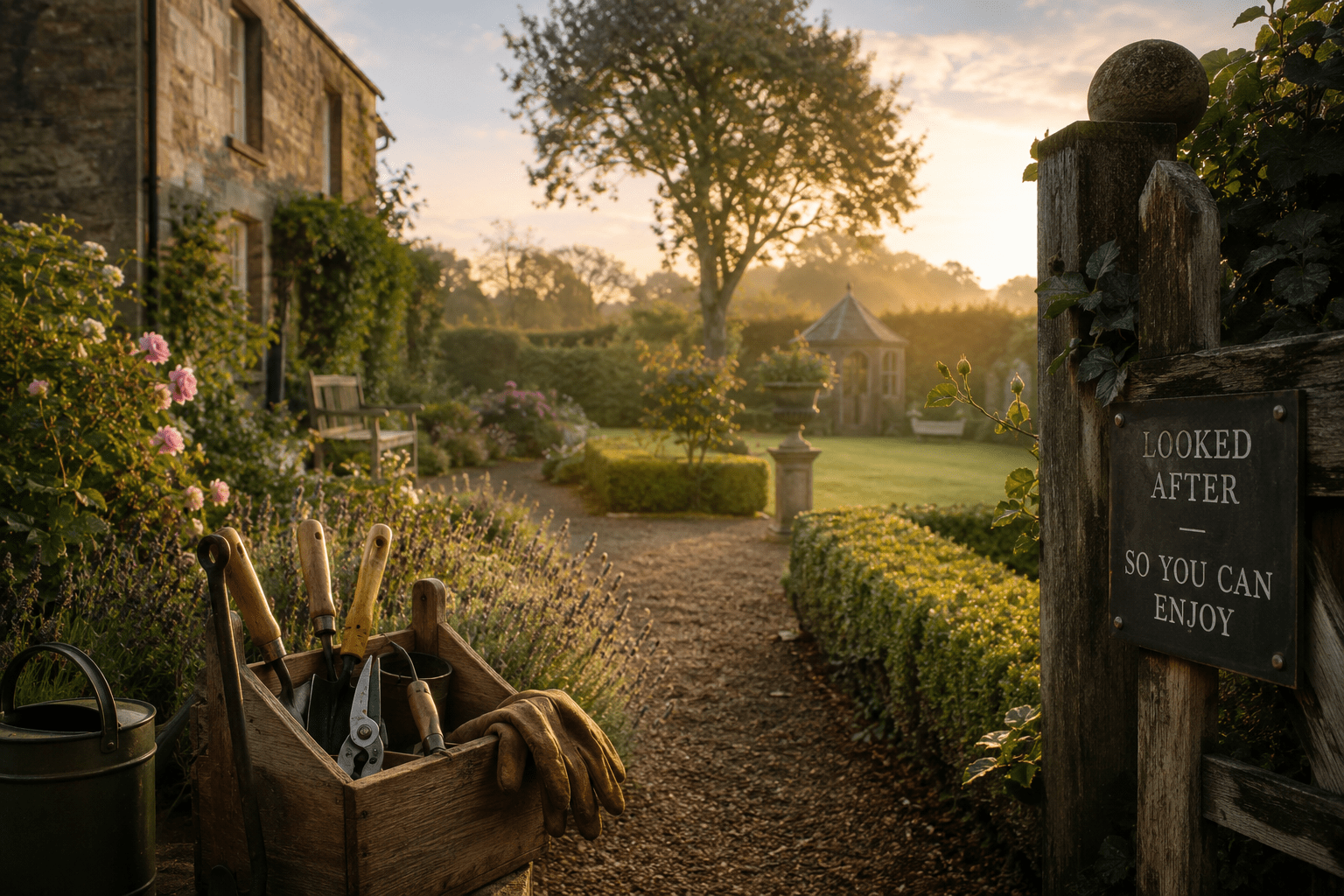
| The Difference Between Gardening and Looking After a Garden |
| Most mornings begin in much the same way. The kettle goes on, I look out of the window to see what the weather has decided overnight, pull on a pair of boots that have long since forgotten what “clean” looks like and gather together whatever tools I think the day might require. There is a comforting familiarity to that routine. Gardening, despite the surprises nature regularly throws our way, is built on countless small rituals. Then I walk to my first garden. It occurred to me not long ago that although I tell people I’m going gardening, that isn’t always what I mean. Of course, there are practical jobs waiting. There always are. A hedge may need reducing, a border weeding, a rose deadheading or a lawn edging. Gardens are wonderfully generous at finding new ways to keep gardeners occupied. But before I reach for a single tool, I almost always do the same thing. I stop. Not for long. Just long enough to look. How has the garden changed since last week? Has the rain flattened the delphiniums? Is the climbing rose finally beginning to flower? Has the bay tree put on another unexpected burst of growth? Has the blackbird decided that yesterday’s freshly mulched border is the perfect place for breakfast? Those few quiet moments rarely appear on an invoice. Yet I increasingly believe they’re the most important part of my visit. When Earthly Comforts first began, I thought my job was straightforward. Clients employed us to maintain their gardens. We would complete the agreed work to the best of our ability and return for the following visit. There’s absolutely nothing wrong with that description. It simply no longer feels complete. Somewhere over the past few years, I found myself becoming less interested in individual tasks and more interested in the places themselves. A garden stopped being a collection of jobs waiting to be ticked off and became something altogether more personal. Every property developed its own rhythm, its own character and its own little quirks that only revealed themselves after many visits. Some gardens are slow to wake in spring, only to suddenly race ahead in June. Others seem to need almost constant gentle guidance to remain balanced. One corner may always dry out before the rest, while another quietly collects damp leaves every autumn, regardless of how often they’re swept away. You only notice those things if you’re paying attention. Perhaps that’s why I’ve become increasingly uncomfortable with describing gardening purely in terms of labour. Labour is certainly part of the job, and often the most physically demanding part, but it isn’t the whole story. Knowing when not to prune can be every bit as valuable as knowing how. Noticing a young tree beginning to lean before it snaps in a winter gale may save years of growth. Seeing that a shrub has outgrown its position allows a conversation long before the saw becomes necessary. Those moments aren’t dramatic. They’re simply the product of familiarity. The more I reflected on it, the more I realised that I wasn’t really trying to become more efficient.I was trying to become more observant. Looking after a garden, at least in the way I understand it today, has very little to do with racing from one task to another. It is closer to becoming familiar with a place. Familiar enough to notice when something has changed. Familiar enough to remember what happened last season. Familiar enough to quietly prevent tomorrow’s problems rather than always reacting to yesterday’s. That, I think, is the point where gardening begins to resemble butlering. Not because of uniforms or grand houses, but because both professions are built upon the same quiet foundation. They depend upon observation, consistency and responsibility. The work itself may be different, yet the mindset feels remarkably similar. A butler isn’t employed simply to complete a list of chores. They’re entrusted to care. The more I thought about that simple idea, the more I realised it had quietly become the philosophy behind Earthly Comforts. We still mow lawns. We still prune hedges. We still weed borders and sweep paths. None of that has changed. What has changed is the way I think about why those jobs matter. They’re no longer isolated tasks. They’re expressions of care. That may sound like a subtle distinction, but I believe it changes everything. When you stop asking, “What jobs need doing today?” and begin asking, “What does this garden need from me today?”, your relationship with the work begins to change. You become less interested in finishing quickly and more interested in leaving wisely. Looking back, I don’t think Earthly Comforts became a Garden Butler service because I deliberately set out to create one. I think it happened because, over time, I stopped seeing gardens as projects and started seeing them as places entrusted to us for a little while. The lawns still need cutting. The weeds still need pulling. Nature remains gloriously indifferent to philosophy. But somewhere between those everyday jobs lies something rather more satisfying. Not simply maintaining a garden. Looking after it. |
| About our writing & imagery Most articles reflect our real gardening experience and reflection. Some use AI in drafting or research, but never for voice or authority. Featured images may show our photos, original AI-generated visuals, or, where stated, credited images shared by others. All content is shaped and edited by Earthly Comforts, expressing our own views. |

