| A curated exploration of Africa’s most iconic, curious, and ecologically important insects |
| 1 Ants, Bees & Wasps: Survival at Scale |
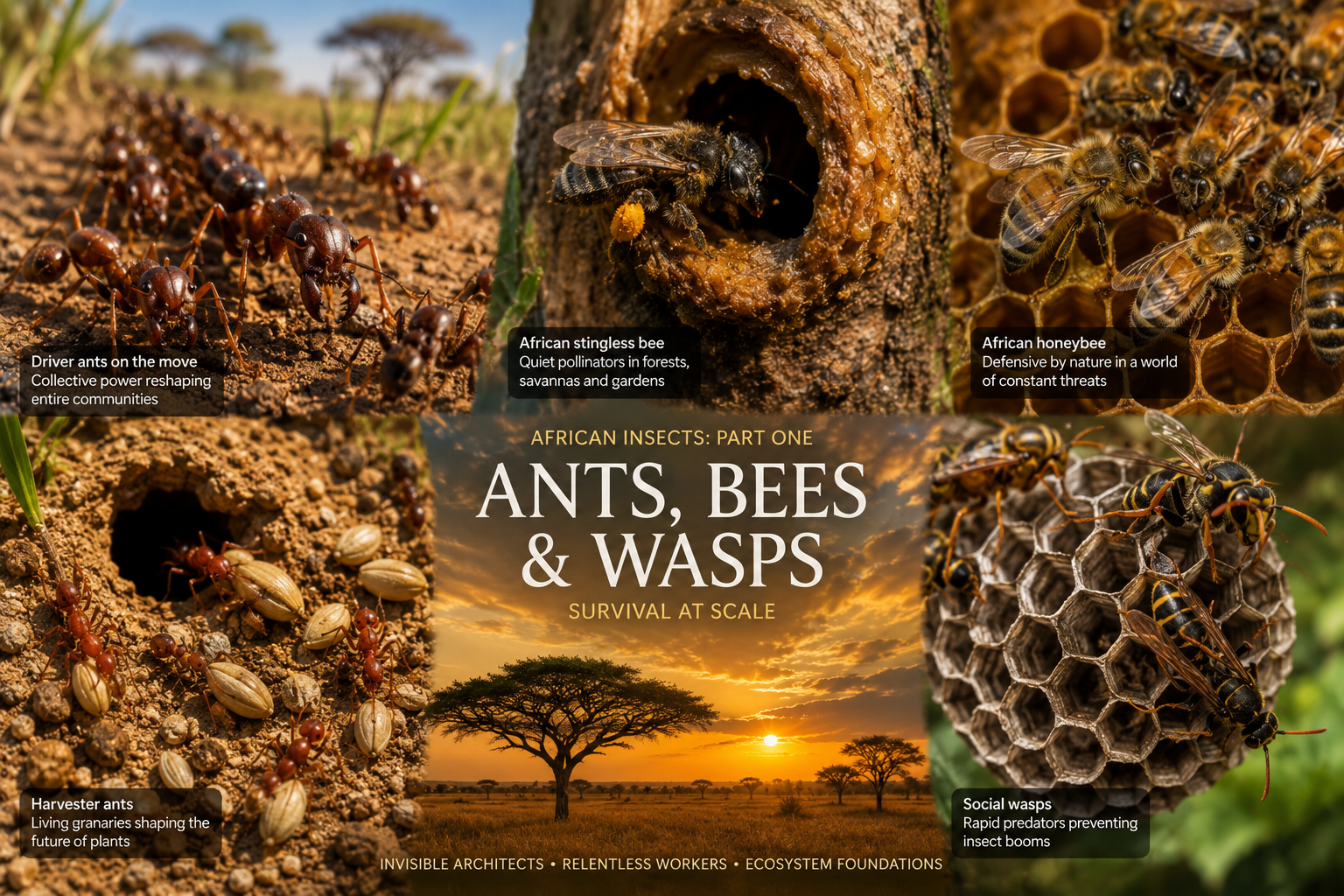
| In Europe, insects have often adapted to landscapes shaped steadily by human hands. Across much of Africa, the challenge is different. Here, many insects live within environments where heat, drought, fire and sudden rainfall are not unusual events but recurring forces that shape almost every aspect of life. A dry season may reduce a flourishing landscape to dust and brittle stems. Then rain arrives, sometimes with extraordinary force, and within days the same ground begins to change. Plants emerge, flowers open, insects multiply, and predators respond. The transformation can be so rapid that it appears almost theatrical, yet there is nothing accidental about it. Every organism involved has evolved around these narrow windows of opportunity. Ants, bees and wasps are among the insects best adapted to this rhythm. They survive not by avoiding difficult conditions, but by building systems capable of absorbing them. Life beneath an unforgiving surface Ants are among the dominant insects across African savannas, forests, deserts and floodplains. Their visible activity may appear chaotic, with workers moving in lines across the soil or disappearing beneath stones, but the colony beneath the surface is usually highly organised. Underground chambers protect from extreme temperature changes. While the soil surface may become dangerously hot during the day, deeper layers remain cooler and retain moisture for longer. Ant colonies exploit these differences with remarkable efficiency, retreating below ground during the most severe heat and returning quickly when conditions improve. This becomes particularly important during prolonged dry periods. Plants may appear dormant, and insect life may seem scarce, yet beneath the soil entire communities remain active. Food is stored, young are protected, and the colony waits for the next change in weather. When rain eventually arrives, the response can be immediate. Workers emerge in large numbers, taking advantage of new seeds, soft plant growth and sudden increases in other insects. What appears to us as a dramatic population explosion is often the result of long preparation. As gardeners, we tend to think of soil primarily in terms of structure, fertility and drainage. Ants influence all three. Their tunnels allow air and water to penetrate compacted ground, while the movement of organic material redistributes nutrients. In some regions, ants may be among the most important soil engineers in the landscape. The work is rarely visible as a single grand event. It accumulates gradually, grain by grain. Driver ants and collective power Few ant species illustrate the strength of collective organisation more clearly than driver ants. Moving in enormous columns, they can overwhelm prey through coordination rather than individual power. A single ant is relatively vulnerable. Tens of thousands acting as one become something entirely different. Driver ant raids move through forest floors and grassland, flushing out insects, spiders and small animals. Their approach sends other creatures into motion, creating opportunities for birds and mammals that follow the columns and feed on escaping prey. This means the ants influence far more than the organisms they capture directly. Their movement temporarily reshapes the behaviour of the whole community around them. Predators gather, prey scatter and animals alter their routes. It is tempting to describe driver ants as aggressive, but that language places a human judgement upon a practical survival strategy. They are not destructive for the sake of destruction. Their colonies require food, and collective hunting allows them to secure it efficiently in environments where resources can be unpredictable. Their strength lies not in the individual, but in the system. Harvester ants and the future of plants In drier regions, harvester ants perform a very different role. They collect seeds and carry them back to underground stores, effectively operating as living granaries. This behaviour provides the colony with food, but it also influences which plants return after drought or fire. Some seeds are consumed, while others are lost, abandoned or discarded in places where they may later germinate. Over time, these choices shape patterns of vegetation. A gardener might notice a self-seeded plant appearing beside a path and think little of it. Across larger landscapes, the repeated movement of seeds by insects can help determine which species spread and which remain confined. Harvester ants therefore sit at an interesting point between consumption and renewal. They remove seeds, yet also distribute them. They reduce some plant populations while unintentionally supporting others. Nature often resists simple classifications. An insect may be a predator, a recycler and a gardener all at once. Bees adapted to risk. African stingless bees are less dramatic in appearance, but no less important. They occupy forests, woodland, savannas and agricultural landscapes, nesting in tree cavities, walls, hollow spaces and sometimes underground. Their colonies pollinate a wide range of native plants and cultivated crops. Much of this work passes unnoticed because attention tends to settle on larger or more familiar honeybees. Stingless bees often operate close to the nest and exploit local flowering plants efficiently. Their success depends upon detailed knowledge of the surrounding landscape, with workers repeatedly visiting reliable food sources. In gardens, we are often encouraged to think of pollination as the work of one or two celebrated species. African landscapes demonstrate the weakness of that assumption. Pollination is usually a shared task, performed by many insects responding to different flowers, temperatures and seasons. African honeybees are better known, particularly for their defensive behaviour. This reputation is sometimes presented as unnecessary aggression, yet it makes greater sense when considered in context. Bee nests are valuable sources of honey, wax and protein. They attract birds, mammals and human collectors. In landscapes where nests are frequently disturbed or attacked, a rapid defensive response becomes an advantage. Hesitation may mean the loss of the colony. Their behaviour is therefore not a flaw, but an adaptation to pressure. They remind us that temperament, like colour or body shape, can be shaped by the environment. Wasps following abundance Social wasps complete this broad system by acting as predators. During wet seasons, insect populations can increase rapidly as plants produce new growth and food becomes temporarily abundant. Wasps respond quickly. Their colonies hunt caterpillars, flies and other insects, helping prevent population booms from continuing unchecked. From a gardener’s perspective, this role is familiar. Wasps are often noticed only when they approach people or buildings. Still, for much of the year, they patrol vegetation and remove insects that might otherwise multiply far more rapidly. In Africa, this work becomes especially important because seasonal abundance can be sudden and intense. The same rain that restores vegetation also creates opportunities for plant-eating insects. Predators must respond at equal speed. Wasps do exactly that. Systems built for uncertainty Ants, bees and wasps succeed across Africa because they do not rely upon stable conditions. Their colonies store food, protect young, regulate temperature and respond quickly when opportunities appear. They operate at scales that are easy to underestimate. Ants alter soil and vegetation. Bees connect plants across wide areas. Wasps regulate insect populations before imbalance becomes obvious. Individually, these insects may appear small and vulnerable. Collectively, they provide much of the structure that allows ecosystems to recover after drought, fire and flood. The lesson is not simply one of toughness. It is one of organisation. In environments where survival cannot be taken for granted, the strongest response is rarely brute force. It is preparation, cooperation and the ability to act when the moment arrives. Across Africa, ants, bees and wasps have refined those qualities over millions of years. They are not merely background life within the landscape. They are part of the framework holding it together. |
| About our writing & imagery Most articles reflect our real gardening experience and reflection. Some use AI in drafting or research, but never for voice or authority. Featured images may show our photos, original AI-generated visuals, or, where stated, credited images shared by others. All content is shaped and edited by Earthly Comforts, expressing our own views. |

