| Part Three Clearing a Garden Without Stripping It |
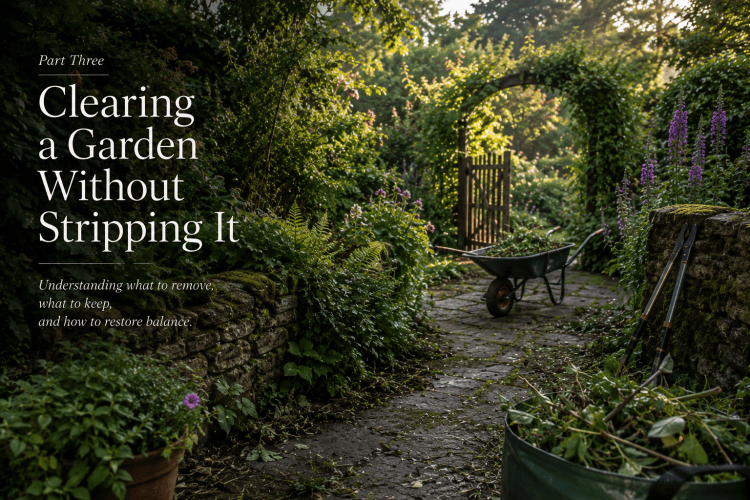
| One of the most common phrases I hear is, “It just needs clearing.” It’s usually said with the best of intentions. A border has become overgrown, a shrub has wandered further than expected, or a path has quietly disappeared beneath months of enthusiastic growth. Standing there, it’s easy to understand why “clearing” seems the obvious answer. Gardens have a remarkable ability to make us feel that more should be removed than retained. Experience has taught me to be a little suspicious of that instinct. Whenever I walk into a garden that has been left to its own devices for a while, I rarely begin by asking what needs to come out. My first question is much quieter. What deserves to stay? That single question changes almost everything. It is tempting to imagine that restoring a garden is rather like emptying a cluttered room. Remove enough unwanted things and the original space reappears. Gardens are far less accommodating than that. They are living communities, and every decision ripples outwards. Remove one overgrown shrub and the light changes. Remove the shade, and the soil begins to dry more quickly. Remove the cover and the birds lose somewhere to shelter. Even the weeds that arrive next season may be different because the balance has changed. A garden remembers every decision. That is one reason I have never believed that the best gardener is the one who removes the most material. Sometimes the greatest skill lies in recognising what has quietly earned its place. I’ve often found treasures hidden beneath neglect. An old stone edging buried beneath couch grass. Snowdrops waiting patiently beneath a blanket of ivy. A forgotten path leading to a seat that hasn’t been used for years. Occasionally an entire border seems to reappear as though it had simply been waiting for somebody to notice it again. Those moments are deeply satisfying, not because we’ve created something new, but because we’ve allowed the original garden to breathe once more. People sometimes imagine gardeners arrive with a plan already formed. The reality is rather different. The first half-hour is often spent reading the garden. Which plants are healthy? Which are struggling? Which have become dominant simply because nobody has gently held them in check? There is a surprising difference between vigorous growth and happy growth. One can easily disguise the absence of the other. Some of the busiest-looking gardens are quietly asking for help. One of the myths I’d happily challenge is the idea that cutting harder always produces better results. Occasionally it does. More often, it simply produces a different problem. A severely reduced shrub may respond with an explosion of vigorous shoots. A border stripped back to bare soil invites opportunistic weeds. A heavily thinned hedge may suddenly expose plants that have spent years sheltered from drying winds or intense afternoon sun. Gardens rarely appreciate dramatic change quite as much as we do. Nature generally prefers negotiation. That doesn’t mean difficult decisions are avoided, far from it. There are times when a neglected shrub has outgrown its welcome, when a self-seeded tree is simply in the wrong place, or when years of unchecked growth leave little alternative but a substantial renovation. Even then, I wonder whether the garden would benefit from several smaller conversations rather than one loud argument. Gardens, like people, often respond better to patience than shock. Wildlife quietly reminds us of this every season. A dense climber that appears to have swallowed a fence may also be sheltering wrens. The pile of old stems tucked behind the shed could be home to beetles, slow worms or overwintering insects. A dead branch, while untidy to some eyes, might be the favourite lookout for a robin. None of these observations means work should stop altogether, but they do influence how and when it happens. Good gardening isn’t only about plants. It’s about recognising that the garden belongs to many occupants besides ourselves. Perhaps that is why I have grown increasingly uncomfortable with the phrase “garden clearance.” It suggests wiping the slate clean. Most gardens don’t need wiping clean. They need understanding. There is a world of difference between revealing a garden and erasing it. That difference often comes down to restraint. Leaving the foxglove that has chosen exactly the right place. Keeping the self-seeded fern tucked into an old wall because it somehow looks as though it has always belonged there. Deciding that one mature shrub, despite being slightly untidy, contributes more to the character of the garden than replacing it ever could. These are rarely dramatic decisions. They are simply thoughtful ones. I’ve noticed something else over the years. Clients are often surprised by what we choose not to remove. There is sometimes a moment of uncertainty. “You’re leaving that?” Yes. Because next spring it will flower. Or because the birds are still feeding there. Or because removing it today would create a gap the garden doesn’t yet know how to fill. Those conversations are some of my favourites. Not because I enjoy disagreeing with clients, but because they usually end with both of us looking at the same plant in a rather different way. Gardens have an extraordinary ability to reward restraint. The older I become, the less interested I am in imposing my own idea of tidiness. I find myself asking what the garden is trying to become and how I can gently guide it rather than force it into shape. There is a quiet satisfaction in leaving a garden looking lighter, healthier and more balanced without anyone immediately spotting exactly what has changed. In many ways, that’s the hidden craft. People often assume a gardener’s success is measured by the amount loaded into the trailer at the end of the day. I suspect the better measure is what remains behind. If the garden still feels like itself—only calmer, healthier and able to breathe again—then we’ve probably judged it well. That judgement doesn’t arrive with a new pair of secateurs. It arrives slowly, one garden at a time, after years spent learning that every plant removed tells one story, while every plant thoughtfully left in place allows another story to continue. And once the shaping is complete, another quieter task begins. The pruning tools are put away, the wheelbarrow emptied, the green waste loaded. Then comes the broom. Strangely enough, it is often that final act of sweeping that convinces people the garden is truly finished. |
| About our writing & imagery Most articles reflect our real gardening experience and reflection. Some use AI in drafting or research, but never for voice or authority. Featured images may show our photos, original AI-generated visuals, or, where stated, images credited to others. All content is shaped and edited by Earthly Comforts, expressing our own views. |

