
| Series One Episode Five The Garden Where Everything Was Too Big |
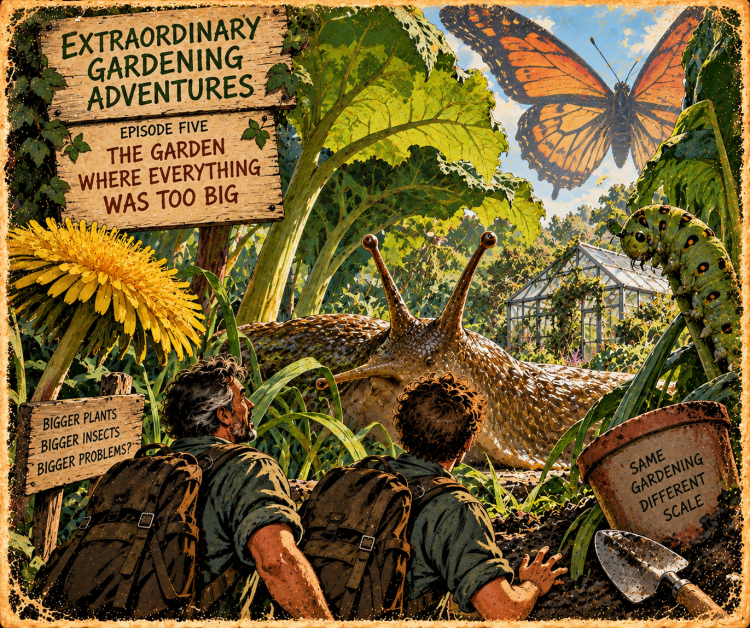
| There are few circumstances in which a slug can improve your situation. Gardeners generally regard them as something to tolerate, discourage or occasionally swear at when they discover what remains of a plant bought three days earlier. A slug the size of a wheelbarrow ought therefore to have been alarming. Instead, after dinosaurs, time travel and discovering that John and I had become a minor piece of twenty-second-century Kent folklore, it produced a strangely uncomplicated reaction. It was enormous, it was moving away from us, and for the moment it wasn’t trying to eat us. By recent standards, that made it almost reassuring. We moved beneath the giant leaves while the human voices behind us faded. Within twenty yards, the garden of 2189 had disappeared completely. The change was astonishing because we hadn’t passed through a door or opening that either of us had noticed. One moment we’d been walking through drought-adapted planting in future Kent; the next we were beneath foliage so large that individual leaves cast shadows like garden parasols. John looked back several times, hoping to identify exactly where the transition had happened, but there was nothing behind us except more enormous vegetation. Whatever boundary we’d crossed was as invisible as the rules governing everything else. The first thing I wanted to establish was whether the plants themselves were genuinely enormous or whether we’d somehow become smaller. John dismissed this as academic until I pointed out that the distinction might matter considerably if we encountered anything else. We stopped beside what looked unmistakably like clover. Each leaf was nearly as broad as my hand, which wasn’t especially helpful. Then we found something familiar enough to settle the question: a plastic plant label sticking out of the soil. It was roughly the size you’d expect to find in an ordinary garden, although badly faded and half buried beneath debris. “We’re normal,” I said. John examined the label. “That’s comforting.” “It means the plants are bigger.” “Yes. That’s the bit that isn’t.” Once we knew what we were looking at, the scale of the place became almost ridiculous. What I’d taken for low shrubs were herbaceous plants—grasses towered above us, their blades broad enough to push aside with both hands. A hosta formed something approaching a small woodland, while farther ahead a clump of rhubarb rose on red stalks thicker than fence posts. Runner beans climbed a framework so high that the upper growth disappeared among the foliage overhead. Even the weeds had benefited. A dandelion stood above John’s shoulder with a flower head the size of a dinner plate, which he regarded with the expression of a man imagining how much root remained below ground. “Don’t,” I said. “I wasn’t going to.” “You were thinking about digging it out.” “Habit.” It was hard not to think like gardeners because the place kept presenting us with familiar problems at impossible scales. Bindweed twisted through the giant planting in ropes thick enough to pull by hand. What looked like couch grass formed dense mats across open ground. Aphids clustered on some of the softer stems, except these were large enough to see individually without leaning closer. That encouraged both of us to stop leaning closer to anything. The garden itself had once been conventionally laid out. Beneath the growth we could still identify paths, edging and occasional sections of fencing. Their proportions remained normal, suggesting the gigantism affected living things rather than the structures around them. Somewhere beneath the vegetation was probably an ordinary domestic garden being comprehensively overwhelmed by plants that had outgrown every space intended for them. It raised an obvious question. “What made them like this?” John asked. I had no idea. Soil fertility alone wasn’t going to turn a runner bean into something capable of climbing a telegraph pole, and no amount of compost would produce a slug you could reasonably fit with a number plate. Whatever had happened here affected more than plants. I wasn’t going to invent an explanation simply because we wanted one. By now we’d learned that these places weren’t particularly interested in explaining themselves. Our immediate concern was finding a route through. The giant garden was much harder to cross than the future one because ordinary planting had become physical terrain. Stems blocked paths, leaves forced us to crawl underneath them, and roots had lifted sections of paving into steep ridges. We used the folding saws occasionally, but cutting our way through everything would have exhausted us and damaged tools we couldn’t replace. Instead we looked for natural gaps, old paths and places where the growth was thinner. The rhubarb provided our first proper shelter. Several immense leaves overlapped above an open patch of ground, creating a dry space beneath them. We stopped there to drink and eat some of the snacks left in our bags. Our food situation wasn’t desperate yet, but it was becoming something we couldn’t ignore. We had enough for perhaps another day if we were careful, although being surrounded by enormous edible plants made the problem feel almost absurd. John looked up at the rhubarb stalk beside us. “We could eat that.” “In principle.” “It’s rhubarb.” “I know.” “Quite a lot of rhubarb.” The difficulty wasn’t recognising it. The difficulty was knowing whether anything in this garden behaved chemically as well as physically like its normal counterpart. Even ordinary rhubarb leaves contain substances you wouldn’t choose to eat, and I had no desire to discover whether gigantism had altered anything else. We still had food so that experimentation could wait. John accepted this reluctantly, although he did point out that one crumble could probably feed Sandwich. While we rested, something rustled beyond the leaves. After our recent experiences, we both went still immediately. A shadow moved across the ground, and there was a wet scraping sound from the direction we’d entered. The wheelbarrow-sized slug appeared beneath the edge of the rhubarb, or another one remarkably similar to it. It moved past without showing the slightest interest in us and began feeding on a fallen leaf. Up close, it was impressive in a way ordinary slugs rarely get credit for. Its muscular body moved in slow waves, tentacles testing the air ahead, while its mouth worked steadily against the plant material. John watched for a while before saying it was at least not interested in meat. I reminded him that slugs weren’t generally known for hunting gardeners anyway. The reassurance lasted until we heard another sound from above. A leaf jerked violently. Something landed on it, making the whole structure dip, and a shape moved across the surface. For a moment all we could see were legs. Then an enormous beetle appeared at the edge and launched itself into the air with a buzz deep enough to feel in my chest. John ducked. “So insects as well?” “Apparently.” “Wonderful.” We packed up. After that, we moved more cautiously. A normal garden contains an astonishing number of animals if you bother to look closely. Beetles, spiders, centipedes, woodlice and countless other creatures occupy almost every layer from soil to canopy. Enlarging the plants was one thing; enlarging the invertebrates transformed the garden into somewhere neither of us wanted to investigate by turning over logs. The next obstacle was webbing. It stretched between two enormous stems across what seemed like the clearest route ahead. The strands were thick enough to see from several yards away and strong enough that a falling leaf had become suspended in them. We stopped well before reaching it. John looked around. “Spider?” “Presumably.” “How big?” “I don’t want to know.” For once he agreed immediately. We detoured. The diversion forced us through a dense stand of giant grasses where visibility dropped to a few feet. I used my folding saw to cut one stem that had fallen across the route and immediately regretted it when the severed upper section crashed through neighbouring foliage like a small tree. Somewhere nearby, something moved rapidly away from the noise. We decided not to investigate what. Beyond the grasses we found a section of original paving and followed it towards what looked like a shed. That was enough to make both of us stop. It was an ordinary garden shed, perhaps eight by six, partly hidden beneath a climber whose stems had engulfed half the roof. Neither of us rushed towards it. The last shed had caused enough trouble. We approached from the side and looked through a dusty window before touching the door. Inside were shelves, pots, old hand tools and bags of what might once have been compost. Everything appeared normal-sized. More importantly, no impossible jungle was visible behind the shelving. John tried the handle. Locked. “Good,” he said. I understood exactly what he meant. Beside the shed stood a water butt collecting roof runoff. It was nearly full, but we still had water from 2189 and saw no reason to risk drinking it. What interested me more was the garden beyond. From the slightly higher ground around the shed we could see farther than before, and for the first time the layout became clear. We were in an enormous version of what had once been an ordinary productive garden. Raised beds disappeared beneath giant vegetables, fruit trees towered above them, and runner-bean frames had become completely engulfed. At the far end stood a greenhouse almost hidden by growth. A path ran between us and it. “That looks too easy,” John said. It did. We followed it anyway. For perhaps fifty yards nothing happened. We passed cabbages whose leaves could have covered dining tables and onions with foliage taller than we were. A pumpkin lay partly across one bed like an orange boulder. I was beginning to wonder whether we’d finally been given an uncomplicated route when John stopped and pointed towards the path ahead. Something was eating one of the cabbages. At first I thought it was another slug. Then it raised its head. Caterpillar. A very large caterpillar. It was easily six feet long. We watched from behind the raised bed while it demolished the edge of a cabbage leaf with astonishing efficiency. Something felt deeply offensive about seeing familiar feeding damage at that scale. Every gardener knows the irritation of finding brassica leaves reduced to lace. Here we could actually watch the culprit removing pieces large enough to wrap a parcel in. John whispered, “Spray?” “I don’t think we’ve got enough.” The insect spray in our rucksacks suddenly seemed rather optimistic. Fortunately, the caterpillar was interested only in the cabbage. We moved around the opposite side of the bed, keeping as much vegetation between us and it as possible. I doubted it posed any deliberate threat, but an animal doesn’t need to want to hurt you if it’s large enough to flatten you accidentally. We were nearly past when a shadow crossed the garden. Both of us looked up. Something moved high above the beds, wings beating slowly. At first the scale made identification difficult, then sunlight caught the colour. A butterfly. Its wingspan must have been twenty feet. For once neither of us made a joke. It was beautiful. Completely impossible, potentially dangerous simply because of its size, but beautiful nonetheless. It crossed above us and settled somewhere among the giant flowers beyond the greenhouse, its wings briefly visible above the vegetation. “That,” John said, “was actually quite something.” It was. The moment didn’t last. Behind us came the unmistakable sound of disturbed vegetation, and when we looked back, the giant caterpillar had left the cabbage. It wasn’t following us deliberately, but unfortunately it was travelling in the same direction. We increased our pace. The path led towards the greenhouse, where an open doorway offered a way through the dense planting. We reached it before the caterpillar and stepped inside. The glass had long since broken from several panels, allowing giant climbers to invade from outside. An enormous grapevine twisted through the roof structure and bunches of fruit hung overhead like clusters of balloons. At the far end was another door. Through it we could see something unexpected: ordinary-sized vegetation. John noticed it at the same moment. We crossed the greenhouse carefully, stepping around roots that had broken through the floor. Behind us, the caterpillar reached the entrance but showed no interest in squeezing inside, preferring a large leaf beside the doorway. The vegetation beyond the far door looked almost ridiculously modest. Grass. Shrubs. Trees whose leaves belonged at sensible heights. After several hours in the giant garden, normality had become suspicious. We stood inside the greenhouse looking out. “Another one?” John asked. “Looks like it.” “Where does this one go?” “No idea.” “Home?” “Possibly.” “You’ve said that before.” He had me there. We stepped outside. The temperature dropped immediately. The air smelled cooler and fresher, carrying something I hadn’t expected to encounter again so soon. Freshly cut grass. John smelled it too. We looked at one another. Somewhere ahead, beyond a line of ordinary trees, was the unmistakable sound of a lawnmower. Not a dinosaur. Not giant insects. Not twenty-second-century machinery. A lawnmower. For the first time since we’d been forced away from the shed, something ahead sounded like the world we’d left behind. We started walking towards it. |
| About our writing & imagery Most articles reflect our real gardening experience and reflection. Some use AI in drafting or research, but never for voice or authority. Featured images may show our photos, original AI-generated visuals, or, where stated, images credited to others. All content is shaped and edited by Earthly Comforts, expressing our own views. |

