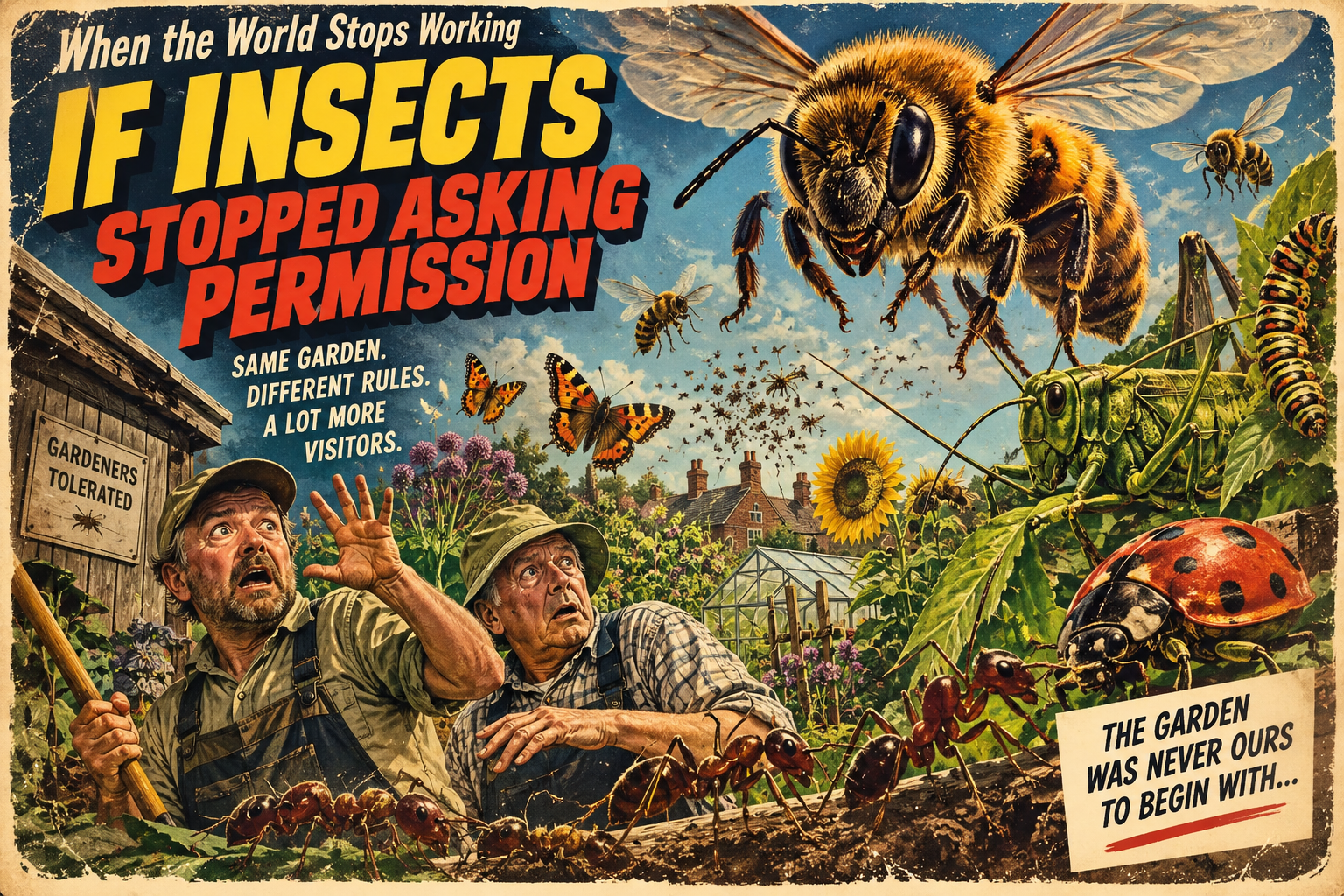
| There has always been an arrangement between gardeners and insects, although I don’t remember anybody formally agreeing to it. We grow the plants, they eat some of them, we complain, they ignore us, and somewhere in the middle a reasonably functioning garden emerges. Aphids are permitted a rose or two before somebody reaches for the hosepipe, caterpillars take liberties with the brassicas, vine weevil larvae operate underground where they hope nobody will notice, and wasps become increasingly interested in lunch as summer progresses. None of this is particularly organised. It is simply the endless negotiation that takes place whenever humans attempt to impose their ideas upon a piece of land already occupied by several thousand other species. The important thing is that, for most of the time, insects appear to recognise certain boundaries. Not consciously, obviously, but through habitat, behaviour and circumstance. The ants stay mostly beneath the paving. Bees investigate flowers rather than kitchens. Caterpillars remain attached to the plants they are eating. Woodlice prefer damp corners. A gardener can therefore maintain the comforting illusion that the garden consists of areas belonging to us and areas temporarily tolerated by everything else. Imagine, then, that the arrangement changed. Not dramatically. There would be no announcement, no sudden swarm darkening the sky and certainly no insects growing to the size of buses; we’ve already had quite enough of that. The change would be subtler. Insects would stop respecting the boundaries we had imagined existed between their world and ours. We would notice it first in the shed. Garden sheds are hardly insect-free environments, at best. Still, there is usually a distinction between finding the occasional spider in the corner and discovering that the entire building has become desirable residential accommodation. You open the door one morning, and there are ants beneath the toolboxes, solitary bees investigating holes in the timber, earwigs behind the shelving and several species of beetle apparently holding a conference beneath the mower. Nothing is attacking you. Nothing is behaving unnaturally. There are rather more tenants than you remember inviting. At first, most gardeners would regard this as interesting. I know I would. Turn over an old pot and find something unusual beneath it, and the immediate reaction is often curiosity rather than alarm. You look closer, take a photograph, wonder what species it is and then carry on with whatever you were doing. The difficulty begins when you lift the next pot and find another colony, then move a bag of compost and discover something living beneath that too. Eventually you realise that practically every unused space in the shed has acquired an occupant. The same thing begins happening in the garden. Masonry bees investigate walls in greater numbers. Ant colonies spread beneath patios and paths. Wasps discover that sheds, roof spaces and compost areas offer excellent nesting opportunities. Aphids arrive on new growth before you’ve properly noticed the new growth exists. Caterpillars appear in numbers that make netting look more like a suggestion than a barrier. Beetles occupy log piles, leaf litter, compost heaps and the gaps beneath containers, while flies become increasingly enthusiastic about anything organic that remains still for more than a few minutes. None of this requires insects to become more intelligent. It only requires them to become more successful. That distinction matters, because gardeners already live in a world in which insects are astonishingly good at finding opportunities. Put a vulnerable plant somewhere suitable and the relevant insect often appears with a speed that seems almost supernatural. Plant lilies and lily beetles somehow receive the address. Grow brassicas and cabbage whites eventually find them. Leave standing water and mosquitoes may investigate. Introduce a stressed container plant, and aphids can appear as though they were included in the potting compost. We tend to notice insects most when they inconvenience us, which gives a rather distorted impression of what they’re doing. Most aren’t interested in our gardens because they are gardens. They’re interested because gardens provide food, water, shelter, warmth, breeding sites and extraordinary concentrations of particular plants. From an insect’s perspective, some of the things we create must look remarkably generous. A vegetable patch is a buffet. A greenhouse is heated accommodation. A compost heap is a combination of a restaurant, a nursery, and a central heating system. And then we become annoyed when something moves in. If insects really stopped asking permission, the first serious casualty is the idea of the controlled garden. You could still garden, but maintaining the degree of separation we currently expect would become increasingly difficult. Every intervention would be temporary. Clear aphids from the beans and another population would arrive. Remove a wasp nest and another queen would find somewhere equally suitable. Protect one crop and pressure would shift to another. Even ornamental gardening would change as plants traditionally considered reliable began experiencing much heavier attention from whichever insects happened to find them useful. For professional gardeners, this would create an interesting problem. Much of gardening is already repetitive because nature has the irritating habit of continuing after we’ve finished. We weed beds knowing weeds will return, mow grass knowing it will grow again and prune shrubs with the full understanding that the plant has not accepted this as a permanent architectural decision. Insects would accelerate the principle. A garden left apparently tidy on Tuesday could be biologically occupied again by Friday. Clients would notice. “Something is eating the roses.” “Yes.” “Can you stop it?” “Temporarily.” That final word would become increasingly important. The temptation, naturally, would be escalation. If there were more insects, people would demand more insecticides, more traps, more barriers, and more ways to keep them from entering particular spaces for a while that might work. But a garden isn’t a sealed laboratory. Air moves through it. Birds land in it. Plants grow across boundaries. Soil contains enormous communities of organisms. Insects fly, crawl, burrow and hitch lifts on plants, vehicles, clothing and probably gardeners. Trying to make an outdoor space permanently insect-free would be rather like trying to keep weather out of it. And there would be another difficulty. We need them. That inconvenient aphid population is part of a food web. Hoverfly larvae eat aphids. Ladybirds eat them. Birds eat insects. Solitary bees pollinate flowers. Beetles break down organic matter. Wasps, despite their public-relations difficulties, are formidable predators of other insects. Countless species perform jobs in gardens without receiving invoices, wages or much appreciation. If insects stopped respecting our boundaries, we couldn’t simply declare war on insects generally without damaging the very systems keeping the garden functioning. This is where the situation would become genuinely interesting. The successful gardener wouldn’t necessarily be the person with the strongest spray. It might be the gardener who became better at negotiation. Not negotiation in the literal sense. I don’t imagine sitting beside a cabbage white with a clipboard would achieve much. But we could change the conditions. We could encourage predators, diversify planting, use physical barriers where they mattered most, tolerate damage where it didn’t, remove breeding opportunities from places where insects genuinely created problems and provide alternatives elsewhere. In other words, we would have to become much better at deciding what actually mattered. That’s harder than it sounds. A few holes in a leaf are not a horticultural emergency. An aphid colony on one stem isn’t necessarily a reason to treat an entire garden. Ants beneath a paving slab may be irritating without being disastrous. A solitary bee nesting in a wall can look alarming to somebody unfamiliar with it while presenting very little danger. Conversely, some insects really can devastate plants, spread disease, damage structures or create situations that require intervention. Gardening would become less about achieving complete control and more about recognising thresholds. How much damage can this plant tolerate? Is this insect actually causing the problem? What happens if we leave it alone? What else depends upon it? Those questions already belong in good gardening. Our imaginary insect rebellion would merely make them unavoidable. The vegetable garden would teach the lesson fastest. Imagine sowing beans, peas, carrots, brassicas, courgettes and salads into a world where insect pressure has become relentless. Growing food would still be possible, but the casual approach would disappear. Netting would need checking, not just installing. Crop rotation would matter. Timing would matter. Plant health would matter. Diversity would matter. You might deliberately sacrifice one crop to protect another, grow more than you expected to harvest, or accept that a certain percentage belonged to the ecosystem before you ever reached the kitchen. That last idea feels slightly uncomfortable because gardeners naturally think of crops as ours. We bought the seed, prepared the soil, sowed it, watered it and spent three months keeping the pigeons away. Discovering that a caterpillar regards this chain of ownership as legally irrelevant can feel rather personal. Yet the garden never really accepted our paperwork. The strangest consequence might actually occur beyond individual gardens. If insects became substantially more successful everywhere, councils, farmers, horticultural businesses and householders would all be dealing with the same pressure. Waste would need managing more carefully. Food storage would change. Buildings would be designed differently. Screens might become as normal on British windows as they already are in many warmer parts of the world. Outdoor eating would become more complicated, and leaving a sugary drink unattended in August would move from mildly foolish to an act of extraordinary optimism. Climate would inevitably be part of the story. Warmer conditions can alter the distribution, breeding cycles and survival of insects, while international trade and plant movement can introduce species into places where they previously couldn’t establish. Some insects that currently produce one generation in a season might manage more under favourable conditions. Others might extend their ranges. New relationships would develop between insects, plants and predators. The unsettling part of this particular What If? is therefore that we don’t actually need insects to make a collective decision. They aren’t going to stop asking permission. They never asked in the first place. The boundaries were ours. A garden is already being crossed every minute by creatures that neither know nor care where the property line sits. Bees fly over fences. Beetles move beneath them. Aphids arrive on the wind. Butterflies inspect whatever happens to be flowering. Ants build colonies without consulting Land Registry. We notice this movement only when it conflicts with something we’re trying to grow. Perhaps the real change in our imaginary future wouldn’t be the insects at all. It would be us finally losing the ability to pretend that gardens are separate from the ecosystems surrounding them. I suspect professional gardening would survive perfectly well. We would adapt because gardeners always do. We’d learn which plants coped, which methods genuinely worked and which battles were no longer worth fighting. Clients would gradually become accustomed to leaves with holes in them. Garden centres would sell increasingly elaborate netting. Somebody would undoubtedly invent a subscription service for beneficial nematodes. Government guidance would arrive, much of it three weeks after everybody had already worked out what to do. And after a while the extraordinary would become ordinary. John and I would arrive at a garden, unload the tools and inspect the beds. There would be aphids on the roses, ants beneath the paving, caterpillars on something expensive and an impressive quantity of insect activity around the compost heap. We’d deal with what genuinely needed it and leave the rest alone. Then we’d stop for lunch. John would open his rucksack. I’d open mine. A wasp would arrive almost immediately. We’d look at it. It would look at us. And nobody would bother pretending it needed an invitation. |
| About our writing & imagery Most articles are grounded in our real gardening experience, observations and reflections. AI may assist with research, drafting and editing, but the experiences, opinions and editorial direction are our own. Featured images may include our photography, original AI-generated visuals or, where stated, images credited to others. All published content is reviewed and shaped by Earthly Comforts before publication. |

