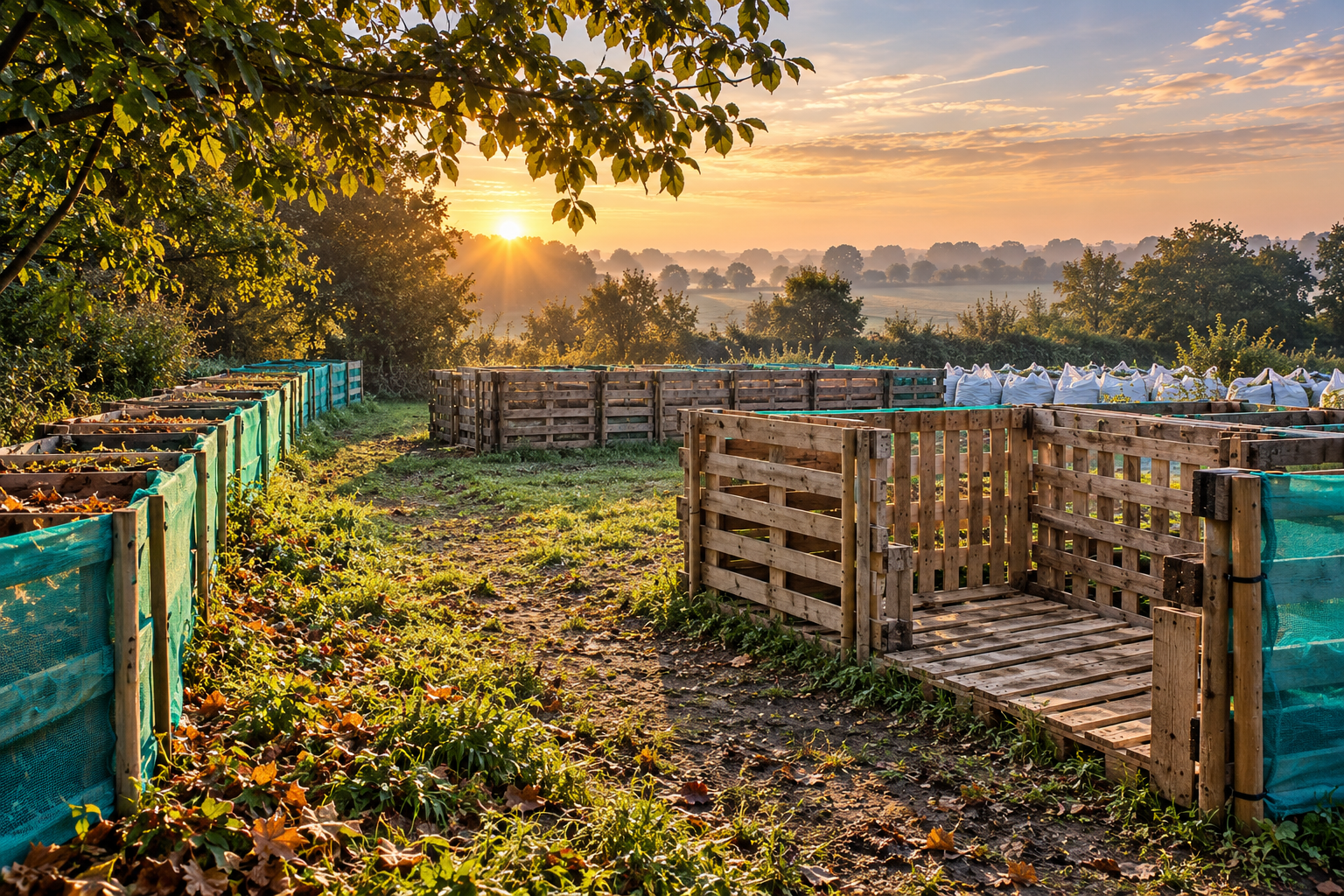
| Episode Three — The First Build: When the Drawings Finally Met the Field End of September 2026 |
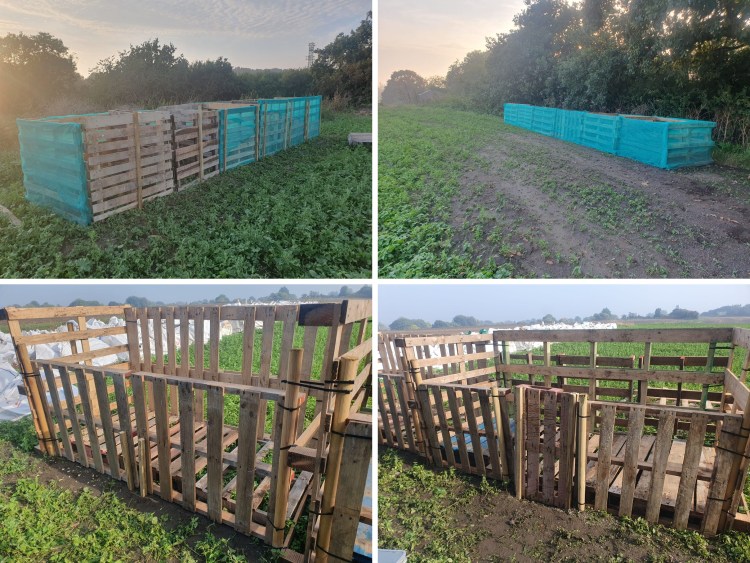
| First compost ovens and kraals. |
| Every project reaches a point when talking has to stop and something physical has to happen. For the Soil Hub, that point arrived over two days at the end of September. We had spent weeks discussing compost ovens, receiving areas, leaf kraals, pallet numbers and how the different parts of the site might eventually work together. Between 26 and 29 September, some of those drawings and conversations finally started to appear on the ground. The difference was immediate. A plan on paper can be wonderfully precise, but a field has its own dimensions, slopes, boundaries and character. Once we started putting pallets together, we could see how much space the structures actually occupied, how they sat against the existing tree line and, perhaps most importantly, how the different parts of the Hub might eventually relate to one another. This was still very much the beginning, but for the first time the Soil Hub was becoming something we could walk around rather than imagine. Starting With What We Have One principle behind the Soil Hub has always been that the experimental year should not begin with expensive infrastructure. We want to find out whether the idea works before throwing large amounts of money at it, so reclaimed pallets remain the main building material. They are cheap, readily available, remarkably adaptable and, if the whole experiment eventually proves to be a terrible idea, they can be dismantled almost as easily as they were put together. That simplicity is important. The photographs from these first few days show structures that are certainly not architectural masterpieces, nor are they intended to be. Pallets vary in size and construction, timber stakes provide additional support, cable ties hold much of the framework together, and green mesh is being used where loose material will eventually need containing. What matters is whether the structures are strong enough to do their job. The first few days also reinforced something we suspected while developing the schematic: there probably won’t be one type of container at the Soil Hub. Different materials require different treatment, and the physical structures are beginning to reflect that. The Compost Banks Take Shape The most recognisable part of the original plan is the composting system. Our basic unit remains a roughly four-foot cube, large enough to contain a meaningful volume of material but still small enough for us to work manually. Six of these units form a bank, allowing five to compost while the sixth provides the working space needed when we turn material from one bay to another. Several of these bays have now begun to take shape. The pallets are supported with stakes, the individual compartments remain open to the air, and green mesh is being introduced around the outside to help retain loose material without turning the structures into sealed boxes. What has changed is our sense of scale. Earlier plans suggested four banks as a starting point, perhaps increasing to eight as the experiment developed. Having now seen the first structures sitting in the field, I think there may eventually be room and reason for something closer to ten six-bay banks. That would give us around sixty individual units, although I am deliberately reluctant to turn that into a target. We will build what the operation actually requires rather than filling the field simply because we can. If we eventually reach ten banks and continue using one bay in each as the turning space, that would leave around fifty active composting units. More importantly, the modular arrangement means we don’t have to make that decision today. We can build another bank when we need another bank. That, increasingly, is how I want the entire Hub to develop. A Receiving Area Becomes Something Larger The receiving system has probably changed more dramatically than anything else. Our original schematic envisaged a couple of receiving kraals where incoming garden material could temporarily sit before being sorted. Once we actually constructed the first large one, however, its usefulness became much more obvious. These are not simply places to dump material. They can become staging areas between material arriving at the Hub and entering a processing system. The first large receiving bay has been constructed from pallets with a wooden pallet base, substantial sides and a central access opening. The raised base gives us a defined working surface, while the central doorway lets us walk into the structure rather than reach over a four-foot wall. For the moment, these larger bays give us somewhere to place bulk bags awaiting attention. A bag can be brought in, opened and inspected, and its contents can then be directed towards whichever part of the Hub is appropriate. Softer mixed garden material may go towards the compost banks, leaves can be separated for leaf mould and substantial woody material can be handled independently. Having built the first one, I can already see us eventually having perhaps ten or twelve of these larger receiving and sorting bays. Again, that isn’t a construction quota. It is simply where the physical experiment is currently pointing us. There is something rather satisfying in the photographs of the first receiving bay, because behind it sit rows of the white bulk bags that helped start this whole project. They represent the problem we are trying to solve, while the pallet structure in front represents our first attempt at a system to solve it. Leaves Get Their Own System The other major development during these first four days was the beginning of the leaf-mould system. Originally, we had imagined perhaps two fairly substantial leaf kraals. Building on the field has changed that thinking too. Instead, we have begun constructing a series of much smaller individual units along the curved perimeter beneath the existing tree line. I much prefer it. The plan now is potentially to continue these small kraals around much of that curved boundary, perhaps eventually creating fifteen or twenty separate units. The pallets are being covered with green mesh to help keep the leaves inside while still allowing air through, and we intend to use large sheets of ordinary cardboard as simple covers on top. This approach should give us much more flexibility than one enormous leaf heap. We can fill individual units at different times, empty them independently, and, during the experimental year, potentially compare them. We may discover differences between batches, leaf types, moisture levels, or simply the time of year they were filled. There is also a landscape advantage. Tucked beneath the tree line, the units follow an existing boundary rather than occupying the middle of the field. Once we added the green mesh, I was surprised by how quickly the pallet structures visually receded into their surroundings. The Field Is Beginning to Tell Us Where Things Belong Perhaps the most useful lesson from these first few days has had relatively little to do with compost. Our original drawings inevitably made the Soil Hub look more formal than it is in reality. Boxes had to be placed somewhere on a page, paths drawn between them and areas given clearly defined purposes. Standing in the actual field, another possibility is emerging. Rather than filling the centre, we can work with the perimeter. The smaller leaf-mould units can follow the tree line. Compost banks can occupy another edge in separate modular groups. Larger receiving and sorting bays can create working stations where they are needed. That leaves a considerable amount of the middle open for whatever the experimental year eventually tells us should happen there. I like that much more than trying to impose a miniature industrial composting site onto a piece of farmland. The Soil Hub was always supposed to become a working landscape, and these first structures suggest we may be able to retain much more of the field’s character than I initially expected. Cheap, Imperfect and Deliberately Experimental Nothing constructed between 26 and 29 September should be regarded as the finished Soil Hub. Some structures will undoubtedly be altered. We may discover that a doorway needs widening, a stake needs strengthening, or a particular arrangement makes turning compost unnecessarily difficult. Something that looks perfectly sensible while empty may prove hopeless once it contains several hundred kilos of wet garden material. That is precisely why we are doing this as an experimental year. The important thing is that the system is finally becoming testable. Until now, we could calculate the theoretical volume of a four-foot compost cube or estimate how many bulk bags might fit inside one, but those figures remained calculations. Once the bags are opened and the ovens are filled, we can start replacing estimates with observations. How many real bags fill an oven? How quickly does the material settle? Which mixtures become too wet? How easily can one full bay be turned into the next? How much labour does that actually require? How quickly do the leaf kraals fill during autumn? How many receiving bays do we genuinely need rather than merely think we need? Those are much more interesting questions now because we finally have somewhere to find the answers. Two Days That Changed the Project From a distance, what happened between 26 and 29 September was fairly modest. We cable-tied pallets together, drove stakes into the ground, stretched green mesh around timber and began creating boxes in a field outside Sandwich. For the Soil Hub, though, those two days represented something considerably more important. The project crossed the line between proposition and practice. Already, some of our earlier ideas have changed. Two leaf kraals may become a chain of fifteen or twenty smaller ones. Two receiving areas may eventually become ten or twelve substantial receiving and sorting bays. Four compost banks may ultimately become something nearer ten. None of those changes means the original schematic was wrong; it means we finally have enough physical information to start challenging it. That is what this first year was supposed to be about. We build something, observe how it behaves, learn from it and adapt the next part accordingly. Only then is it worth writing about. By the evening of 29 September, we still had an enormous amount to do. Most of the material remained in bags, most of the proposed structures had yet to be built, and not a single finished handful of Soil Hub compost existed. But compost bays stood in the field. Leaf kraals followed the trees. A receiving area waited for its first proper workload. For the first time, the Soil Hub existed somewhere other than on paper. |
| About our writing & imagery Most articles reflect our real gardening experience and reflection. Some use AI in drafting or research, but never for voice or authority. Featured images may show our photos, original AI-generated visuals, or, where stated, images credited to others. All content is shaped and edited by Earthly Comforts, expressing our own views. |

