
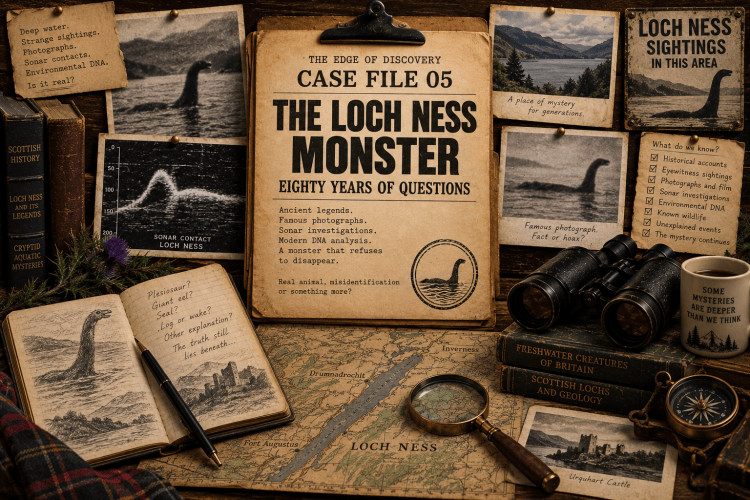
| Case File 05 The Loch Ness Monster — Eighty Years of Questions |
| Loch Ness seems almost designed to contain a monster. It stretches for roughly 23 miles through the Scottish Highlands, surrounded by steep hills and frequently covered by low cloud, rain and mist. Its water is stained dark by peat carried down from the surrounding landscape, so that visibility beneath the surface rapidly deteriorates. Stand beside it on a grey Highland morning, and it is not difficult to see how generations of people came to believe something extraordinary might be moving beneath the water. Yet the greatest mystery of Loch Ness is not simply whether a large unknown animal lives there. It is how a collection of sightings, photographs, newspaper stories, scientific investigations, mistakes and deliberate hoaxes combined to create perhaps the most famous aquatic monster in the world. Bigfoot belongs to the forests, the Yeti to the Himalayas, but Nessie occupies something rather different: one clearly defined body of water that we can repeatedly investigate. That should make the Loch Ness Monster easier to solve. Strangely, it hasn’t. Before Nessie Became Nessie Almost every account of the Loch Ness Monster eventually reaches back to the sixth century and the life of Saint Columba. According to a biography written around a century after Columba’s death, the Irish missionary encountered local people burying a man who a creature in the River Ness had supposedly attacked. Columba later commanded the creature to retreat when it approached another swimmer. It is a wonderful story, but using it as straightforward zoological evidence is problematic. Medieval religious texts were not wildlife survey reports, and stories concerning saints confronting dangerous animals or supernatural forces formed part of a much broader tradition. More importantly, the episode was associated with the River Ness rather than necessarily with the loch itself. Treating it as the first confirmed Nessie sighting requires reading a medieval religious account through modern cryptozoological eyes. Later traditions certainly described strange water creatures in Scotland. Kelpie and water-horse stories belonged to Scottish folklore long before the twentieth century, and dark lochs naturally provided fertile ground for tales of things living beneath the surface. But the creature now known internationally as Nessie is largely a modern phenomenon. Its real explosion into public consciousness came in 1933. The Road That Helped Create a Monster This is one detail about the Nessie story I find particularly interesting. During the early 1930s, improvements to the road running along the northern shore of Loch Ness made the loch much more visible and accessible to travellers. More people could now look across the water for longer periods from viewpoints that had previously been much harder to reach. In April 1933, hotel manager Aldie Mackay reportedly saw a disturbance in the loch and described something resembling a whale. The Inverness Courier reported her account, and newspaper interest grew. Later that year George Spicer and his wife reported an even stranger encounter: a large creature supposedly crossing the road ahead of their car before disappearing towards the loch. The modern Loch Ness Monster arrived at almost the same time more people were allowed to look for it. This raises an interesting question. Did road improvements reveal an animal that had always been there, or did increased observation create more opportunities for ordinary events to be interpreted through an emerging monster story? Once newspapers began reporting sightings, visitors knew what to look for. Every unusual wake, distant bird, floating log and unexplained disturbance suddenly had a possible identity. The feedback loop had begun. Sightings created publicity, publicity brought observers, observers produced more sightings, and the monster became increasingly real in the public imagination, whether or not an unknown animal existed beneath the water. Then came the photograph that seemed to settle everything. The Surgeon’s Photograph In 1934, the Daily Mail published an extraordinary image attributed to London doctor Robert Kenneth Wilson. A long, narrow neck appeared to rise from the dark water, topped by a small head. It looked almost exactly like what the world expected a mysterious prehistoric survivor to look like, and because Wilson was a doctor, the image gained an aura of respectability. It became known as the Surgeon’s Photograph and for decades remained the defining image of the Loch Ness Monster. The photograph helped establish something that would profoundly influence the mystery: the idea that Nessie resembled a plesiosaur, one of the long-necked marine reptiles that lived during the age of dinosaurs. The resemblance was irresistible. Here, apparently, was a prehistoric animal that had somehow survived extinction and remained hidden within a Scottish loch. Unfortunately, the photograph eventually became associated with one of cryptozoology’s most celebrated hoaxes. Accounts emerging decades later described a small model mounted on a toy submarine and photographed on the loch. Whatever uncertainty remains around some details of the story, the Surgeon’s Photograph can no longer sensibly be treated as reliable evidence for an unknown animal. Yet its influence survives. Ask somebody to draw the Loch Ness Monster, and there is a good chance they will produce a long neck rising from the water. One questionable photograph did not merely record the monster; it helped design it. That distinction matters enormously. Could a Plesiosaur Actually Live in Loch Ness? This is where the romantic explanation begins encountering some serious biological problems. Plesiosaurs were marine reptiles, not dinosaurs, and they disappeared from the fossil record during the mass extinction at the end of the Cretaceous around 66 million years ago. Loch Ness itself is a much younger geological feature shaped by glacial processes. A surviving plesiosaur population therefore could not simply have remained continuously sealed inside the modern loch since prehistoric times. We would need to propose that descendants survived elsewhere and later entered Loch Ness. Even then, one animal would not be sufficient. As with Bigfoot and the Yeti, we would need a breeding population capable of surviving generation after generation. Large predators require substantial amounts of food, and a population of enormous aquatic reptiles would place considerable demands upon the loch’s ecosystem. There is another problem. Depending upon their physiology, plesiosaurs would presumably need to surface to breathe. Loch Ness may be deep and dark, but its surface is very visible. An air-breathing population repeatedly coming to the surface across decades should provide considerably more opportunities for clear observation than the evidence suggests. The plesiosaur is therefore a wonderful monster. It is considerably harder to make into a plausible Loch Ness animal. What Does the Loch Actually Hide? Loch Ness is impressive. It contains an enormous volume of water and reaches depths of more than 200 metres. Its dark appearance creates an impression of almost limitless depth, and stories sometimes suggest underwater caves or secret passages through which a monster might enter and leave unseen. The reality is less romantic. Loch Ness connects through the River Ness and the Caledonian Canal system. Still, no established hidden tunnel connects its depths directly to the ocean, through which giant marine creatures can casually commute. Nor is the bottom an unknowable abyss extending indefinitely beneath Scotland. What makes the loch difficult to observe is not that it is bottomless, but that its water is dark and visibility is poor. Peat staining means that a large object can disappear from view surprisingly quickly beneath the surface. This makes Loch Ness excellent territory for ambiguous sightings. Something does not need to dive hundreds of metres to become invisible; it may need to descend only a short distance. And there are perfectly real large animals capable of entering or living within the loch. Atlantic salmon migrate through the system, European eels are abundant, seals have occasionally entered freshwater systems, and groups of swimming animals can create surprisingly strange wakes when viewed from a distance. The question therefore becomes less: could something be hidden? and more: what sort of something could realistically be hidden there? The Problem of Waves Water is remarkably good at creating monsters. Boat wakes can travel significant distances after the vessel responsible has disappeared from view. Under suitable conditions, they can form a series of humps that appear remarkably animal-like. Floating logs move. Birds dive and reappear somewhere unexpected. Otters swimming in line can create the impression of a single elongated creature, while deer crossing water may present little more than a head and neck. Mirages and unusual atmospheric conditions can complicate matters further. Distance is particularly difficult to judge across open water when there are few reference points. Something apparently enormous and hundreds of metres away may actually be much smaller and closer. Scientific investigations at Loch Ness have demonstrated how easily this can happen. Oxford and Cambridge University expeditions in the early 1960s monitored substantial areas of the loch. They concluded that boat wakes could produce some classic multi-humped “sea serpent” observations, while diving birds could account for some apparent long-neck sightings. The same investigations recorded some sonar contacts they could not immediately explain, which is a useful reminder that identifying many observations does not automatically explain every observation. This is precisely why I dislike the idea that cryptozoological investigations must end with either monster or hoax. An enormous territory lies between those two possibilities, containing ordinary animals, unusual behaviour, optical effects, imperfect observations, and events for which insufficient evidence survives to provide any conclusion at all. Sometimes “unexplained” means we no longer have enough information to explain it. Tim Dinsdale and the Moving Hump In 1960, aeronautical engineer Tim Dinsdale travelled to Loch Ness determined to investigate the mystery. On the final day of his search, he filmed an object moving across the water. The approximately four-minute sequence became one of the best-known pieces of Nessie evidence after the Surgeon’s Photograph. The film is interesting because the object clearly moves and produces a wake. Dinsdale became convinced that he had filmed the monster and subsequently devoted much of his life to investigating Loch Ness. A later assessment by Britain’s Joint Air Reconnaissance Intelligence Centre interpreted the object as probably animate. However, other investigators have argued that its appearance and movement are consistent with a boat. Even zoologist Maurice Burton, who had encouraged Dinsdale’s early interest, became sceptical of the film. Once again, ambiguity survives. I find Dinsdale’s film interesting for much the same reason I find the Patterson-Gimlin Bigfoot film interesting. Neither gives us enough information to identify its subject beyond reasonable dispute, and repeated examination has not magically created information the original film failed to capture. Enhancement can reveal detail. It cannot manufacture detail that was never recorded. Sonar Goes Monster Hunting Unlike Bigfoot or the Yeti, Nessie supposedly inhabits a confined environment through which researchers can repeatedly pass scientific instruments. This made sonar an obvious investigative tool. Beginning in the 1960s and 1970s, expeditions attempted to detect large moving targets beneath the surface, and recorded various intriguing contacts. Some sonar returns appeared to show sizeable objects moving within the water column. The problem is that sonar does not automatically tell us what produced an echo. Fish shoals, underwater structures, instrument behaviour, and other phenomena can create returns that require interpretation. An unexplained sonar contact shows the equipment detected something; identifying that something as an unknown giant animal requires much more evidence. This is nevertheless where Loch Ness differs fundamentally from many cryptozoological mysteries. The creature has been subjected to organised searches involving cameras, sonar, hydrophones, boats and decades of observation. The search has not consisted solely of people wandering around hoping to glimpse something. And still we have no specimen. That increasingly becomes the central problem. Then Science Tested the Water In 2018, an international team led by geneticist Professor Neil Gemmell of the University of Otago approached the mystery using a technique that earlier Nessie hunters could barely have imagined: environmental DNA, or eDNA. Animals constantly leave genetic material behind through skin cells, scales, mucus, faeces and other biological traces. Instead of finding the animal itself, researchers can collect water and identify organisms that have recently occupied that environment from the DNA they leave behind. The team collected 250 water samples from locations and depths throughout Loch Ness. The team extracted, sequenced, and compared the resulting DNA with genetic databases. The study found no evidence supporting plesiosaurs, sharks, catfish or sturgeon. It did find eel DNA in abundance, detected across the loch. (University of Otago) This did not prove that Nessie is an enormous eel. Environmental DNA can tell us that eels are present; it does not tell us that one is four metres long. Gemmell himself emphasised that distinction. Nevertheless, the results left the possibility of unusually large eels among the natural explanations still worth considering. (University of Otago) For me, this is one of the most exciting chapters in the entire Nessie story, even though no monster appeared. We have moved from staring at grainy photographs towards collecting genetic traces from the water itself. The mystery has become a vehicle for demonstrating an extraordinarily powerful method of studying biodiversity, exactly the kind of transition from folklore towards testable science that The Edge of Discovery is interested in. (University of Otago) Could Nessie Be a Giant Eel? The European eel is already an extraordinary animal. Its life cycle involves migrations between European fresh waters and the Atlantic, and Loch Ness contains plenty of eel DNA. An unusually large eel seen briefly near the surface could certainly produce a strange elongated shape, particularly if visibility were poor. But we need to be careful not to replace one monster with another simply because the second sounds more scientific. The eDNA study did not discover a giant eel. No freshwater eel approaching the enormous sizes attributed to some Nessie sightings has been caught in Loch Ness, and the researchers could not determine individual size from the genetic material in the water. (University of Otago) A large eel could plausibly explain some sightings. That is considerably different from proving that a giant eel explains Nessie. The distinction matters because I increasingly suspect that many famous cryptids may not have a single explanation. A distant wake could create one Nessie. A swimming deer might create another. An unusually large eel, seal or group of otters could produce another. Expectation and imagination might contribute to yet more. Add deliberate hoaxes and the occasional genuinely unexplained observation and, over ninety years, a remarkably convincing monster can emerge without any single monstrous animal ever existing. The Creature We Expected to See The Surgeon’s Photograph illustrates another problem particularly well. Once the long-necked Nessie entered popular culture, subsequent observations were no longer taking place in isolation. People arrived at Loch Ness already knowing what the monster was supposed to look like. That matters because human perception is interpretative. We do not receive an image through our eyes and store it like a camera. The brain rapidly decides what shapes, movements, and patterns probably represent, drawing upon previous experience and expectation. If somebody who has never heard of Nessie sees a dark shape and wake on a distant loch, they might report an unidentified animal or object. Someone who has spent the morning visiting a Nessie exhibition may see the same disturbance and immediately wonder whether they have just encountered the monster. Neither person needs to be dishonest. Expectation changes the available interpretations. Bigfoot has its familiar walking silhouette. The Yeti has its snow-covered ape. Nessie has the arched neck emerging from dark water. In each case, popular culture may be doing more than illustrating the mystery. It may be helping perpetuate it. What About All the Witnesses? Many Nessie sightings have been reported, and dismissing all witnesses as liars would be both unfair and intellectually lazy. People undoubtedly see unusual things on Loch Ness. The real question is whether all—or any—of those observations require an unknown species to explain them. Some witnesses have been experienced boat operators, fishermen and residents familiar with the loch. Their testimony deserves to be recorded seriously. Familiarity with an environment can make unusual events more noticeable because the observer knows what ordinary conditions normally look like. But expertise does not make human perception infallible. Distance, light, weather, waves and brief viewing times can deceive anyone. Nor does sincerity establish zoological identity. A person can accurately report that they saw something they cannot explain without being able to tell us what the something was. That distinction has become a recurring theme of this series. An unexplained observation is evidence that something was observed. It is not automatically evidence for the creature proposed to explain it. So Could a Monster Still Be Down There? If by “monster” we mean a surviving plesiosaur or an equivalent population of enormous unknown aquatic vertebrates, the evidence is extremely poor. The loch’s geological history, the ecological requirements of a breeding population, the absence of remains, decades of observation, and modern eDNA results all weigh strongly against that explanation. Could an unusually large known animal occasionally produce extraordinary sightings? Certainly. Could a species presently unrecorded in Loch Ness occasionally enter the system? That possibility cannot be dismissed absolutely, although a permanent population of very large unknown animals should leave increasingly detectable evidence. Could there still be things living in Loch Ness that science has not catalogued perfectly? Of course. No sensible scientist would claim to know the identity and location of every organism in a vast natural ecosystem at every moment. But that is very different from saying there is room for a population of prehistoric monsters. The more interesting possibility, to me, is that Nessie may be real without being an animal. By that I don’t mean supernatural. I mean that Nessie exists as a phenomenon created by many different ingredients: genuine observations, misidentified wildlife, wakes, unusual water conditions, folklore, hoaxes, photographs, newspaper reporting and generations of expectation. The creature produced by those ingredients has become culturally real enough that people travel halfway around the world hoping to see it. That is an extraordinary natural-history story even if no monster ever surfaces. Eighty Years of Questions — And Rather More Than Eighty Years Our title says Eighty Years of Questions, although the modern Nessie phenomenon has now actually passed ninety. Perhaps that tells us something about the mystery’s durability. Technologies that early investigators could scarcely have imagined have arrived: high-resolution digital cameras, sophisticated sonar, drones, underwater vehicles and environmental DNA. Each generation has brought better equipment to the loch. What has not arrived is the animal. That absence must count heavily in any assessment of the evidence. Yet I don’t think Loch Ness has become less interesting because of it—quite the opposite. We can now study not only what might live beneath the water but how mysteries develop, how evidence changes as technology improves and why human beings remain fascinated by the possibility that familiar landscapes still contain something unknown. Perhaps one day a camera will record an enormous animal surfacing from the loch and everything will change. Perhaps future DNA surveys will give us an increasingly detailed catalogue of perfectly ordinary Scottish wildlife. Either result would teach us something. Until then, I would approach Nessie exactly as we approached Bigfoot and the Yeti: listen to the witnesses, examine the photographs, test what can be tested, discard evidence that fails and resist the temptation to fill the remaining gaps with whatever answer we most want to find. The dark water will do the rest. Listen. Investigate. Reach your own conclusion. For now, Loch Ness still has its monster—even if we have yet to establish whether the monster itself has ever had Loch Ness. Case File 05 remains open. |
| Case Assessment STATUS: UNRESOLVED — WITH STRONG NATURAL EXPLANATIONS No accepted biological evidence currently shows that a large unknown vertebrate inhabits Loch Ness. The famous Surgeon’s Photograph is not reliable evidence; the plesiosaur hypothesis faces major geological and ecological challenges, and modern environmental-DNA sampling found no genetic evidence supporting a prehistoric reptile, giant catfish, sturgeon, or shark. The 2018 sampling did, however, reveal abundant eel DNA throughout the loch, leaving large eels as one possible explanation for some observations while providing no evidence that exceptionally gigantic specimens actually exist there. (University of Otago) The most plausible overall picture may therefore involve several explanations rather than one. Wildlife, boat wakes, optical effects, mistaken distance, expectation and deliberate hoaxes can account for many reports. At the same time, a residue of sightings remains impossible to reconstruct reliably from the evidence now available. “Unexplained” should remain exactly that until better evidence allows us to say more. |
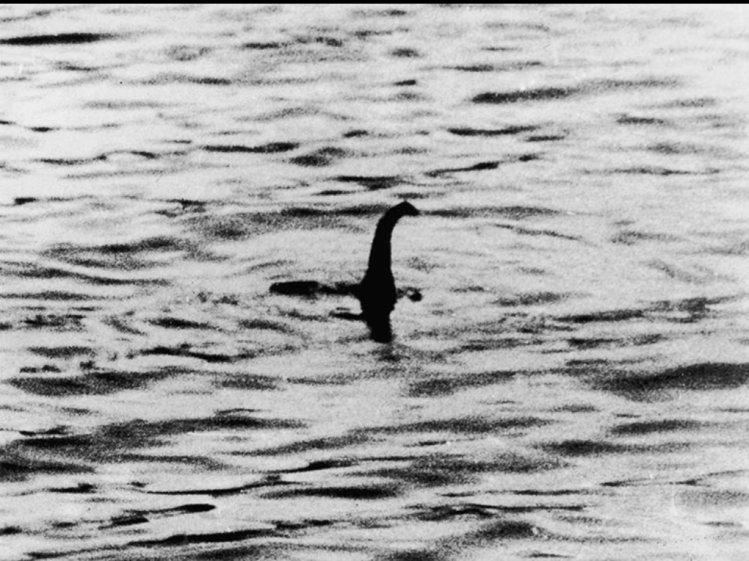
| The Photograph That Created Nessie The 1934 Surgeon’s Photograph became perhaps the most influential monster photograph ever taken. Its elegant curved neck rising from the water helped establish the plesiosaur-like Nessie that still appears in popular culture today. Its importance now lies less in what it proves about an animal than in what it demonstrates about imagery. Once millions of people had seen that silhouette, the world possessed a template for what Nessie was supposed to look like. Subsequent witnesses were no longer observing Loch Ness without expectations. The photograph may therefore have done far more than document a monster. It helped create one. |
| Searching a Loch with DNA Environmental DNA has fundamentally changed how we investigate places such as Loch Ness. Animals constantly shed tiny biological traces into their surroundings, allowing scientists to detect organisms without catching or even seeing them. The 2018 Loch Ness project collected 250 water samples from around and through the loch’s depths and compared recovered DNA with genetic databases. (University of Otago) No evidence emerged for a plesiosaur or several of the other large exotic animals proposed as Nessie candidates. Eel DNA, however, was widespread. The technique could not establish the size of those eels, so the wonderfully tempting headline “Nessie is a giant eel” goes far beyond the evidence. (University of Otago) What the experiment demonstrated was arguably more interesting. We can now search for an animal without waiting for it to surface. |
| Further Exploration Readers wanting to explore the scientific investigation can start with the University of Otago’s account of the Loch Ness environmental-DNA study, which explains both the 250-sample survey and what its results can—and cannot—tell us about the animals in the loch. (University of Otago) For the longer history of organised investigations, the Loch Ness Project archive and timeline records the Dinsdale film, university expeditions, sonar work and decades of attempts to turn the world’s most famous lake monster into something scientifically testable. |


Another fascinating read, Rory! ❤️ I love how you explore these mysteries without insisting that we must believe or dismiss them outright. I’m not sure whether Nessie exists, but I rather like the idea of leaving a little mystery in the world. 😊 And I must admit, I don’t even like calling it a monster! 😂 The same goes for Godzilla and King Kong. 🤣
Some photographs may well have been created to attract tourists, while others might have explanations we haven’t considered. Who knows? That’s part of what makes it so fascinating! I’ve always loved a good mystery. 🤗
What I do know is that if there were an undiscovered creature living in Loch Ness, I would hate to see it hunted down or harmed simply because humans wanted answers. Curiosity is wonderful, but so is allowing other creatures to live in peace.
Perhaps some mysteries don’t need to be solved after all. Sometimes it’s lovely just to wonder, imagine and keep an open mind.
Thank you for another wonderful read, ❤️🌊
LikeLiked by 1 person
You are very welcome Sonel, thank you fort commenting. I agree with you, do we always need to know the answers to everything? For me no, but for the world apparently we are in the minority.
LikeLiked by 1 person