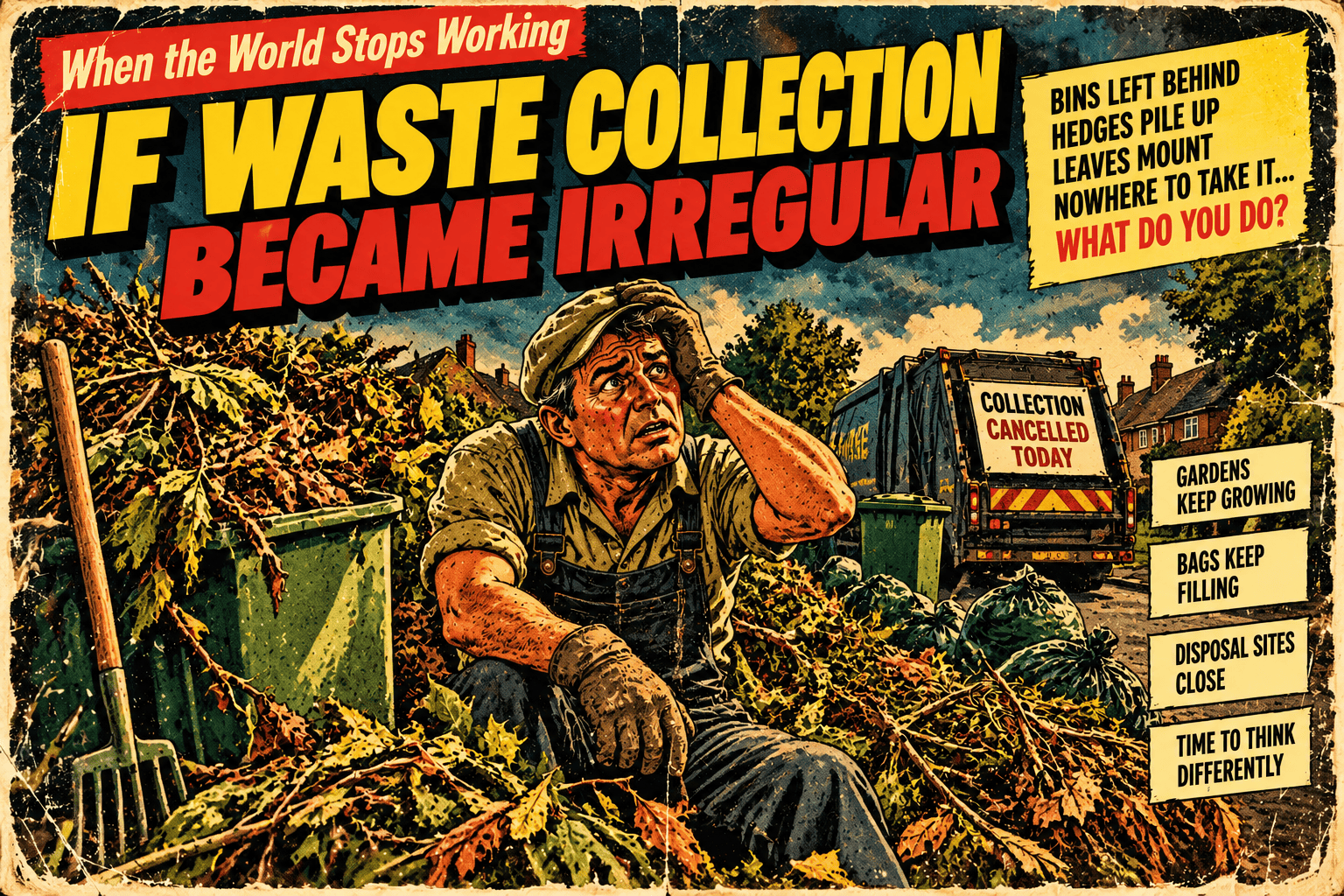
| One peculiar thing about professional gardening is how much time you spend dealing with things you deliberately cut off. We arrive at a garden intending to make it look better, spend several hours pruning, mowing, weeding, and clearing, and by the end of the visit there may be an impressive quantity of material that wasn’t lying around when we arrived. The garden looks considerably tidier, but only because its untidiness is now sitting in bags, barrows or piles waiting to go somewhere else. Most of the time we don’t think too deeply about that final part. Garden waste disappears because a system is designed to make it disappear. Householders have green bins or garden-waste collections, professional gardeners use licensed disposal routes, councils and contractors process enormous quantities of organic material, and somewhere beyond the garden gate our cuttings become somebody else’s responsibility. From the client’s point of view, the important thing is that when we leave, the hedge is trimmed, the lawn is cut, and the mountain of vegetation created in the process is gone. But what if that last part became unreliable? Not completely unavailable. Once again, complete collapse would almost make the problem simpler because everyone would immediately know they needed an alternative. Imagine instead that green-waste collections became irregular. One week they arrive, the next they don’t. Disposal sites reduce their opening hours. Commercial collections become increasingly expensive or occasionally fail to appear. A vehicle breakdown, staffing shortage, fuel disruption or backlog somewhere in the system means material that normally leaves a garden on Tuesday may still be sitting there the following Monday. Initially, it would be irritating rather than disastrous. A green bin remains full for another fortnight, so perhaps the next lawn cut goes into a temporary bag. Hedge trimmings are stacked behind the shed until there is space. A gardener keeps a few additional bags in the van. Everybody assumes the disruption will be sorted out shortly because that is what we tend to assume when familiar services become unreliable: the normal system is still the real one, and the inconvenience is just something happening around it. After a few missed collections, however, the mathematics begins to change. Gardens don’t stop producing material simply because nobody is collecting it. Grass keeps growing, hedges keep extending, weeds keep appearing, and trees keep shedding leaves. In autumn, in particular, a modest garden can generate astonishing quantities of vegetation in a relatively short period. If you don’t remove that material at roughly the same rate it’s produced, every available temporary storage space fills surprisingly quickly. Professional gardeners would feel the pressure almost immediately. Green waste isn’t simply an environmental question for us; it is a practical one involving time, space, vehicles, and cost. A day’s gardening can produce bags of grass, hedge trimmings, weeds and woody material, and the next day’s work produces more. A van that spends its working life gradually filling with vegetation eventually stops being useful. You cannot carry tools, machines and people efficiently when half the load space has become a travelling compost heap. There are also limits to how much you can leave at clients’ properties. Some gardens have plenty of space and might barely notice a temporary pile of prunings behind a shed. Others are small urban gardens where every square metre already has a purpose. Telling somebody with a compact courtyard that the six bags of hedge trimmings will need to remain beside the back door until collection services improve isn’t going to make you especially popular, however unavoidable the situation might be. At first, I suspect we’d all try to preserve the existing system. More bags would be bought. Temporary storage would be found. People would make extra trips whenever disposal facilities were available. Businesses would pay higher collection charges because maintaining the normal service to clients seemed important. Yet if irregularity continued for months rather than weeks, the sensible response would eventually change. Instead of asking how to store more waste until somebody took it away, we’d begin asking why we were creating so much material that needed to leave in the first place. That question could change gardening considerably. Take a hedge. The conventional approach is straightforward: cut it, collect everything that falls, put the trimmings into bags and remove them. The client sees a neat hedge and a clean garden. But suitable hedge trimmings are organic material, and depending upon what they consist of and what facilities are available, some can be shredded, composted or used in other ways. Suddenly, a garden with enough room for a shredder and composting area has an advantage over one that depends entirely on removal. Grass presents a similar question. Many gardeners automatically collect clippings because that produces the finish clients expect, but mulching mowers show that grass doesn’t always need to leave the lawn. Under suitable conditions, finely chopped clippings can return to the turf rather than being collected. It isn’t appropriate in every situation, particularly when grass is long or wet. Still, widespread collection problems would certainly make gardeners reconsider when collecting was actually necessary and when it was simply habitual. Autumn leaves would probably undergo the greatest transformation. We currently spend enormous amounts of time collecting them, partly because leaves on lawns, paths and surfaces genuinely can cause problems and partly because gardens are expected to look tidy. Yet leaves are also the raw material for leaf mould, one of the most useful and straightforward soil-improving materials a garden can produce. If collections became unreliable, leaf cages might begin appearing everywhere. What had previously been twenty bags waiting beside the gate could become next year’s soil conditioner sitting quietly in a corner. Weeds would be more complicated. Some can be composted perfectly well, while others require more thought, particularly if they carry mature seed, spread through persistent roots or rhizomes, or need specific handling. Diseased material could also present problems. An irregular waste system wouldn’t magically make everything safe to compost at home, so gardeners would need to sort material better rather than treat all green waste as one convenient category. Woody waste would create another industry on its own. Branches and substantial prunings take up enormous amounts of space largely because of their awkward shapes. Put the same material through a suitable chipper, and its volume falls dramatically. At the same time, the resulting woodchip becomes useful for paths, mulching, composting systems, or habitat, depending on the material and circumstances. Larger gardens might begin regarding shredders and chippers as ordinary equipment rather than specialist machinery. At the same time, professional gardening businesses would have a strong incentive to process more material close to where it was produced. The visual character of gardens might begin changing too. For decades we have become accustomed to the idea that good maintenance means removing evidence of natural processes. Leaves fall, so we remove them. Plants die back, so we cut them down. Branches fall, so they disappear. Grass grows, so we remove its clippings. The garden continually produces organic matter, and we continually export it in pursuit of tidiness, then buy compost, mulch, and soil improvers to bring organic matter back again. There is something wonderfully inefficient about that when you stop and look at it. Irregular waste collection would force us to look. Clients might initially resist because piles of leaves, compost bays and woodchip aren’t what everybody imagines when they think of a beautifully maintained garden. The trick is integrating those processes properly rather than simply letting waste accumulate. A composting area can be organised. Leaf cages can be screened. Woodchip can be used deliberately rather than dumped. Deadwood can become habitat in an appropriate part of a garden without making the whole place look abandoned. The distinction between waste and resource would become increasingly important. A pile of hedge trimmings blocking a path is waste. The same material shredded and entering a managed composting system is a resource. Twenty sacks of autumn leaves waiting indefinitely for collection are a problem; the same leaves contained and becoming leaf mould are future soil improvement. The physical material hasn’t changed. What changes is whether we have somewhere useful to send it. That brings us back, once again, to the interconnected nature of this series. We have already imagined compost becoming more valuable than fertiliser and soil becoming increasingly difficult to manage. Now the material that can contribute organic matter to that soil is becoming harder to remove. The obvious answer is emerging almost by itself: perhaps more of the garden’s biological material should remain within the garden’s biological system. That doesn’t mean everything stays. Gardens aren’t closed ecosystems, and professional gardening inevitably produces material that cannot sensibly remain on site. Large tree work, invasive plants, diseased material and sheer excess volume would still require proper disposal routes. Small gardens don’t have room to process everything they generate, while some clients understandably don’t want composting facilities dominating their limited outdoor space. A functioning collection and recycling infrastructure would therefore remain important. But perhaps we’d stop using it quite so casually. Another consequence people might not expect is that gardens might be maintained differently, to reduce how much material they produce. Hedges might be allowed to grow slightly more naturally rather than being clipped repeatedly into rigid shapes. Shrubs could be selected for their eventual size instead of planting vigorous species and then spending twenty years preventing them from becoming the size they were always meant to be. Lawns might be cut differently, and some areas could be managed less intensively. Plant selection would become partly a waste-management decision. A fast-growing hedge is wonderfully useful when you want screening quickly, but less wonderful when every cut produces six bags of material you have nowhere to put. A huge ornamental grass may look magnificent, but somebody eventually has to deal with the enormous bundle of dry stems it produces. A vigorous climber covering a fence quickly sounds attractive until you realise that maintaining it creates a small mountain several times a year. Gardeners would begin thinking not only about how a plant grows, but what happens to all that growth afterwards. That is already something we perhaps don’t consider enough. When people design gardens, they naturally think about what plants will look like when mature. They pay less attention to the annual stream of material they produce while maintaining them. Yet every clipped hedge, mown lawn, pollarded tree and cut-back perennial is effectively a small organic-material factory. Multiply that by millions of gardens and the scale becomes enormous. Local solutions might therefore become increasingly important. Communities could develop shared composting or shredding facilities. Allotments might process material collectively. Councils could encourage neighbourhood green-waste hubs rather than relying entirely upon household collections. Professional gardeners might operate their own managed composting sites, turning material collected from clients into useful products rather than paying simply to dispose of it. And yes, that particular possibility sounds suspiciously familiar to me. The broader point is that once disposal becomes unreliable, local processing becomes resilience. The shorter the distance between where organic material is produced and where it becomes useful again, the less dependent the system is upon vehicles, collection schedules, fuel, staffing and distant processing facilities. It doesn’t eliminate those systems, but it reduces how much we need them. There would inevitably be less attractive consequences. Fly-tipping could increase if people found legitimate disposal difficult or expensive. Unsuitable material might be dumped in the countryside, along woodland edges, or in other people’s skips. Poorly managed piles of waste could create smells, attract pests or cause neighbour disputes. Some people would burn material that would be better handled another way, creating smoke and nuisance. An unreliable collection system wouldn’t automatically produce environmentally enlightened behaviour; sometimes it would simply produce frustration. That is why the transition would matter. If people were told that collections were becoming less frequent without realistic alternatives, waste would accumulate. If, however, gardens were gradually designed to retain and process more of their own material, the disruption could produce something unexpectedly useful: a horticultural culture less dependent upon throwing biological resources away. Unlike some scenarios in When the World Stops Working, this one requires very little imagination. Waste services already experience disruptions. Costs change, regulations change, and commercial disposal is already a significant consideration for gardening businesses. Green waste is bulky, seasonal and relentless. Every gardener knows the feeling of looking at a day’s work and wondering how something that looked perfectly manageable while attached to plants has somehow become an enormous pile once cut down. Perhaps the strange part isn’t imagining a future where we keep more of it. Perhaps the strange part is how accustomed we’ve become to moving it around. If collections became unreliable for long enough, the perfectly maintained garden of the future might contain something previous generations tried to hide: a visible working system for dealing with its own organic material. Compost bays, leaf cages, woodchip stores and habitat piles wouldn’t represent untidiness. They would show that the garden could process at least some of what it produced. John and I would still finish a day’s work with bags beside the van. Something would always need taking away. But perhaps there would be fewer bags than before because the grass had been mulched, the leaves had gone into a cage, and suitable prunings had been shredded for the client. John would look at the remaining pile. “That’s it?” “That’s it.” He’d look back at the garden, then at the unusually empty van. “This could catch on.” And for once, I’d be perfectly happy if it did. |
| About our writing & imagery Most articles are grounded in our real gardening experience, observations and reflections. AI may assist with research, drafting and editing, but the experiences, opinions and editorial direction are our own. Featured images may include our photography, original AI-generated visuals or, where stated, images credited to others. Earthly Comforts reviews and shapes all published content before publication. |

