| Episode 4 The Beautiful Bullies |
| Every experienced gardener eventually comes to know a particular sort of plant rather well. It arrives with the best of intentions, usually looking attractive, healthy and thoroughly deserving of its place in the border. It may have been recommended for its ability to suppress weeds, soften awkward edges or cover an area where little else seems willing to grow. For the first year or two, everything goes according to plan. The plant settles in, produces attractive foliage or flowers, and begins to spread exactly as we had hoped. We congratulate ourselves on making a sensible choice. Then, somewhere along the way, the relationship changes. What was once a useful addition becomes increasingly difficult to ignore. Stems begin appearing amongst neighbouring perennials, roots extend beyond their allotted space, and plants that previously grew quite happily start to disappear beneath an advancing carpet of foliage. Before long, the gardener is no longer encouraging the ground cover to establish but trying to persuade it to stop. The very qualities that made the plant attractive in the first place have become the source of the problem. I have often thought that gardening involves a surprising amount of negotiation. We decide where plants ought to grow, how large they should become and which neighbours they should live alongside. The plants, meanwhile, follow their own biological priorities, which rarely include respecting the boundaries of a carefully planned border. Some are naturally restrained, others spread steadily without becoming troublesome, and a few seem determined to occupy every available inch of ground. This last group deserves our attention, although the line between a useful ground-cover plant and a beautiful bully is not always as clear as we might imagine. When success becomes the problem Ground-cover plants are generally selected because they spread. We want them to occupy bare soil, create continuity beneath larger planting and compete with unwanted vegetation. If they remained permanently within the dimensions of their original nursery pots, they would be rather disappointing. Their ability to expand is therefore not a defect but an essential part of their usefulness. The difficulty begins when their rate or method of expansion becomes incompatible with the planting around them. Some species spread through creeping stems that root wherever they touch suitable soil. Others produce underground rhizomes or runners, allowing new shoots to emerge some distance from the original plant. A few rely heavily on seed production, appearing in unexpected places long after the parent plants have finished flowering. These different spreading methods create very different maintenance problems, and understanding them is far more useful than simply describing a plant as vigorous. A plant that spreads through visible surface stems may be relatively easy to control if you can lift and remove those stems before they establish. A plant with persistent underground rhizomes can be considerably more troublesome, particularly when those roots become entangled with desirable perennials. Seed-producing plants present another challenge altogether, because the gardener may be dealing with numerous new individuals rather than the expansion of one established clump. Growing conditions also matter. A plant that behaves perfectly well in dry, impoverished soil may become remarkably enthusiastic when introduced to a fertile, moisture-retentive border. Equally, something regarded as aggressive in a mild, sheltered garden may spread much more slowly in an exposed position with difficult soil. Plant behaviour is influenced by its surroundings, and recommendations that ignore those differences can be misleading. The innocent-looking periwinkle Periwinkle is a good place to begin because it demonstrates how an attractive and genuinely useful ground-cover plant can become troublesome when given the wrong assignment. Both Vinca minor and Vinca major have qualities that make them appealing. Their evergreen foliage provides year-round cover, their flowers bring welcome colour, and they tolerate conditions in which more demanding plants might struggle. In the right setting, particularly beneath established shrubs or across a substantial area of difficult ground, they can be extremely effective. The problem is that periwinkle does not necessarily recognise where the ground-cover area is supposed to end. Its trailing stems can extend across the soil and root at intervals, gradually creating a network that becomes increasingly difficult to disentangle from neighbouring plants. Vinca major is generally the more vigorous of the two, although Vinca minor can also spread considerably once established. In a mixed border containing smaller herbaceous perennials, this behaviour can become frustrating, especially when the periwinkle begins growing through the crowns of plants we would rather preserve. What makes the situation particularly awkward is that the plant may still look perfectly attractive. There is no obvious moment when it suddenly becomes a weed. It continues producing glossy leaves and flowers while quietly expanding beyond its intended territory. The gardener may tolerate this for several seasons, perhaps trimming the most obvious wandering stems, until reclaiming the border becomes much larger than expected. I would not suggest avoiding periwinkle altogether. That would ignore its genuine usefulness in suitable situations. But I would be cautious about introducing it into a small, intricately planted border where its neighbours are unlikely to compete successfully. The question is not whether periwinkle is a good plant, but whether it is a good plant for that particular place. The deceptive charm of creeping Jenny Another plant that illustrates the problem rather beautifully is Lysimachia nummularia, commonly known as creeping Jenny. With its rounded leaves and low, trailing stems, it has an appealing softness that makes it popular around pond margins, along border edges and amongst paving. The golden-leaved cultivar, ‘Aurea’, is particularly attractive, introducing bright foliage into places where darker greens might otherwise dominate. At first glance, creeping Jenny seems almost too delicate to cause trouble. It hugs the ground, produces cheerful yellow flowers and lacks the imposing appearance we might associate with an aggressive plant. Yet its stems can root as they spread, allowing it to occupy considerable areas when moisture and growing conditions are favourable. In a damp border, it may gradually weave itself through neighbouring plants, creating a mat that is much more extensive than the original planting suggested. Its shallow-rooted habit makes unwanted growth relatively straightforward to lift, especially compared with plants with deep or persistent underground rhizomes. Nevertheless, the amount of growth can be considerable, and fragments left behind may establish again. Where creeping Jenny is allowed to grow amongst delicate plants, repeated removal may become part of the regular maintenance routine. There is an interesting contradiction here. The very softness that makes creeping Jenny attractive can encourage us to underestimate its competitive ability. It does not need to become tall or woody to dominate a small space. Sometimes simply occupying the soil surface densely enough is sufficient to prevent less vigorous neighbours from flourishing. When a carpet becomes a blanket One of the most familiar ground-cover plants in British gardens is Ajuga reptans, or bugle. Its low rosettes of foliage, often bronze, purple or variegated in cultivated forms, are attractive throughout much of the year. At the same time, its upright spikes of blue flowers can be particularly appealing in spring. It is also valuable to pollinating insects, making it a tempting choice for gardeners wanting attractive, wildlife-friendly planting. Ajuga spreads through runners, gradually forming colonies that can be extremely useful beneath taller perennials or along the front of a border. In suitable conditions, it can create a handsome carpet of foliage without much maintenance. Yet where moisture, soil and space favour rapid expansion, it may move further than anticipated, occupying gaps intended for other plants or spreading into lawns and neighbouring beds. I think Ajuga illustrates an important point about ground cover: a plant does not have to be especially tall, deeply rooted or difficult to remove to become dominant. A dense carpet can alter the opportunities available to other plants simply by occupying the light and space at ground level. Seedlings may struggle to establish, smaller perennials can become surrounded, and the border’s visual character gradually changes as one species becomes increasingly prominent. This does not necessarily make the planting unsuccessful. In some situations, a broad drift of Ajuga is exactly what we want. But if the original intention was to create a varied mixture of smaller plants, you need to consider its spreading habit and manage it occasionally. The plants that travel underground Surface-spreading plants are relatively easy to observe. We can usually see where they are going and intervene before they move too far. Plants that spread beneath the soil can be more deceptive because their expansion may remain unnoticed until new shoots emerge amongst established planting. Geranium macrorrhizum, the bigroot cranesbill, is an interesting example. It is one of the most useful hardy geraniums for ground cover, particularly in difficult positions beneath shrubs and trees. Its aromatic foliage, attractive flowers and tolerance of relatively dry conditions make it a dependable choice in many gardens. It spreads through thick, shallow rhizomes, gradually creating substantial colonies that can suppress competing vegetation and provide an attractive lower layer. In the right place, this plant is excellent. Indeed, its ability to occupy ground that would otherwise require regular weeding is one of its greatest strengths. But it can also become dominant amongst smaller, less competitive plants, and established colonies may need lifting or reducing to maintain the balance of a mixed border. Fortunately, its relatively shallow rhizomes often make this manageable, especially compared with deeper-rooted or more persistent species. At the other end of the scale are plants whose underground growth makes them far less suitable for confined borders. Some forms of bamboo, for example, produce running rhizomes that can travel considerable distances before new shoots emerge. Although bamboo is not generally thought of as conventional ground cover, it demonstrates how dramatically a plant’s method of expansion can affect the garden around it. A running bamboo planted without sufficient thought can become a problem extending well beyond the original planting area. The lesson is that what happens beneath the soil can be just as important as what we see above it. A plant’s eventual height, flower colour and foliage may tell us very little about the work involved in keeping it within reasonable limits. The enthusiastic self-seeders Not every beautiful bully spreads by creeping across the ground. Some establish themselves through prolific self-seeding, gradually appearing throughout a border until their numbers begin to change its character. Alchemilla mollis, lady’s mantle, is a particularly familiar example. Its softly scalloped leaves catch droplets of water beautifully, and its clouds of yellow-green flowers combine with an extraordinary range of other plants. It is one of those perennials that can make a border feel generous and natural, softening hard edges and linking together plants of different heights and colours. Yet lady’s mantle can also produce large numbers of seedlings, particularly where bare soil is available. Left to its own devices, it may gradually occupy spaces intended for other plants, appearing in gravel, along paths and amongst established perennials. Fortunately, unwanted seedlings are generally easy to remove while young, and cutting back flowering stems before seed develops can help limit its spread. The problem is therefore usually one of regular attention rather than an impossible battle. This is a different kind of vigour from that displayed by Vinca or creeping Jenny. The individual plants may remain relatively manageable, but their offspring appear in increasing numbers. It is also a useful reminder that leaving bare soil available can encourage the very self-seeding behaviour we later find troublesome. Personally, I think a certain amount of self-seeding can be one of gardening’s great pleasures. Plants sometimes choose positions we would never have considered, creating combinations that look remarkably natural. But there is a difference between giving a garden some freedom and letting one species make all the decisions. Why the setting matters more than the reputation At this point, it’s easy to divide ground-cover plants into two categories: the well-behaved and the troublesome. Unfortunately, gardening rarely offers such convenient distinctions. A plant that becomes a nuisance in one garden may be precisely what another gardener needs. Consider a large, established shrub border with difficult access, dry soil and extensive root competition. A vigorous ground-cover plant that can establish there and spread steadily may be invaluable. The alternative could involve repeated weeding, exposed soil and a substantial amount of labour for very little visual improvement. In that situation, a plant’s determination to spread is not necessarily a disadvantage. Move the same plant into a small ornamental border containing delicate bulbs, slow-growing perennials and carefully arranged specimens, and its behaviour may become entirely inappropriate. The plant has not changed, but the expectations placed upon it have. We are asking something naturally expansive to behave as though it were restrained. Scale is particularly important. A plant spreading a metre beyond its original position may be almost irrelevant in a large woodland garden but disastrous in a narrow border only half a metre wide. The amount of time available for maintenance also matters. A gardener who enjoys regular dividing, thinning and rearranging may happily accommodate plants that would be entirely unsuitable for someone wanting a relatively settled, low-maintenance garden. There is also a distinction between vigorous garden plants and species that present wider environmental problems. Some invasive non-native plants can escape cultivation and damage natural habitats, and their management may involve legal responsibilities. Do not confuse these with ordinary enthusiastic ground-cover plants that require occasional control. Before introducing an unfamiliar species, particularly one known for spreading aggressively, consider both its behaviour in gardens and its potential impact beyond them. The art of keeping the balance The most effective way to manage vigorous ground cover is usually to understand its behaviour before planting rather than attempting to correct a problem years later. This begins with realistic spacing, suitable positioning and an appreciation of how much ground a plant may eventually occupy. Nursery labels can provide useful guidance, but the dimensions printed on them are not always a reliable indication of what a spreading plant might achieve over many seasons. In established gardens, regular observation matters as much. It is much easier to remove a few wandering stems, unwanted runners or young seedlings than to reclaim an entire border after several years of unchecked expansion. Some plants benefit from periodic division, while others can be kept within reasonable bounds by lifting the outer edges of an established colony. Where a plant spreads through persistent underground rhizomes, however, control may require more careful and sustained work. I would also be cautious about relying on physical edging as a universal solution. It can help with some shallow-rooted plants, but others will grow over it, beneath it or around its ends. The effectiveness of any barrier depends on the species and the way it spreads. No amount of clever edging can replace an understanding of the plant itself. Sometimes the most sensible decision is to remove a ground-cover plant altogether. That can feel disappointing, particularly when the plant is healthy and attractive, but gardening is not simply about keeping everything alive. It is about creating a planting in which different species can flourish together. If one plant continually overwhelms its neighbours, removing it may be the best way to restore the balance. A little wildness is not necessarily a bad thing. There is a danger, of course, that in trying to control every enthusiastic plant we remove some of the spontaneity that makes gardens interesting. A perfectly disciplined border, in which every plant remains exactly where it was placed, may look impressive for a time, but it can also feel rather static. Plants spread, mingle, self-seed and occasionally surprise us. Those processes are part of what makes a garden a living environment rather than a permanent arrangement of ornamental objects. Some of the most attractive borders I encounter contain plants that have clearly been allowed a degree of freedom. Hardy geraniums wander beneath shrubs, lady’s mantle appears in unexpected gaps, and small colonies of ground cover gradually soften the boundaries between individual plants. The result can look wonderfully settled, as though the planting has developed its own understanding of the space. The skill lies in knowing when to intervene. Not every unexpected seedling needs removing, and not every spreading stem represents the beginning of a problem. Equally, ignoring the early signs of a particularly vigorous plant can create considerable work later. Good gardening involves recognising the difference between a plant contributing to the border and one beginning to take possession of it. Perhaps that is why I find the expression beautiful bullies rather appropriate. These plants are not villains, and many possess qualities that make them genuinely valuable. They are enthusiastic occupants of the spaces we provide, sometimes with rather less consideration for their neighbours than we might prefer. Giving plants the right amount of freedom As we have explored throughout this series, ground cover is about far more than concealing bare soil. It can protect the soil surface, create continuity between larger plants, contribute to wildlife habitat and reduce some of the work involved in maintaining a border. But those benefits depend on choosing plants whose behaviour suits their surroundings. A successful ground-cover plant should not necessarily be the fastest-growing, the densest or the most determined to spread. It should do the job required without creating a greater problem elsewhere. Sometimes that will mean choosing a restrained species that gradually forms a modest colony. In other situations, particularly across large or difficult areas, a vigorous plant may be exactly the right answer. The important thing is to make that decision deliberately rather than discovering the consequences several years later. I suspect most gardeners can recall at least one plant they once encouraged enthusiastically and now spend a surprising amount of time trying to contain. Perhaps it was a periwinkle, a particularly determined hardy geranium, an overgenerous lady’s mantle or something altogether different. Whatever the plant, the experience teaches us that success in gardening is not always measured by how quickly something grows. Sometimes the real achievement is finding a plant that knows, with a little help from the gardener, when enough is enough. And that brings us neatly to the next question in this series. If ground-cover plants can occupy the soil so effectively, can they genuinely reduce the need for weeding, or are we simply exchanging one form of maintenance for another? That is where we shall turn in Episode 5: Living Mulch — Can Plants Really Replace Weeding? |
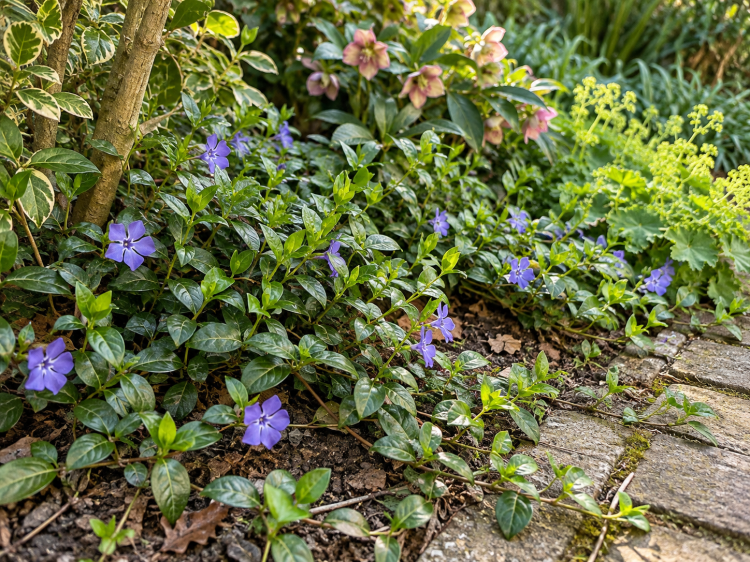
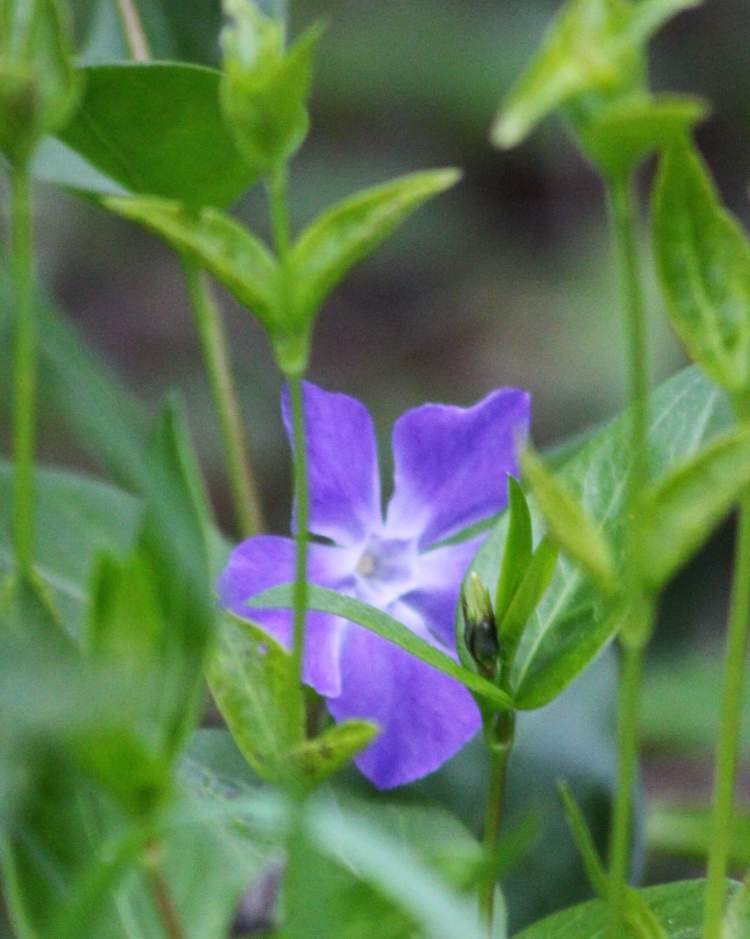
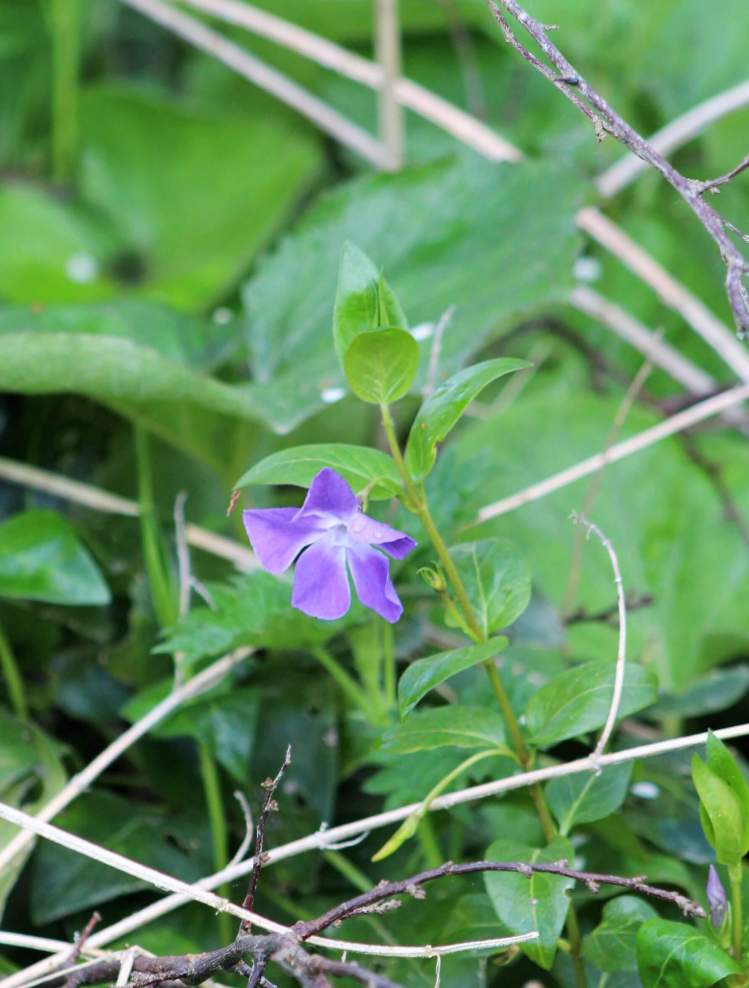
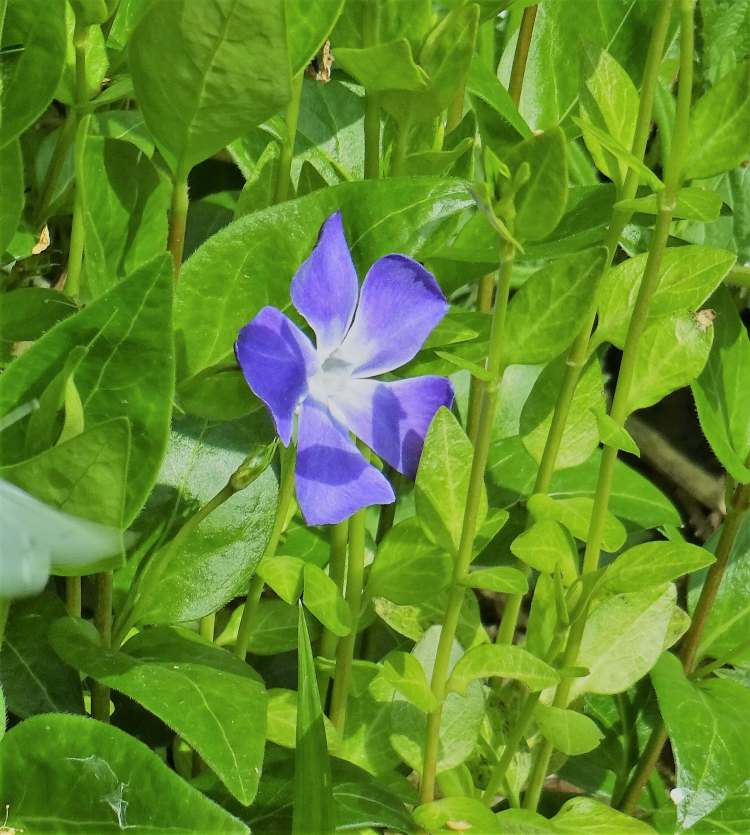
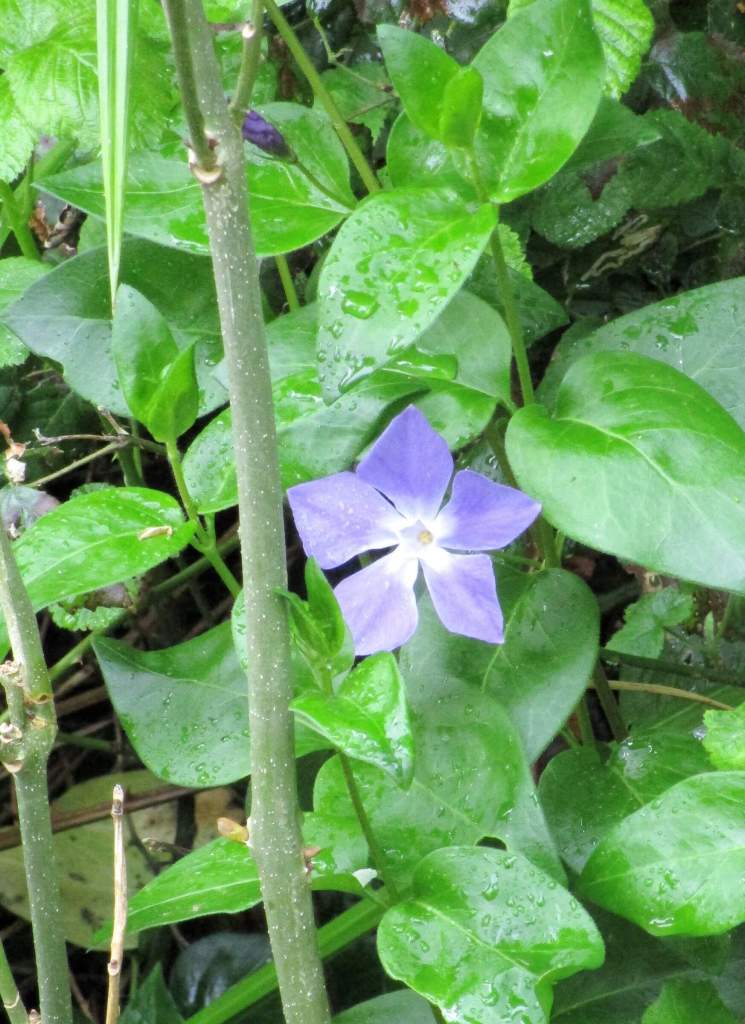
| Periwinkle (Vinca) spreads through a mixed border, its attractive purple flowers disguising a determined growth habit. Left unchecked, its creeping stems can gradually occupy space intended for neighbouring plants. |
| Most articles are grounded in our real gardening experience, observations and reflections. AI may assist with research, drafting and editing, but the experiences, opinions and editorial direction are our own. Featured images may include our photography, original AI-generated visuals or, where stated, images credited to others. Earthly Comforts reviews and shapes all published content before publication. |

