| A 5-Part Series |
| A curated exploration of South America’s most iconic, curious, and ecologically important insects |
| Part Two — Butterflies & Moths: Colour as Communication |
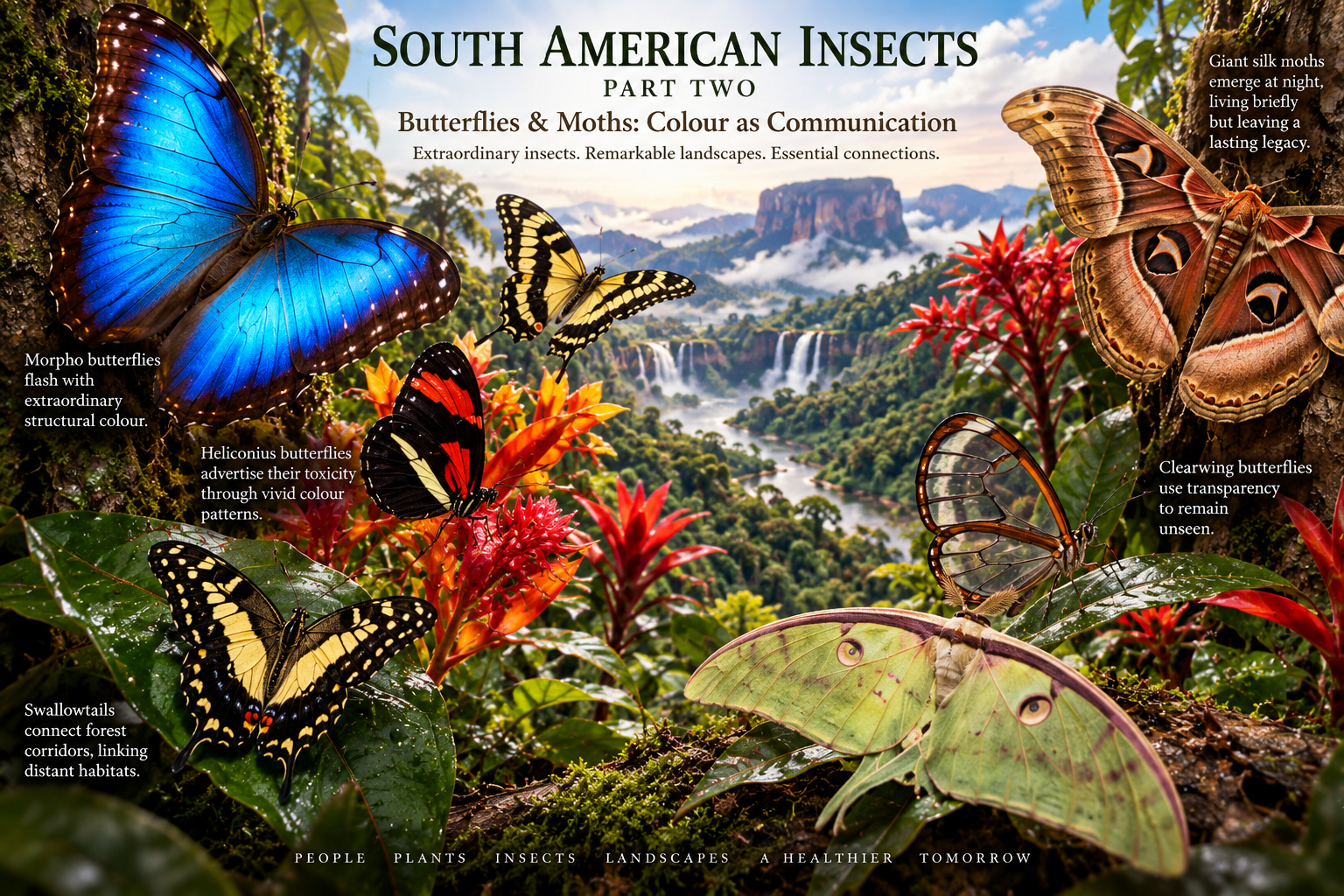
| Few places on Earth offer such extraordinary displays of insect colour as South America. Within its tropical forests, butterflies move through shafts of sunlight like fragments of living stained glass. At the same time, moths remain concealed against bark and foliage until darkness allows them to emerge. It would be easy to regard this variety as nature indulging in decoration, but colour in the insect world is rarely without purpose. It can advertise danger, attract a mate, confuse a predator or make an otherwise conspicuous creature almost impossible to recognise. The tropical rainforest provides a particularly interesting setting for these relationships. Light is constantly changing as it passes through layers of vegetation, producing bright openings surrounded by deep shade. An insect may be clearly visible for a moment before disappearing into the background, while the same markings that attract attention in one setting become effective camouflage in another. Butterflies and moths have evolved an extraordinary range of responses to these conditions, and their appearance often tells us something about the pressures under which they live. For a gardener accustomed to watching butterflies moving through summer borders, the underlying principles are familiar. We notice their colours first, perhaps admiring the markings of a peacock butterfly or the delicate patterning of a common blue. Yet what appears beautiful to us may serve an entirely different purpose to another animal. South America’s butterflies and moths take these visual relationships to remarkable extremes. Morpho butterflies and the science of blue Among South America’s most recognisable insects are the brilliant blue morpho butterflies. Their wings can flash intense metallic colour as they move through forest openings, creating an effect that seems almost too vivid to belong to a living creature. Remarkably, much of this blue comes not from ordinary blue pigment, but from microscopic structures within the wing scales that interact with light. These structures reflect particular wavelengths, creating what is known as structural colour. As the butterfly changes position, its wings change too, sometimes shifting from brilliant blue to much darker tones. The effect is particularly striking in flight, when repeated wingbeats create alternating flashes that may make the butterfly more difficult for a pursuing predator to track. Yet a morpho is not blue in every direction. The undersides of the wings are often brown, patterned with markings and eye-like spots that give the butterfly a very different appearance when it settles. With its wings closed, an insect that seemed impossible to overlook a moment earlier can become surprisingly difficult to distinguish from the surrounding vegetation. This contrast between visibility and concealment is one of the most interesting features of butterfly colouration. We tend to assume that bright colours must make an animal more vulnerable, but visibility can sometimes contribute to survival. A sudden flash may confuse a predator, while an abrupt change in appearance can make it difficult to maintain visual contact with moving prey. The lesson is that camouflage is not always about being dull. Sometimes it depends upon controlling when and how colour becomes visible. Heliconius butterflies and the value of a warning Heliconius butterflies use colour differently. Many display bold combinations of red, yellow, orange and black, often arranged in striking bands or patches across their wings. Rather than trying to disappear, these butterflies advertise themselves, and for good reason. Many Heliconius species possess chemical defences that make them distasteful to predators. Their conspicuous patterns can act as warning signals, allowing birds and other hunters to learn that particular appearances are associated with an unpleasant meal. Once predators make that association, they may avoid similarly marked butterflies in the future. The relationship becomes more remarkable through mimicry. Different defended species sometimes evolve closely resembling wing patterns, reinforcing the warning signal predators recognise. This form of shared resemblance is known as Müllerian mimicry, and South American Heliconius butterflies provide some of its most celebrated examples. Their biology is unusual in another respect. While most adult butterflies get most of their nutrition from nectar and other liquids, several Heliconius species also collect and digest pollen. This additional nutrient source helps support their comparatively long adult lives, with some surviving for months rather than the shorter periods common among many butterflies. Longevity changes behaviour. A butterfly that survives longer can become familiar with feeding areas and repeatedly visit particular flowers. Some Heliconius follow regular routes through the forest, returning to known resources rather than wandering entirely at random. There is something rather appealing about a butterfly with a familiar daily circuit. Gardeners know that certain flowers become reliable destinations for visiting insects, but in these tropical species the relationship between memory, feeding and movement can become especially sophisticated. Swallowtails and the importance of movement Swallowtail butterflies bring another dimension to South America’s insect diversity. Many are strong fliers, able to move through forest edges, clearings, river corridors, and more open landscapes. Their often substantial wings and distinctive markings make them conspicuous, although the family includes considerable variation in size, colour and behaviour. Some South American swallowtails possess elongated hindwing tails, while others have evolved striking warning patterns or mimic chemically defended butterflies. Their larvae are equally interesting, often relying upon particular groups of host plants for development. An adult may travel across a broad area in search of nectar, but successful reproduction ultimately depends upon finding vegetation suitable for its caterpillars. This distinction matters enormously. A landscape can provide plenty of flowers for adult butterflies while offering little opportunity for their young to develop. Nectar alone does not guarantee that a butterfly population can sustain itself. It is a principle worth remembering in our own gardens. We are often encouraged to plant flowers for butterflies, which is sensible, but their complete life cycles require more than attractive blooms. Caterpillar food plants, shelter, suitable overwintering conditions and a degree of tolerance towards feeding damage all contribute to successful reproduction. South America’s swallowtails demonstrate the same relationship on a much larger scale. Where forests become fragmented, adults may still travel between habitat patches. Still, the distribution of host plants and the conditions encountered along the way influence whether those journeys lead to another generation. Movement creates opportunities, but it cannot indefinitely compensate for the loss of suitable habitat. Clearwing butterflies and the advantage of transparency Not every butterfly benefits from brilliant colour. South America’s clearwing butterflies, particularly those within the tribe Ithomiini, have developed another remarkable strategy: partly transparent wings. Rather than reflecting or absorbing light as coloured wings do, transparent areas let much of it pass through. The result is an insect whose outline becomes less obvious against complicated vegetation. Viewed among leaves, branches and shifting patches of light, parts of the butterfly can appear to merge with the background. The effect is not quite the invisibility that popular descriptions sometimes suggest. Wing veins, borders and other markings remain visible, and many clearwing species also possess chemical defences. Their appearance reflects a combination of transparency, warning signals and mimicry rather than one simple strategy. Nevertheless, the principle is extraordinary. Where a morpho uses flashes of reflected light and Heliconius butterflies employ conspicuous warnings, clearwings reduce some of the visual information available to an observer. It is another reminder that evolution does not produce a single correct answer to the problem of survival. Different insects can occupy similar habitats while relying upon apparently contradictory solutions. One advertises its presence, another changes appearance between flight and rest, while a third becomes difficult to distinguish from the light passing through the forest. Each strategy has advantages, limitations and circumstances in which it works particularly well. Giant silk moths and the brief lives of adults South America’s giant silk moths introduce a different sense of scale. Members of the family Saturniidae include some of the continent’s largest and most spectacular moths, with broad wings carrying intricate patterns, translucent patches and markings that can resemble eyes. Unlike the familiar image of a moth repeatedly visiting flowers, many adult saturniids do not feed. Their mouthparts are reduced or nonfunctional, and they accumulate the energy needed for adult activity during the caterpillar stage. The adult’s principal task is reproduction, often within a comparatively short lifespan. This makes the earlier stages of development especially important. Caterpillars must obtain sufficient nourishment from their host plants to support metamorphosis and the adult activities that follow. By the time the moth emerges, the resources gathered during larval growth have largely determined its future. Some species have large eye-like markings that may startle or discourage predators, while others rely on camouflage, unusual wing shapes, or simply remaining inactive during daylight. The enormous variety of patterns within the group reflects the different pressures faced by insects that are often large, relatively short-lived and active mainly at night. It is tempting to regard such brief adult lives as wasteful, particularly when the moth itself is so spectacular. But longevity is not necessarily the measure of evolutionary success. If reproduction is achieved, a short adult existence may be entirely sufficient. The moth’s life is not confined to the few days during which we happen to admire its wings. Most of its development happens long before that moment. Colour, gardens and the limits of appearances The more closely we examine South America’s butterflies and moths, the less useful it becomes to divide their appearance into simple categories: beautiful, dull, conspicuous, or camouflaged. A brilliant blue butterfly may become almost invisible when resting. A boldly patterned species may be safer because predators recognise its warning colours. Transparent wings can provide concealment, while the enormous markings of a silk moth may discourage an attack. Colour is only one part of the relationship. Behaviour, flight, habitat, chemistry, and predators’ visual abilities all influence whether a particular pattern provides an advantage. A marking that works well in shaded forest may offer little protection in an exposed clearing, while changes in vegetation can alter the background an insect must survive against. This is where the subject becomes particularly relevant to gardening. We often judge wildlife by what attracts our attention, yet the less conspicuous relationships may be equally important. A caterpillar feeding on a host plant, a moth resting beneath a leaf or an adult butterfly repeatedly returning to a particular patch of flowers all represent stages of a larger ecological process. A garden designed solely around the appearance of adult butterflies may overlook much of what those insects actually need. Providing suitable host plants, maintaining flowering diversity and allowing some undisturbed vegetation can support the complete lifecycle rather than simply encouraging occasional visitors. It is also worth looking more carefully before deciding that an insect’s appearance tells us what it is doing. Brightness does not necessarily mean vulnerability, and concealment does not always require subdued colours. Nature has a considerably more inventive understanding of visibility than we do. Messages carried on wings South America’s butterflies and moths reveal a world in which appearance has become a sophisticated means of communication and survival. Morpho butterflies manipulate reflected light, Heliconius species reinforce warnings through colour and mimicry, swallowtails combine powerful flight with specialised relationships to plants, clearwings reduce their visibility through transparency, and giant silk moths carry the results of a lengthy larval development into a brief but remarkable adult existence. None of these adaptations operates independently of the landscape. Forest structure influences light, host plants determine breeding opportunities, predators shape defensive strategies, and seasonal conditions affect when insects emerge and how successfully they reproduce. For a gardener, the fascination lies partly in recognising familiar principles expressed in unfamiliar forms. The butterfly visiting a border at home and the morpho crossing a South American forest opening are responding to different environments. Still, both depend upon relationships between plants, weather, predators and the stages of their own development. We naturally admire butterflies and moths for their beauty. There is nothing wrong with that, and South America provides extraordinary opportunities for admiration. But the real interest begins when we look beyond the colours themselves and consider why those colours exist. A flash of blue, a warning band of red, a transparent wing or an enormous eye-like marking is not simply decoration. Each represents a specific response to the challenges of surviving long enough to reproduce. In South America’s forests, wings carry messages written through millions of years of adaptation. And much of what they communicate was never intended for human eyes. |
| About our writing & imagery Most articles reflect our real gardening experience and reflection. Some use AI in drafting or research, but never for voice or authority. Featured images may show our photos, original AI-generated visuals or, where stated, credited images shared by others. All content is shaped and edited by Earthly Comforts, expressing our own views. |

