| Episode 3— Light, Illusion and Deception |
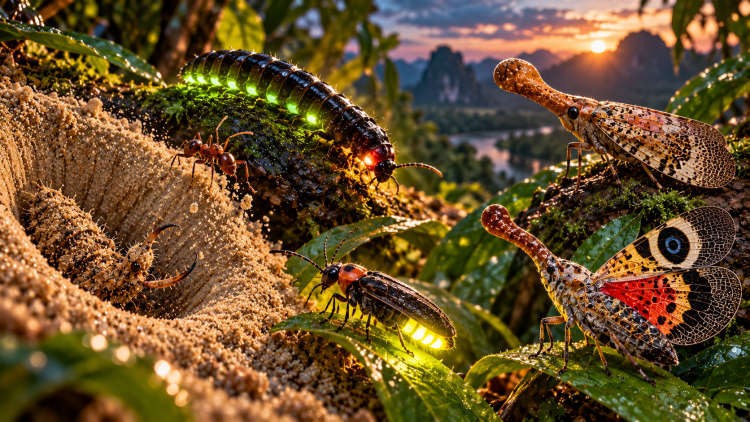
| There is something rather wonderful about discovering that an insect is not quite what we thought it was. Sometimes the misunderstanding is ours, caused by a misleading name or an appearance that suggests something entirely different. Other times, the insect itself is responsible, using light, movement, or deception to influence another animal’s behaviour. Insects have done extraordinary things with appearances for millions of years, and some have developed methods of hunting, communicating, or avoiding predators that would be impressive in a much larger creature. I remember the cicadas calling from the tropical vegetation around our home in Malaysia, particularly during the evenings when the sounds of insects seemed to come from every direction. Those gardens were full of activity, much of which I could hear without ever discovering exactly what was responsible. Looking back, I suspect that was part of the attraction. The insects we could see were fascinating enough, but there were always others concealed somewhere in the greenery, carrying on with their lives quite independently of our curiosity. Our five subjects this time take us from sandy traps to illuminated bodies, and eventually to a spectacular insect whose reputation was partly established by a mistake made centuries ago. Some genuinely produce their own light, others exploit the behaviour of unsuspecting animals, and one has spent a remarkably long time being credited with an ability it doesn’t possess. 11. The Antlion — Myrmeleontidae An antlion is a particularly good example of an insect whose familiar name describes only part of its life. The adult is a delicate, winged creature that superficially resembles a damselfly, although its antennae and other features show it belongs to a different insect order, Neuroptera. The larvae are another matter entirely. Many are squat, formidable little predators with large, curved jaws, and some species have perfected a hunting method that involves constructing a trap in loose, dry sand. If you have ever noticed a small, neat, funnel-shaped depression in sandy ground, particularly somewhere sheltered from rain, you may have been looking at an antlion pit. These traps are not simply holes dug for convenience. Their shape, steep sides, and unstable surface are key to how they work, allowing the larva to exploit the physical properties of sand rather than relying on speed or strength alone. The larva excavates its pit by moving through the sand and throwing particles outwards with movements of its head. Once the funnel is complete, it settles beneath the surface near the bottom, leaving its jaws ready to seize anything unfortunate enough to lose its footing. An ant wandering onto the slope may find the sand beginning to slide beneath it, and as it struggles to escape, its movements disturb more particles, sometimes causing further collapses. The antlion detects vibrations travelling through the sand and can respond by throwing additional grains towards the struggling insect. This behaviour is particularly interesting because sand-throwing does more than bombard the prey. Research shows it helps maintain the trap’s steep, unstable sides, making escape harder while keeping the funnel in working condition. The insect effectively uses gravity and the movement of individual sand particles to help its hunting, allowing a relatively stationary predator to capture animals that would otherwise be considerably more mobile. There are limitations, naturally. Not every antlion species constructs pits, and even amongst those that do, the availability of suitable dry material matters. Heavy rain, compacted soil, or an unsuitable surface can make pit construction impractical. Larvae of non-pit-building species use other hunting methods, often concealing themselves among soil or debris and waiting for prey to pass within reach. For a gardener, antlions offer an interesting reminder that ground conditions can determine which animals can live there. We often think about soil in terms of plant growth, drainage and fertility, but its physical structure can be equally important to small predators. The antlion’s trap is an excellent example of an insect turning an ordinary environmental feature into a remarkably effective hunting arrangement, with the victim encountering what appears to be little more than a patch of sand while something considerably more dangerous waits beneath it. 12. The Railroad Worm — Phengodidae Of all the insects in this episode, the railroad worm probably has the most evocative common name. It suggests something mechanical, perhaps a small creature travelling along a track, although the explanation is considerably more interesting. Railroad worms belong to the beetle family Phengodidae, found principally in the Americas, and their name comes from the arrangement of glowing organs along the bodies of their larvae and certain adult females. In darkness, the paired lights can resemble the illuminated windows of a railway carriage, particularly in species whose bodies produce several distinct points of light. Many adult females retain a larva-like appearance, remaining elongated and wingless rather than developing the more familiar adult beetle form. Males, by contrast, generally possess wings and often elaborate, feathery antennae. This difference between the sexes is so pronounced that someone unfamiliar with the group might struggle to believe they belong to the same species, especially when the female displays a series of luminous organs along her body. The light comes from bioluminescence, a chemical process involving a substance called luciferin and an enzyme known as luciferase. The reaction generates visible light, allowing the insect to illuminate particular parts of its body without relying upon an external light source. Although bioluminescence occurs in several unrelated groups of organisms, the chemistry and structures involved can differ considerably, making these systems particularly valuable to scientists studying how light production has evolved. Railroad worms are especially remarkable because some can produce more than one colour. Species in the genus Phrixothrix possess luminous organs along their bodies that produce greenish light, while specialised organs near the head can emit red light. Naturally occurring red bioluminescence is exceptionally rare among terrestrial animals, and scientific investigations have shown that differences in light-producing enzymes contribute to the colours observed. Research into these beetles has consequently attracted interest beyond entomology, particularly amongst scientists studying the chemistry of biological light production. The purpose of the light is another fascinating question. Different luminous organs may perform different functions, and researchers have proposed roles involving defence, communication and illumination of the immediate surroundings. However, the precise function of every colour and light-producing structure has not been established across all railroad worm species, and it would be misleading to suggest that every luminous organ has an explanation simply because the underlying chemistry is understood. There is something rather appealing about the idea of a small animal moving through the darkness with its own series of illuminated windows. The comparison with a train may be fanciful, but it offers a memorable way to recognise an extraordinary natural phenomenon. Unlike some of the insects we shall encounter later in this episode, the railroad worm genuinely deserves its luminous reputation, even as we still investigate exactly how its different lights influence the world around it. 13. The Firefly — Lampyridae Fireflies are amongst the most familiar examples of bioluminescence, although the name can be misleading in Britain, where we are more accustomed to talking about glow-worms. Both belong to the beetle family Lampyridae, and many members can produce light. Not all fireflies fly, not all adults glow, and light-production patterns vary considerably between species, making the family more diverse than the familiar image of tiny flashing insects drifting through warm summer evenings might suggest. The British common glow-worm, Lampyris noctiluca, provides a particularly interesting example. Adult females remain wingless and produce a conspicuous greenish glow to attract flying males. In contrast, males are recognisable beetles with wings that can locate females during the breeding season. In other parts of the world, particularly warmer regions, fireflies may produce repeated flashes rather than a continuous glow. These flashes can form recognisable patterns, with timing and duration helping individuals identify suitable mates amongst the surrounding vegetation. A chemical reaction involving luciferin, luciferase, oxygen, and cellular energy produces the light. The reaction is highly efficient at producing visible light without generating the large amounts of wasted heat associated with many artificial lighting systems. What interests me particularly is that the light is not simply decorative. It carries information, and in some species the timing of a male’s flashes and a receptive female’s response form an exchange that allows the insects to locate one another in darkness. Yet wherever animals communicate, another animal may exploit that information. Certain female fireflies in the genus Photuris have developed an extraordinary way to obtain food by imitating the flashing responses of females from other firefly species, particularly members of the genus Photinus. A male approaching what appears to be a suitable mate may instead encounter a predator, with the female Photuris capturing and eating the deceived insect. This behaviour is known as aggressive mimicry, and it shows how an apparently straightforward biological signal can take on a very different meaning depending on who produces it. Firefly communication is therefore considerably more complicated than a collection of pretty lights appearing over a field on a summer evening. The signals have evolved within relationships involving reproduction, recognition and, in certain species, predation, creating opportunities for deception wherever one insect can exploit another’s response. Another aspect of their lives is worth considering, particularly from a gardening perspective. Many fireflies spend a substantial proportion of their lives as larvae, often living amongst vegetation, leaf litter and soil. Some prey upon snails and other soft-bodied invertebrates, while adults of certain species may feed little or not at all. Habitat conditions matter, and artificial lighting can interfere with the signals some species use to find mates. The increasing brightness of our nights is therefore more than a matter of losing the pleasure of seeing stars. For animals whose reproductive communication depends upon small points of light, the surrounding darkness can be part of the habitat itself. A garden does not necessarily become better for wildlife simply because we can see every corner of it after sunset, and sometimes leaving a quiet area unlit may be just as valuable as providing suitable vegetation or shelter. 14. The Lantern fly — Fulgoridae After considering two groups of insects that genuinely produce light, we arrive at one that has acquired a luminous reputation without possessing the ability at all. Lantern flies belong to the family Fulgoridae, a group of plant hoppers found predominantly in tropical and subtropical regions. They are true bugs, members of the order Hemiptera, and feed with specialised piercing mouthparts that let them extract plant fluids. They are not flies in the ordinary entomological sense, and despite their common name, they do not possess glowing lanterns. The misunderstanding has persisted for centuries. Early naturalists reported that certain lantern flies could produce light, particularly from the extraordinary projections found on the heads of some species. The idea became established in natural-history writing, although subsequent investigation failed to demonstrate the supposed ability. Modern entomologists do not recognise bioluminescence as a family characteristic, making lantern flies a particularly good example of how an attractive explanation can attach to an animal and survive long after its scientific basis has disappeared. That might seem disappointing after our railroad worms and fireflies, but lantern flies possess enough unusual features without needing an imaginary light source. Many species have strikingly elongated or enlarged head structures, sometimes projecting forwards like horns, snouts or peculiar ornamental extensions. Others display brilliant wing colours, intricate patterns or waxy secretions that can form unusual structures around the body. The diversity is remarkable, and the function of some of these features remains uncertain. Camouflage, predator deception and sexual selection have all been suggested as possible explanations for particular head shapes. Still, there is insufficient evidence to claim that one interpretation applies throughout the family. This is where I think natural history becomes particularly interesting. It would be easy to explain every unusual projection as a defensive disguise, especially when the shape reminds us of something familiar, but resemblance alone is not proof of function. An insect may look like a thorn, a leaf or another animal without necessarily having evolved that appearance for the reason we imagine. Lantern flies also show how difficult it can be to correct a familiar misconception once it becomes attached to an animal’s name. The name survives even though the light does not, and the story keeps appearing in popular accounts of unusual insects. It reminds us that scientific knowledge develops through observation, comparison, and testing, not by repeating explanations that happen to sound convincing. From the perspective of someone who spent childhood years in Southeast Asia, I find this group particularly appealing. The tropical vegetation I remember supported an enormous variety of insects, many of which were probably overlooked because they remained motionless against bark or amongst foliage. I cannot identify the lantern flies that may have occupied those surroundings, but the family includes some of the most extraordinary-looking plant hoppers in the region. Their appearance alone would have interested me, and they certainly didn’t need to glow. 15. The Peanut-Headed Lanternfly — Fulgora laternaria Our final insect is a member of the lantern fly family. Still, it deserves separate attention because it has played a prominent role in the group’s peculiar reputation. Fulgora laternaria, commonly known as the peanut-headed lantern fly, occurs in tropical parts of Central and South America. It is a substantial insect with broad, patterned wings and an extraordinary elongated projection extending forward from its head, producing a silhouette unlike that of most insects we encounter. The projection gives the insect its familiar common name, although it is not a separate peanut-shaped head. It is an extension of the head itself, and at first glance the structure can appear almost comical. Look more closely, however, and the animal becomes considerably more interesting, particularly when you consider the head shape alongside the markings and patterns on its wings. The head projection has been compared to a reptile’s appearance, and the insect’s wings contain markings that can resemble large eyes when exposed. These features have led to suggestions that the lantern fly may deceive predators by giving the impression of a more formidable animal. This is an attractive explanation, particularly when photographs emphasise the unusual head shape or the contrasting wing patterns, but the evidence requires careful interpretation. Although predator deception has been proposed, the precise defensive value of the head projection remains uncertain. We should not assume that birds or other predators interpret the insect’s appearance the same way we do, particularly when photographs, illustrations, and familiar animal shapes influence our comparisons. An unusual resemblance may be biologically important, but establishing that importance requires more than observing that two things look alike. The most famous misconception associated with Fulgora laternaria concerns its supposed ability to glow. The naturalist and illustrator Maria Sibylla Merian included the insect in her celebrated work on the insects of Suriname, published in 1705. Her account helped perpetuate the belief that its head could produce a powerful light, and the story became part of the insect’s reputation despite the absence of convincing evidence. Later scientific investigations failed to establish any genuine bioluminescent mechanism in the head projection. The peanut-headed lantern fly does not illuminate the forest at night; however, the claim has been repeated often. It is worth remembering the circumstances in which early naturalists worked, particularly when studying unfamiliar tropical animals. Specimens were difficult to preserve, observations were frequently made under challenging conditions, and some accounts relied upon information supplied by others. Merian’s contribution to natural-history illustration and the study of insect life cycles remains important. Recognising an error in one observation does not diminish the value of her wider work, and the story reminds us that scientific understanding advances partly by testing explanations accepted by earlier generations. What once seemed convincing may eventually prove mistaken, while other observations made at the same time remain valuable centuries later. The peanut-headed lantern fly remains extraordinary even after we remove its imaginary light. Its unusual head, large patterned wings and plant-feeding habits provide plenty of reasons to investigate it. At the same time, its place in the history of natural-history observation adds another dimension to its story. Sometimes the strangest thing about an insect is the explanation we have attached to it, and occasionally removing that explanation makes the real animal more interesting rather than less. What We See, and What We Think We See Our five insects have taken us through several different kinds of deception. The antlion constructs a trap that exploits sand movement, while the railroad worm produces genuine light through specialised chemistry. Fireflies use illumination to communicate, although some species have discovered that predators can exploit the same signals to hunt. Lantern flies, meanwhile, demonstrate how an extraordinary appearance can encourage explanations that survive long after the evidence supporting them has disappeared. An important distinction exists between an insect deceiving another animal and a human observer misunderstanding what an insect is doing. Both can produce fascinating stories, but they are not the same biological phenomenon. That distinction matters, especially when we write about unusual creatures, because it is tempting to make every strange insect seem more remarkable by attaching a dramatic explanation to its appearance. Yet the real biology is often extraordinary enough without embellishment. A larva that can maintain an unstable sand trap, a beetle that produces red light, or a firefly that imitates another species’ mating signals hardly requires additional invention. The more closely we investigate these animals, the more apparent it becomes that even familiar groups contain behaviours that remain poorly understood. At the same time, scientists are still trying to establish the functions of some of the most conspicuous structures. Perhaps that is part of what has kept me interested since childhood. Another question always waits behind the first answer, and the natural world rarely feels obliged to behave as we expect. In the next episode, we shall move towards insects whose relationships with plants and water produce some equally unusual arrangements, including remarkable body shapes, elaborate coverings and predators that have made the surface of a pond their hunting ground. For now, I think we can leave the lantern flies in peace. They have spent quite long enough being expected to switch themselves on. |
| Companion Resources — Explore Further For readers interested in the science behind these remarkable insects, the following research papers and specialist natural-history resources provide further information about their behaviour, biology and unusual adaptations. 1. Antlions — Myrmeleontidae Sand-Throwing Behaviour in Pit-Building Antlion Larvae Journal of the Royal Society Interface, 2021 — Original research examining how antlions use sand throwing to maintain their traps and hinder escaping prey. 2. Railroad Worms — Phengodidae Biophysical and Biochemical Aspects of Phengodid Bioluminescence Photochemistry and Photobiology, 1993 — Scientific research investigating the chemistry responsible for the different colours of light produced by railroad worms. 3. Fireflies — Lampyridae Aggressive Mimicry in Photuris: Firefly Femmes Fatales Science, 1965 — Original behavioural research documenting how female Photuris fireflies imitate the mating signals of other species to attract and capture males. 4. Lanternflies — Fulgoridae The First Phylogeny of the Lanternfly Family Fulgoridae Molecular Phylogenetics and Evolution, 2009 — Research investigating the evolutionary relationships of lanternflies and the diversity of their unusual structures. 5. Peanut-Headed Lanternfly — Fulgora laternaria Peanut-Headed Lanternfly — University of Cambridge Museum of Zoology University of Cambridge Museum of Zoology, 2020 — A specialist natural-history account examining the insect’s unusual anatomy and its historical reputation for producing light. We selected these resources for their scientific relevance and credibility. Some focus on particular species within a wider insect family, and findings should not automatically apply to every member of that group. |
| Wander through the Article Directory and see where curiosity takes you next. |
| About our writing & imagery Most articles reflect our real gardening experience and reflection. Some use AI in drafting or research, but never for voice or authority. Featured images may show our photos, original AI-generated visuals, or, where stated, credited images shared by others. All content is shaped and edited by Earthly Comforts, expressing our own views. |

