| Polygonatum Solomon’s Seal and the Beauty of Knowing Your Place |
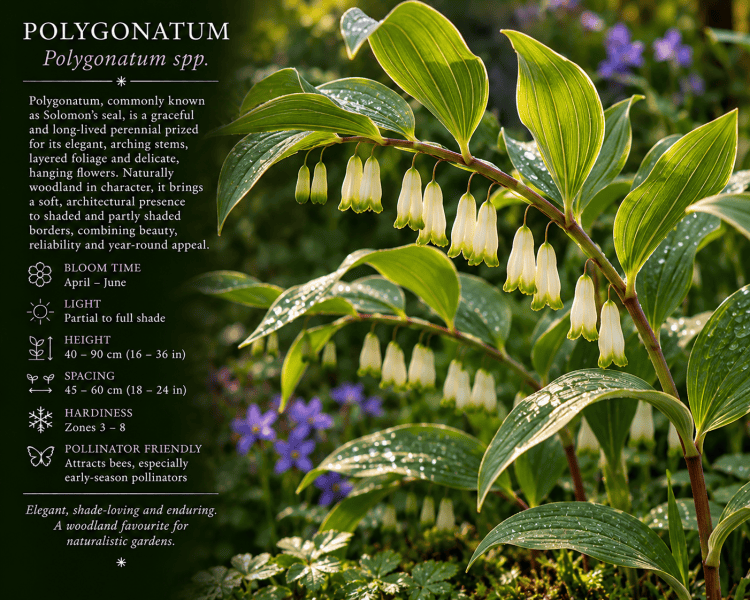
| Some parts of a garden never seem particularly grateful for the attention they receive. You improve the soil, introduce something promising, water it through the summer, and return the following spring to find that your carefully chosen plant has either disappeared or looks thoroughly miserable. Meanwhile, a few feet away, something you barely noticed has been quietly thriving for years. Gardening has a rather effective way of reminding us that enthusiasm and good intentions are not always enough. Solomon’s seal is one of those plants that understands its surroundings rather better than we sometimes do. Known botanically as Polygonatum, it is a genus of woodland perennials whose graceful, arching stems and dangling flowers give them an appearance quite unlike most other garden plants. In spring, shoots emerge from underground rhizomes and gradually unfurl into elegant stems lined with alternating leaves. Beneath these arches hang small, tubular flowers, usually creamy white with greenish tips, arranged so regularly that they almost appear to have been placed there individually. It is a remarkably orderly plant, though not in the rigid way gardeners sometimes try to impose on their borders. The name Solomon’s seal is generally associated with the circular scars left on the underground rhizomes when old stems die away. These markings were traditionally compared with the impression of a seal, giving rise to the common name. The botanical name Polygonatum comes from Greek words meaning many knees, referring to the jointed appearance of the rhizomes. It is a curious example of a plant whose most distinctive names refer not to its flowers or foliage, but to something normally hidden beneath the soil. There is something rather appealing about that. Solomon’s seal belongs to the asparagus family, Asparagaceae, and several species are grown in British gardens. Polygonatum multiflorum, a native British species, is particularly associated with woodland habitats, while Polygonatum odoratum and its variegated forms are familiar ornamental choices. Although their precise requirements vary, most appreciate the cool, moisture-retentive conditions found in humus-rich woodland soil. That doesn’t mean they need permanent dampness. They generally dislike prolonged drought, especially when competing with established tree roots. A position in partial shade, with soil improved using well-rotted organic matter, will often suit them beautifully. Once established, they can form substantial clumps, but they don’t usually demand immediate results. Patience, once again, is part of the arrangement. What makes Polygonatum especially useful is its ability to provide structure without relying upon large, colourful flowers. The arching stems create a natural rhythm through shaded planting, particularly alongside ferns, hostas, Epimedium and other woodland perennials. Their fresh green foliage catches the spring light, while the flowers reward anyone prepared to bend down and look beneath the leaves. It is worth doing so, because the flowers are more interesting than their modest appearance suggests. Their tubular shape attracts visiting insects, including bumblebees, which can reach the nectar within. Later in the season, rounded berries may develop and gradually darken as they mature. These are attractive but poisonous if eaten, as are other parts of the plant, so Solomon’s seal is not to be confused with an edible member of the asparagus family. Gardeners also occasionally find a small complication when inspecting the foliage. Solomon’s seal sawfly can strip leaves surprisingly quickly. Its greyish larvae feed along the leaf edges, sometimes leaving little more than the central stems behind. The damage can look alarming, particularly on an established clump that has otherwise required very little attention. Fortunately, healthy plants usually recover the following year, although repeated severe defoliation can weaken them. Checking the undersides of leaves in late spring and early summer helps you spot infestations before the damage becomes extensive. It is one of those occasions when a few minutes of observation can save a considerable amount of disappointment. You can propagate established clumps by dividing their rhizomes during dormancy, usually in autumn or early spring. Each section should retain healthy buds and roots, and replant the divisions at about their previous depth. It is a straightforward way to increase a planting, although the newly divided sections may need time to settle before producing their characteristic graceful display. Perhaps the most interesting thing about Solomon’s seal is that it succeeds by doing precisely what its woodland ancestry has prepared it to do. It doesn’t compete with the brightest flowers in the border, nor does it attempt to remain conspicuous throughout winter. Its stems emerge in spring, the flowers hang quietly beneath the foliage, and by autumn the plant begins withdrawing underground again. Everything has its season, and little effort is wasted. We sometimes approach difficult garden spaces as problems requiring increasingly elaborate solutions. We search for plants that will tolerate unsuitable conditions, then spend years trying to persuade them to be happy somewhere they never wanted to grow. Solomon’s seal suggests another approach. Understand the conditions first, choose plants that naturally appreciate them, and allow the garden to develop accordingly. It may not sound particularly adventurous, but there is considerable satisfaction in seeing a plant flourish without constant intervention. The graceful arches, the little hanging flowers, and the slow expansion of an established clump all remind you that successful gardening isn’t always about changing the environment. Sometimes it is simply about recognising which plants already know how to live there. |
| Wander through the Article Directory and see where curiosity takes you next. |
| About our writing & imagery Most articles reflect our real gardening experience and reflection. Some use AI in drafting or research, but never for voice or authority. Featured images may show our photos, original AI-generated visuals, or, where stated, credited images shared by others. All content is shaped and edited by Earthly Comforts, expressing our own views. |

