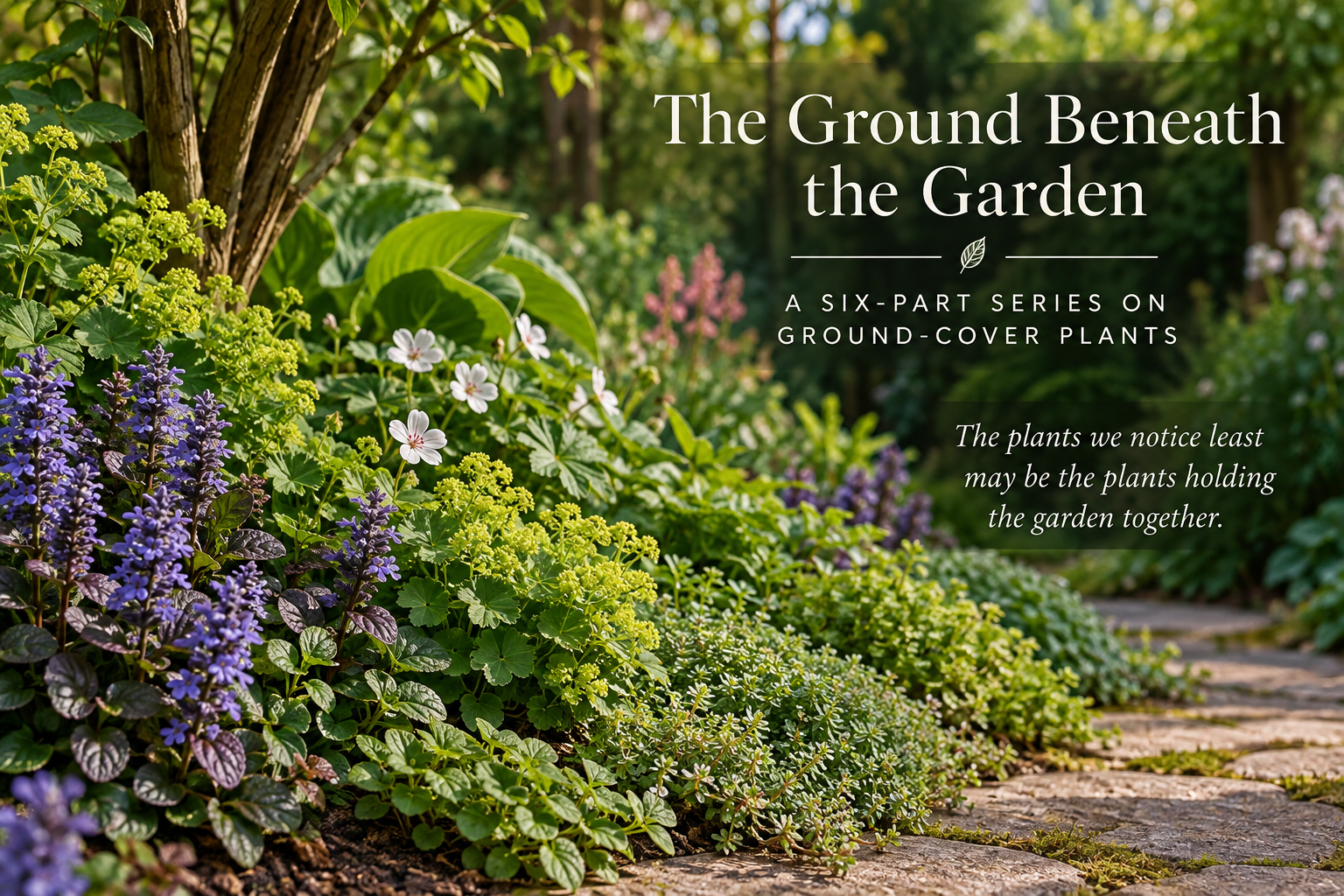
| Episode 6 Building the Layer Beneath the Border |
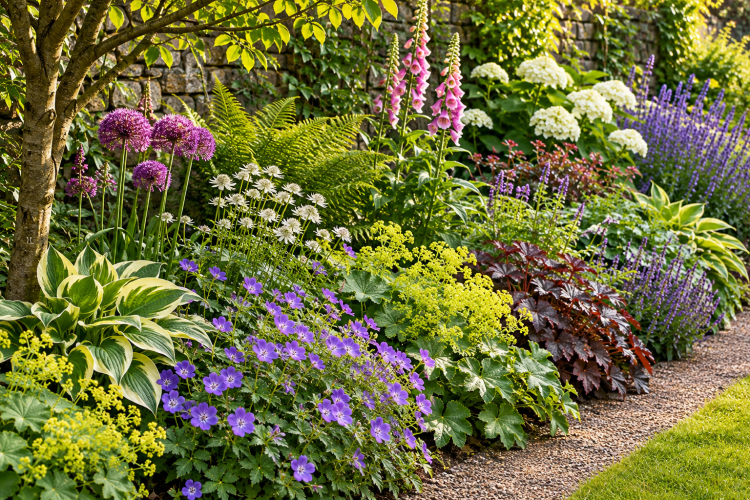
| At some point in a garden’s development, the individual plants begin to feel less like separate specimens and more like parts of something greater. The shrubs have established themselves, the perennials return each year with increasing confidence, and the spaces that once seemed rather conspicuous begin to disappear beneath overlapping foliage. It is often at this stage that a border acquires the character we had hoped for when it was first planted, although the process may have taken several seasons longer than we originally imagined. Much of that transformation happens close to the ground. Beneath the more obvious attractions of flowers, ornamental grasses and established shrubs, smaller plants gradually occupy the spaces between them. Their contribution may be modest individually, but collectively they can change the appearance, behaviour and maintenance requirements of the entire border. Throughout this series, we have explored why bare soil rarely remains bare, the opportunities presented by sunshine and shade, the difficulties created by overly enthusiastic plants, and the realistic advantages of living mulch. We have also discovered that ground cover is not a universal solution to every gardening problem. Some plants are too vigorous for their surroundings, others struggle when conditions are unsuitable, and even the most successful planting requires occasional intervention. The question now is how we bring those observations together. If we want to create a border in which the lower planting layer contributes to the garden rather than simply filling the gaps, where should we begin? |
| Begin with the garden that already exists. One of the easiest mistakes when planning ground cover is to start with a list of attractive plants rather than examining the conditions in which they will be expected to grow. A photograph of a beautiful planting combination can be wonderfully persuasive, but the same arrangement may behave quite differently in another garden. Before choosing anything, I would spend some time looking carefully at the border itself. How much direct sunlight does it receive, and does that change significantly throughout the year? Is the soil naturally moisture-retentive, or does it dry out quickly in summer? Are there established trees and shrubs whose roots already occupy much of the available ground? Does water collect in certain places after heavy rain, while other areas remain stubbornly dry? These observations are particularly important in British gardens, where conditions can vary considerably within a relatively small space. A border may receive several hours of strong morning sunshine before falling into shade, while the ground beneath an evergreen shrub remains comparatively dry year-round. The soil beside a wall may behave differently from the soil only a few feet away, and the shelter provided by surrounding buildings can influence both temperature and moisture. There is also the question of existing planting. A mature shrub border does not offer the same opportunities as a newly prepared bed. Established roots, accumulated leaf litter and the physical spread of neighbouring plants all influence what can successfully occupy the lower layer. Rather than assuming these conditions must be changed, it is often more sensible to choose ground cover that can work within them. The objective is not to impose a planting scheme upon the garden, but to understand what the garden is already telling us. Think in layers rather than carpets. The expression ground cover can suggest a continuous, uniform carpet of vegetation, and in certain situations that may be exactly what is required. A difficult bank, an extensive area beneath shrubs or a simple planting beside a pathway might benefit from a relatively consistent covering. However, the most interesting ornamental borders often contain several overlapping layers rather than a single uninterrupted mass. Imagine a border containing a small ornamental tree, a collection of shrubs, several taller perennials and ornamental grasses. Beneath these, lower-growing plants can occupy the spaces between stems and crowns, providing a softer transition towards the soil. Some may spread horizontally, others form rounded clumps, and a few may produce seasonal flowers that rise briefly above their foliage before disappearing again. The result is not necessarily a perfectly even covering. Indeed, a little variation in height, texture and seasonal growth can make the planting far more attractive. The important point is that each layer contributes something without preventing the others from developing. Hardy geraniums are particularly useful in this respect because different species and cultivars offer a wide range of growth habits. Some form generous mounds of foliage that soften the edges of larger plants, while others remain comparatively compact. Lady’s mantle, Alchemilla mollis, can create attractive rounded foliage beneath taller plants, although its tendency to self-seed should be considered. In suitable shaded conditions, Epimedium can provide a more restrained lower layer, with delicate spring flowers and foliage that often remains attractive for much of the growing season. The choice should always be guided by the space available and the behaviour of the individual plant. A vigorous geranium may be entirely appropriate beneath an established shrub but less welcome beside a delicate perennial. A compact ground-cover plant might be ideal near a pathway yet become lost beneath a rapidly expanding border. Successful layering is therefore less about covering every available inch and more about allowing plants to occupy complementary positions. Give the important plants room to breathe. There is a temptation, particularly when trying to reduce weeds, to fill every gap as quickly as possible. Yet the spaces between plants are not always wasted ground. They may be essential to the health and development of the specimens already growing there. Many herbaceous perennials emerge from crowns at or just below the soil surface. If vigorous ground cover grows directly over these crowns, developing shoots may struggle to emerge or become crowded by surrounding foliage. Similarly, some shrubs benefit from having their immediate bases kept relatively clear, particularly where excessive moisture and accumulated debris might encourage problems. Bulbs introduce another consideration. Spring-flowering bulbs can coexist beautifully with suitable ground cover, often emerging through low foliage before the surrounding planting reaches its full height. However, dense mats of roots and stems may make it difficult to introduce additional bulbs later, while particularly vigorous plants can compete with smaller or weaker-growing species. This is where observation becomes more valuable than rigid planting rules. Rather than attempting to create a perfectly continuous covering, we can leave deliberate openings around sensitive crowns and allow seasonal plants room to develop. As the border matures, those openings may become less noticeable beneath the surrounding foliage without being completely occupied at soil level. It is also worth remembering that ground cover itself changes with age. A small plant purchased in a nursery pot may eventually occupy a considerable area, and the speed of that development can vary with soil, moisture, and exposure. Allowing for its mature spread may seem to leave rather too much bare ground initially, but it can prevent unnecessary competition and repeated removal later. A successful border is not necessarily the one containing the greatest number of plants. It is the one in which the plants have sufficient space to fulfil their intended roles. Choose plants for the conditions, not just their appearance By now, we have encountered a wide variety of plants capable of occupying the lower layer of a border, but no single species suits every situation. In sunny, freely draining conditions, low-growing thyme may provide attractive aromatic foliage and flowers that are useful to visiting insects. Certain hardy geraniums can form effective ground cover in ordinary garden soil. At the same time, drought-tolerant species such as some sedums are better suited to open, sunny positions with good drainage. In partial shade, the possibilities broaden in different directions. Epimedium is particularly valuable beneath deciduous shrubs and trees, especially once established, while Geranium macrorrhizum can tolerate a range of conditions and develop a substantial covering of aromatic foliage. Its vigour, however, means it should be placed where its spreading habit will be an advantage rather than a problem. For moist, shaded ground, other possibilities become available, including certain ferns and woodland perennials whose foliage can create a layered effect. In drier shade, plant selection becomes more demanding because competition from established roots may be considerable, even when the soil appears sheltered from the sun. The most useful question is not simply whether a plant tolerates shade or sunshine, but whether it will thrive under the particular combination of conditions present. A plant described as suitable for shade may still require moisture, while another that tolerates dry soil may need careful watering during establishment. It is equally important to consider seasonal behaviour. Some ground-cover plants remain evergreen, others lose their foliage during winter, and a few disappear almost entirely for part of the year. This does not make deciduous plants less valuable, but it does influence how effectively they cover the soil across the seasons. A mixture of plants with different growth cycles can sometimes provide a more continuous effect than relying on one species alone. The objective should be a planting that stays interesting and functional throughout the year, rather than one that looks impressive for a few weeks and then leaves large areas unexpectedly exposed. Preparing the ground properly If one stage of creating ground cover deserves more attention than it usually receives, it is preparation. A newly planted border may look promising immediately, but the quality of the underlying soil and the presence of established weeds will strongly influence how successfully it develops. Planting amongst persistent perennial weeds without first addressing them can create years of unnecessary maintenance. Bindweed, couch grass and ground elder are particularly troublesome because their underground structures allow them to regenerate amongst the roots of desirable plants. Once ground cover has established, removing these weeds becomes more difficult, and attempts to extract them can damage the planting we are trying to preserve. Where possible, it is therefore sensible to remove persistent weeds before planting and allow sufficient time to identify any regrowth. The method will depend on the weed and the circumstances, but thorough preparation is generally more effective than hoping the ground cover will eventually overwhelm an established infestation. Soil improvement should also be considered in relation to existing conditions rather than treated as an automatic requirement. Incorporating suitable organic matter can improve the structure and moisture-holding characteristics of some soils, but not every plant benefits from highly enriched ground. Species adapted to relatively poor, freely draining conditions may perform badly if planted into soil that has been made excessively rich or moisture-retentive. In established borders, extensive digging can damage the roots of trees, shrubs and perennials. Applying an appropriate organic mulch to the surface, while avoiding the crowns and bases of plants, may be more practical than trying to cultivate the entire area. Good preparation is not necessarily elaborate preparation. It means understanding what the soil needs, removing avoidable obstacles and giving the new planting a reasonable opportunity to establish. Planting for the garden we want in five years. One of the most useful changes we can make in our approach to garden design is to think beyond the first growing season. A newly planted border can appear disappointingly sparse, particularly when small plants have been spaced according to their expected mature size. The temptation is to fill the gaps with additional specimens, but doing so may create unnecessary competition once everything begins to develop. I would rather accept a period of visible soil than create a border that becomes overcrowded after two or three seasons. Temporary organic mulch can protect the exposed ground while plants establish, and careful weeding during this period is a worthwhile investment in the border’s future condition. Planting in small groups can also produce a more coherent effect than scattering individual specimens throughout the space. Repeated groups of compatible plants help create visual continuity, while differences in foliage and seasonal flowering prevent the lower layer from becoming monotonous. The precise arrangement will depend on the character of the garden. A formal border may benefit from repeated patterns and clearly defined edges, while a more naturalistic planting can allow groups to overlap and develop less predictable boundaries. Whichever approach we choose, it is worth leaving room for change. Some plants will grow more strongly than expected, others will struggle, and occasionally a species will prove unsuitable despite apparently favourable conditions. Gardens are living environments, and their development rarely follows a design plan with complete obedience. The ability to adjust a planting over time is not evidence that the original design has failed. It is part of the process of creating a garden that responds to its surroundings. Maintenance becomes a matter of observation. Once the lower planting layer has established, the work required to maintain it often changes considerably. In the early stages, attention may focus on watering, removing weeds, and ensuring that young plants are not overwhelmed by neighbouring vegetation. Later, the emphasis shifts towards managing the balance between established species. A spreading perennial may need reducing where it begins to encroach on a smaller neighbour. A clump that has become congested might benefit from division, while a gap created by the loss of a plant offers an opportunity to reconsider the surrounding arrangement. Edges deserve particular attention. Ground cover that is perfectly acceptable within a border may become inconvenient when it begins to extend across a pathway, into a lawn or over a drainage channel. Keeping these boundaries defined can make an otherwise informal planting look cared for without requiring the entire border to be controlled too rigidly. There is also value in allowing some natural variation. Not every seedling needs to be removed immediately, and not every plant that extends beyond its original position is necessarily causing a problem. Self-seeding perennials can sometimes create attractive combinations that we would never have planned deliberately. The important distinction is between development that enriches the garden and growth that threatens its balance. For a working gardener, this observational approach is particularly valuable. Regular visits provide opportunities to notice small changes before they become substantial problems. A few minutes spent removing an unwanted seedling or reducing an overly vigorous clump can prevent much more demanding work later. Ground cover may reduce routine weeding, but it does not remove the need for knowledgeable maintenance. In many ways, it makes that knowledge more important. A border that works with the seasons A successful lower planting layer should also be considered across the full gardening year. In spring, bulbs and early-flowering perennials may provide the first signs of activity, often appearing before the surrounding shrubs have developed their leaves. As temperatures rise, hardy geraniums, lady’s mantle and other herbaceous plants expand, gradually closing the spaces between established specimens. Summer brings the fullest development of many borders, when foliage overlaps and the soil beneath becomes less visible. This is often when the benefits of ground cover are most apparent, particularly during dry periods when exposed soil can lose moisture rapidly. Autumn introduces another stage. Some plants continue flowering, others begin to retreat, and fallen leaves accumulate amongst the lower vegetation. Rather than treating every leaf as something that must be removed immediately, we can consider whether some of this material might be allowed to remain and contribute to the soil. Excessive accumulations may need managing where they smother small plants or delicate crowns. Still, a modest covering of leaves is part of the natural cycle of many woodland and shrub-based plantings. Winter reveals the garden’s underlying structure. Evergreen ground cover may continue to provide foliage, while deciduous species leave more open areas until spring. This is not necessarily a weakness. Seasonal change is part of a planted border’s character, and the contrast between winter structure and summer abundance can be one of its greatest attractions. The aim should not be to make the garden look identical throughout the year, but to create a planting that remains coherent as its appearance changes. Knowing when not to plant After six episodes devoted to the value of ground cover, it may seem slightly contradictory to suggest that some spaces should remain unplanted. Nevertheless, this is an important part of responsible garden design. Not every exposed patch of soil represents a failure. Some plants require open ground around their crowns, while certain wildlife species depend upon areas of suitable bare soil for nesting or other activities. A garden with a variety of conditions can be more ecologically interesting than one where every surface is covered with the same dense vegetation. There are also practical considerations. Narrow maintenance routes, access to drains and inspection points, and spaces needed for occasional work should not be planted so densely that they become difficult to use. A border that looks beautiful but prevents essential maintenance is unlikely to remain satisfactory for long. In some situations, an organic mulch may be more appropriate than living vegetation, particularly where root competition is already severe, or access is limited. Elsewhere, a small area of open soil may provide an opportunity for seasonal planting or future changes. The objective is not maximum coverage at any cost. It is thoughtful coverage where it provides a genuine benefit. The garden beneath the garden When we stand back and admire a well-established border, our attention is naturally drawn towards the most conspicuous features. We notice the flowers, the changing colours, the movement of ornamental grasses and the structure provided by shrubs and trees. These are often the elements that inspired us to create the garden in the first place. Yet beneath them lies another part of the planting that deserves equal consideration. The lower layer influences how much soil remains exposed, how easily weeds establish, how moisture and organic matter are managed, and how successfully different plants coexist. It can soften hard edges, connect otherwise separate groups of planting and provide seasonal interest in places that might otherwise be overlooked. Its value is not simply practical. A border in which plants overlap naturally often feels more settled than one in which every specimen stands apart from its neighbours. The eye moves through the planting rather than repeatedly encountering empty spaces, and the garden begins to develop a sense of continuity that is difficult to achieve through individual plants alone. Of course, there will always be exceptions. Some gardens benefit from deliberate openness, and certain planting styles depend upon clearly separated forms. Ground cover is not a rule to follow, but a design tool that can be used with considerable imagination. Perhaps that is the most useful lesson from this series. The question is not whether every garden should contain more ground cover, but whether we are paying enough attention to what happens beneath the plants we admire. |
| The final word — a garden that holds itself together We began this series with a simple observation: bare soil rarely remains bare for long. Left undisturbed, nature has a remarkable ability to occupy available ground, whether through grasses, wildflowers, shrubs or the succession of plants that gradually establish themselves in suitable conditions. Gardening involves guiding that process. We choose the plants we want, arrange them according to their character and requirements, and intervene when necessary to maintain a balance between beauty, practicality and the wider environment. Ground cover is one expression of that approach. It allows us to deliberately occupy the spaces beneath larger planting, reducing some of the opportunities available to weeds while creating a more connected and resilient garden. But it also asks us to understand plant behaviour, respect the limitations of individual sites, and accept that maintenance remains part of the relationship. There is no perfect ground-cover plant, just as there is no entirely maintenance-free garden. There are only plants that are more or less suitable for particular situations, and gardeners willing to observe, learn and make adjustments as those situations change. For me, that is what makes gardening endlessly interesting. A border is never truly finished. Even when the planting appears settled, its character continues to evolve through growth, competition, seasonal change and the occasional surprise. And perhaps the greatest satisfaction comes when the garden begins to do more of the work for itself, not because we have abandoned it, but because we have understood how its different parts can support one another. The plants we notice least may indeed be the plants holding the garden together. And that, I think, is a fitting place to leave The Ground Beneath the Garden. |
| Most articles are grounded in our real gardening experience, observations and reflections. AI may assist with research, drafting and editing, but the experiences, opinions and editorial direction are our own. Featured images may include our photography, original AI-generated visuals or, where stated, images credited to others. Earthly Comforts reviews and shapes all published content before publication. |


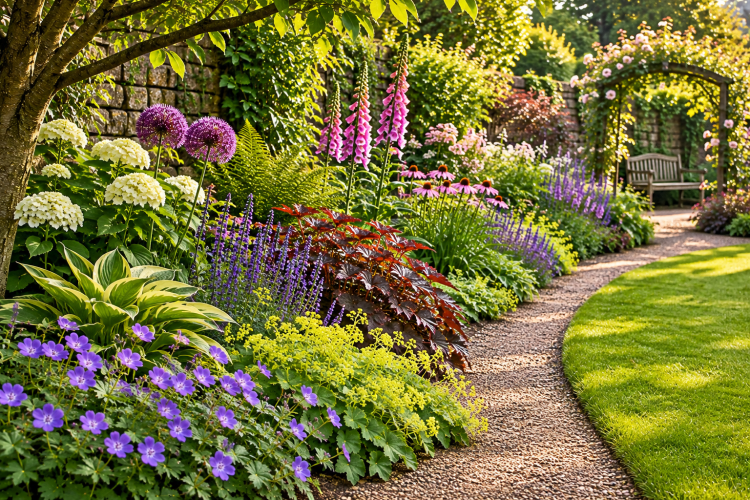
Oh, Rory, this garden is absolutely dreamy! 😍🌸 I fell in love with the winding path, the beautiful layers of flowers and foliage, and that gorgeous dappled sunlight filtering through the trees. It has such a peaceful, welcoming feel to it.
I can imagine spending hours wandering along that path, camera in hand, stopping every few steps to admire another flower or capture a little visitor enjoying the garden.
And that little bench! I can already picture myself sitting there with a cup of tea, while Sir Rambo supervises from lovely bench, complete with a suitably grand cushion, of course. One must make proper arrangements for royalty! 😂👑🐾
I also love the point you’ve made throughout this series about paying attention to what happens beneath the plants we admire. It’s so easy to focus on the beautiful flowers and overlook the quieter layers that support them. A garden is so much more than the blooms we see; it’s the combination of all those different plants, textures and little details that brings it to life. I think that’s a lovely reminder to look a little closer.
This is exactly the sort of garden I would love to have. A little haven filled with colour, birdsong and all those beautiful details that make you want to slow down and simply enjoy being there.
Thank you for sharing these lovely garden inspirations, Rory. You’ve given me another addition to my dream-garden collection! ❤️🌿
LikeLike