| Episode 9 The Wood Warbler: The Little Voice Beneath the Great Trees |
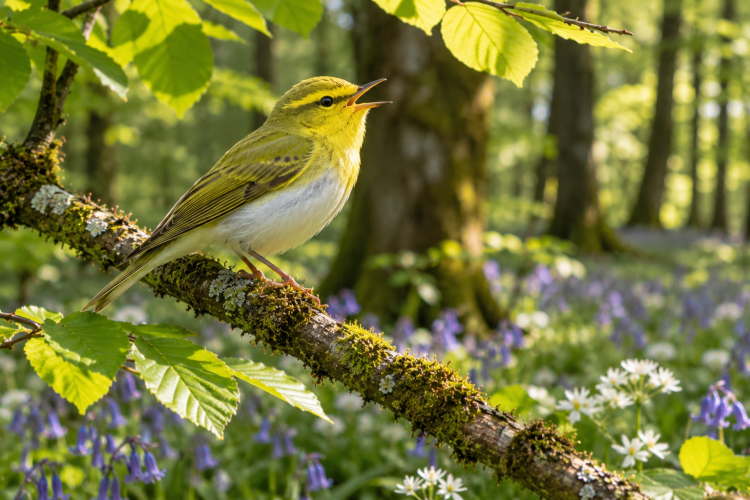
| There is something rather satisfying about working beneath mature trees on a warm spring morning. The light is softer, the soil often holds its moisture a little longer, and the surrounding garden seems to operate at a different pace from the open borders baking in the sunshine. Of course, gardening beneath trees comes with its own difficulties. Roots occupy considerably more space than we might wish, dry shade can be particularly unforgiving, and some plants stubbornly refuse to accept that the conditions are perfectly suitable simply because we have decided they ought to be. Nevertheless, a particular atmosphere beneath an established canopy is hard for younger gardens to reproduce. Woodland possesses that atmosphere on a much grander scale. Walk beneath mature oaks or beeches in late spring, and you become aware of the different layers of life surrounding you. Fresh leaves filter the sunlight, branches move gently overhead, and the woodland floor carries a mixture of emerging plants, fallen leaves and patches of bare earth. Birds move amongst the branches, often heard long before they are seen. Somewhere within this landscape, if you are fortunate enough to be in the right woodland at the right time, a peculiar sound begins to travel through the trees. It starts with a few separate notes, accelerates rapidly and ends in a remarkable trembling trill, rather like a small coin spinning to a halt on a wooden table. The bird responsible is the Wood Warbler (Phylloscopus sibilatrix), a small summer visitor whose appearance gives little indication of the performance it can produce. It is one of those birds that demonstrates how misleading size can be when judging the natural world. A creature weighing little more than ten grams can fill a quiet woodland with a sound that seems completely disproportionate to its physical presence. And, as with so many birds in this series, the closer we look at its life, the more we discover that its survival depends on details of the landscape most of us would otherwise overlook. A Bird That Announces Itself The Wood Warbler is a close relative of the Willow Warbler and Chiffchaff, and all three belong to the genus Phylloscopus. To somebody unfamiliar with them, they can appear frustratingly similar: small, active, greenish birds moving through foliage with little consideration for the person attempting to identify them. Yet the Wood Warbler has a particularly fresh appearance, with bright yellow-green upperparts, a yellow throat and upper breast, and contrasting clean white underparts. Its relatively long wings also give it a distinctive shape when viewed clearly. Its voice, however, is the feature most likely to give it away. The male has two principal song types. The best known is a rapidly accelerating series of notes ending in a vibrating trill, often compared with the sound of a spinning coin. The other is a softer, descending series of plaintive notes that can sound almost melancholy. Hearing both from the same bird reminds us that birdsong is more varied than the simplified descriptions we sometimes find in identification guides. The Wood Warbler’s song is particularly effective in the relatively open spaces beneath mature woodland canopies. A male may sing from branches above the ground, moving between perches as he establishes his territory and attracts a mate. Unlike the Skylark, which broadcasts its song from high above an open field, the Wood Warbler works within the architecture of the trees themselves. I find this relationship between birds and their surroundings fascinating. We often think of birdsong as simply a collection of different voices, but the environment shapes how those voices are used and heard. Dense vegetation, open grassland, reedbeds and mature woodland all present different acoustic conditions. The sound of a bird is therefore part of its habitat, just as much as its nesting site or food supply. It is another reason why walking through woodland with your ears open can reveal far more than concentrating entirely upon what you can see. The Woodland Floor Matters One of the most interesting aspects of the Wood Warbler’s life is its preference for particular woodland structures. It is often associated with mature deciduous woodland, especially oak and beech, where there is relatively open space beneath the canopy and suitable ground vegetation for nesting. This may sound slightly contradictory. We often assume that woodland wildlife benefits most from dense, tangled vegetation, and in many circumstances that is certainly true. Shrubs, brambles and young trees provide essential shelter and nesting opportunities for numerous species. Yet the Wood Warbler frequently favours woodland where the understorey is comparatively sparse, allowing it to move and forage beneath the trees while retaining suitable concealed nesting places at ground level. Its nest is a domed structure built amongst low vegetation and leaf litter, usually on the ground. The female constructs it using grasses, leaves, and other plant material, creating a carefully concealed chamber in which she lays the eggs and raises the chicks. There is something remarkable about the contrast between the bird’s aerial activities and its nesting arrangements. It spends much of its time moving amongst branches, searching leaves for insects, yet its family begins life hidden amongst the vegetation beneath the trees. This dependence upon both canopy and ground conditions illustrates why woodland management is rarely straightforward. A woodland can contain magnificent mature trees and still lack suitable habitat for certain species. Equally, a woodland with dense regeneration may be excellent for some birds while becoming less suitable for others. The answer is not to manage every woodland in precisely the same way, but to understand the different requirements of the creatures living there. What Gardeners Can Learn From Woodland Gardening beneath trees presents a smaller version of this challenge. We may have an established tree providing valuable shade and shelter, but what happens beneath it can vary enormously depending upon how the ground is managed. Some gardens contain trees standing in closely mown lawns, with grass struggling beneath the canopy and little other vegetation permitted to establish. Others have dense shrub planting, groundcover, leaf litter and a mixture of plants adapted to shade. Neither arrangement is automatically right or wrong, but each supports a different wildlife community. One mistake we sometimes make is assuming that more planting must always mean more biodiversity; in reality, structure and variety matter as much as sheer quantity. An open patch beneath a tree may be valuable for birds searching for food, while nearby shrubs provide cover. Fallen leaves support invertebrates and contribute to soil health, while carefully chosen groundcover can protect the soil without creating an impenetrable mass of vegetation. As gardeners, we often want to fill every available space. Bare soil can appear unfinished, and an open area beneath shrubs may look like an invitation to add another plant. Yet woodland reminds us that spaces between plants can be just as important as the plants themselves. That does not mean leaving large areas of soil exposed unnecessarily, particularly where erosion, drying or weed establishment may become problems. It means recognising that a garden can benefit from variation in height, density and structure rather than being planted uniformly from one boundary to another. The Wood Warbler is a useful reminder that wildlife does not necessarily prefer the fullest or most luxuriant-looking habitat. It prefers the habitat that meets its particular needs. A Small Traveller Between Continents Like the Willow Warbler, the Wood Warbler is a long-distance migrant. It arrives in Britain during spring, generally from April onwards, after spending the winter in sub-Saharan Africa. The journey is extraordinary for such a small bird, involving vast distances and a succession of landscapes that must provide suitable conditions along the way. Once in Britain, males establish territories within suitable woodland, and breeding takes place during the relatively brief summer season. By late summer, the birds begin departing again, leaving the woodland to its resident species and the gradual changes of autumn. The fact that these tiny birds repeatedly cross continents is astonishing enough, but their dependence upon different habitats at different times of year makes their conservation particularly complicated. A Wood Warbler may successfully breed in a British woodland yet encounter difficulties during migration or on its wintering grounds. Conversely, favourable conditions in Africa cannot compensate for the disappearance of suitable breeding habitat in Britain. This is a recurring reality of migratory bird conservation. We can protect the woodland where a bird sings, but its survival also depends upon places we may never visit and decisions made by people who have never heard its song. The bird connects those distant landscapes simply by living its life. The Changing Fortunes of a Woodland Singer The Wood Warbler has experienced a substantial decline in Britain over recent decades, and its distribution has contracted in many areas. It remains most strongly associated with suitable woodland in western and northern parts of the country, including areas of Wales, western England and Scotland. However, its occurrence varies considerably between individual woodlands. The reasons for its decline are not fully understood. Changes in woodland structure, breeding conditions, climate and factors affecting survival outside the breeding season may all be involved. Research has also considered the possible influence of predation and changing ecological relationships within woodland habitats. It would be tempting to identify one clear cause and offer a simple solution, but the evidence does not support such certainty. This is something I think we should be comfortable acknowledging when discussing wildlife. Nature is complicated, and not every question has a tidy answer. We can recognise that a species is declining without pretending to understand every mechanism responsible. We can also support conservation measures while accepting that their effectiveness may vary between places. Gardening teaches much the same lesson. A plant may struggle because of soil conditions, moisture, shade, competition, disease or several factors acting together. Sometimes the cause is obvious. At other times we make an informed adjustment, observe what happens and learn from the result. The difficulty comes when we assume that every problem must have one explanation. Woodland is an especially complex environment because its structure changes over decades. Trees mature, canopies close, gaps appear, shrubs develop, and ground vegetation responds to changes in light. Deer browsing, woodland management and natural disturbance can all influence these processes. For a bird with relatively specific habitat preferences, such changes can determine whether a woodland remains suitable. The Value of Leaving Things Alone — Sometimes There is a fashionable assumption that wildlife conservation always means allowing nature to take its course without interference. In certain places, that approach can produce wonderful results. Natural regeneration, dead wood accumulation and the development of complex woodland structures all have enormous ecological value. But it is not universally appropriate. Some species depend upon habitats that require periodic disturbance or management to remain suitable. Open woodland can gradually become densely shaded. Grassland can develop into scrub. Scrub can become woodland. Each stage supports different wildlife, and allowing one stage to replace another inevitably changes the community of species present. The Wood Warbler demonstrates why conservation must consider habitat structure rather than simply counting trees. In gardens, the equivalent lesson is that thoughtful management can be beneficial without becoming excessive control. Pruning a shrub to admit light may encourage a richer layer of planting beneath it. Retaining leaf litter in suitable places can improve soil and provide habitat. Allowing a corner to develop naturally may support insects and birds, while keeping another area open can create different opportunities. There is no single correct level of tidiness for every garden, just as there is no single ideal woodland structure for every bird. The challenge is understanding what we are trying to achieve and recognising that different creatures require different conditions. The Extraordinary in the Ordinary The Wood Warbler is not a bird most people are likely to encounter in their gardens. Its habitat preferences link it more closely to woodland than to ordinary domestic planting, and its declining population means even suitable-looking places may no longer support it. Yet its story has considerable relevance to the way we think about gardens and landscapes. It reminds us that wildlife depends upon structure, not simply appearance. It demonstrates that mature trees and the spaces beneath them form interconnected habitats. It reveals how a bird weighing only a few grams can depend upon environmental conditions spread across continents. And perhaps most importantly, it encourages us to question the assumption that the most valuable natural places are necessarily the ones that look most impressive. A woodland may appear beautiful to us while lacking the particular conditions needed by a declining species. A garden may be filled with expensive plants while offering relatively little shelter or food. Conversely, an unremarkable patch of vegetation beneath mature trees may support an extraordinary variety of life. The Wood Warbler does not care whether a woodland looks picturesque. It cares whether it can survive there. Listening Beneath the Canopy There is a particular pleasure in discovering a bird through its song rather than its appearance. You hear something unfamiliar, stop walking and listen again. Perhaps the sound comes from somewhere above the path, hidden amongst fresh leaves. You wait, trying to locate the source, and eventually a small movement reveals a bird that looks entirely incapable of producing such a remarkable noise. The Wood Warbler’s accelerating trill is one of those sounds that stays with you once you learn it. It belongs to a particular kind of woodland atmosphere: filtered sunlight, mature trees, a relatively open floor and the quiet movement of spring life amongst the branches. For a gardener, something is reassuring about the idea that a landscape can contain such extraordinary detail without advertising it. We spend so much time concentrating on what needs doing that it is easy to overlook what is already happening. A tree is not simply a tree. Its branches, bark, leaves, roots and the ground beneath it form a collection of habitats used by countless organisms. A woodland is not simply a gathering of trees, but a changing community of plants, animals, fungi and microorganisms, all responding to one another and to the passing seasons. The Wood Warbler occupies one small part of that enormous arrangement. Its song may last only a few seconds at a time, but behind it lies an extraordinary journey, a particular relationship with woodland structure and a breeding life concealed amongst leaves on the ground. Perhaps that is what makes birds such rewarding subjects for this series. They encourage us to begin with something simple—a sound, a movement, a flash of colour—and gradually discover how much of the wider natural world is connected to it. The next time you walk beneath mature trees in spring, it may be worth slowing down for a moment. Listen beyond the familiar voices of Blackbirds and Robins, and pay attention to the smaller sounds travelling through the canopy. You may hear nothing unusual. Or you may hear a tiny bird producing a sound rather like a coin spinning to a halt, and discover that the woodland has been keeping one of its more remarkable secrets just above your head. Watching For… Wood Warblers are summer visitors to Britain, generally arriving during April and May and departing later in the summer. They are most likely to be encountered in suitable mature deciduous woodland, particularly oak and beech woods with a relatively open understorey and suitable ground vegetation. Western and northern woodlands offer some of the better opportunities, although the species is now localised and absent from many apparently suitable places. The male’s accelerating trill is the most useful identification feature, particularly when combined with its softer, descending song. Visually, look for a small warbler with bright yellow-green upperparts, a yellow throat and upper breast, and clean white lower underparts. Its long-winged appearance can also help distinguish it from similar species, although the bird’s constant movement amongst leaves may make detailed observation difficult. If you hear a Wood Warbler, remain on established paths and avoid disturbing the surrounding ground vegetation, particularly during the breeding season. Its nest is concealed at ground level and can be remarkably difficult to detect. A patient listener standing quietly beneath the trees is far less disruptive than somebody searching through vegetation for a better view. Sometimes the finest wildlife encounters are the ones where we stand still and allow nature to continue around us. |
| Wander through the Article Directory |
| Wander Through the Series Directory |
| About our writing & imagery Most articles reflect our real gardening experience and reflection. Some use AI in drafting or research, but never for voice or authority. Featured images may show our photos, original AI-generated visuals, or, where stated, credited images shared by others. All content is shaped and edited by Earthly Comforts, expressing our own views. |

