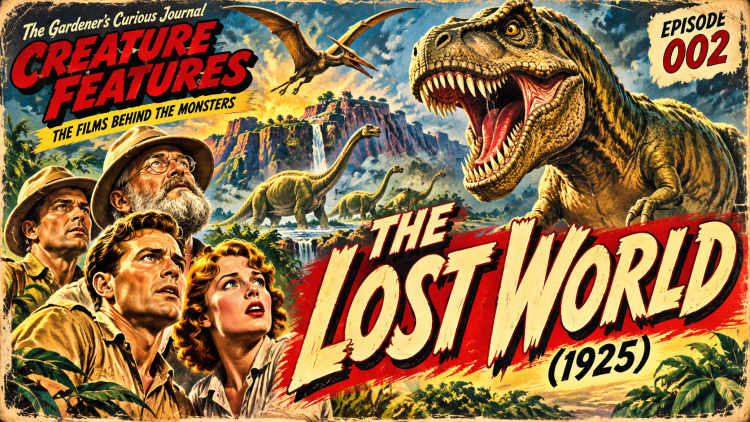
| Episode 002 |
| The Lost World (1925) When Dinosaurs First Conquered the Cinema |
| Before giant radioactive ants began terrorising American towns, before sharks made seaside holidays considerably less appealing, and long before computer-generated dinosaurs could demolish entire theme parks, there was The Lost World. Released in 1925, this remarkable silent adventure introduced audiences to prehistoric creatures moving, fighting and apparently living before their eyes. Almost a century before digital effects became commonplace, filmmakers were already finding extraordinarily inventive ways to bring extinct animals back to life. Directed by Harry O. Hoyt and adapted from Sir Arthur Conan Doyle’s 1912 novel, The Lost World occupies an important position in cinema history. Pioneering stop-motion animation brought its creatures to life. Although their appearance reflects the scientific understanding of the period, their movements demonstrated possibilities that would influence generations of filmmakers. An Expedition into the Impossible The story follows Professor George Edward Challenger, played by Wallace Beery, an eccentric and formidable scientist who claims to have discovered evidence that prehistoric creatures still inhabit an isolated plateau in South America. Unsurprisingly, his assertions are greeted with considerable scepticism. After all, announcing that dinosaurs remain alive somewhere beyond civilisation is the sort of claim likely to attract raised eyebrows, particularly when the principal evidence consists of an extraordinary traveller’s account. An expedition is assembled to investigate, including journalist Edward Malone, portrayed by Lloyd Hughes, and the adventurous Sir John Roxton, played by Lewis Stone. Bessie Love appears as Paula White, whose missing father provides an additional reason for undertaking the journey. Upon reaching the plateau, the explorers discover that Challenger’s claims are considerably less ridiculous than they initially appeared. Dinosaurs roam the landscape, prehistoric reptiles battle for survival, and the expedition finds itself surrounded by creatures that humanity had previously known only through fossils and scientific reconstruction. The film’s adventure eventually extends beyond the plateau, showing that transporting a prehistoric animal into modern civilisation may not be the wisest decision an explorer could make. The Man Who Made Dinosaurs Move The real star of The Lost World is arguably neither Wallace Beery nor any of his fellow actors, but special-effects pioneer Willis O’Brien. O’Brien developed elaborate stop-motion techniques in which articulated models were photographed one frame at a time, their positions adjusted slightly between exposures. When projected at normal speed, the resulting images created the illusion of continuous movement. The process demanded extraordinary patience. A relatively brief sequence might require hundreds of individual adjustments, and combining animated creatures with live-action performers added technical challenges. O’Brien’s work was supported by a team that included sculptor Marcel Delgado, whose model-making helped give the dinosaurs their distinctive appearance. Their creations possessed a sense of weight and personality that made them more than simple moving objects. The film’s most memorable sequences include battles between prehistoric animals and the appearance of a gigantic brontosaur in London. Although modern audiences may notice the limitations of the effects, the ambition remains impressive. These were not creatures generated instantly by computer software, but painstakingly constructed models animated through countless individual photographs. O’Brien would later develop his techniques further for King Kong (1933), establishing a direct creative connection between two of early cinema’s most influential monster productions. The Creatures Behind the Monsters Unlike many later creature features, The Lost World did not depend upon inventing fictional animals. Its monsters were inspired by creatures that genuinely existed, although their cinematic appearance reflected early twentieth-century palaeontology. The film features several recognisable prehistoric animals, including sauropod dinosaurs, predatory theropods and Triceratops. Its prehistoric landscape also includes animals other than dinosaurs, notably the flying reptile Pteranodon. This distinction matters because popular cinema has frequently grouped almost every prehistoric reptile under the convenient heading of dinosaur. Pterosaurs, however, belonged to a separate evolutionary lineage, while dinosaurs themselves included an enormous diversity of animals with very different body structures and lifestyles. The film’s sauropods are particularly interesting. During the 1920s, enormous long-necked dinosaurs were often imagined as sluggish, heavy-bodied creatures spending considerable time in water to support their weight. Modern research has substantially revised that interpretation, presenting sauropods as predominantly terrestrial animals with sophisticated adaptations for supporting their extraordinary size. Predatory dinosaurs have undergone equally dramatic scientific reassessment. Their posture, movement and relationship to modern birds are now understood very differently from the lumbering reptilian monsters commonly depicted in early cinema. Nevertheless, the filmmakers were working from the scientific illustrations and fossil interpretations available to them. Their dinosaurs provide a fascinating visual record of how prehistoric life was imagined a century ago. A Few Fascinating Cinematic Discoveries One particularly interesting aspect of The Lost World is Sir Arthur Conan Doyle’s involvement. The creator of Sherlock Holmes was enthusiastic about the possibilities of motion-picture technology, and the film’s production benefited from the enormous public interest surrounding his prehistoric adventure. The film also established a storytelling formula that would become remarkably familiar: explorers discover an isolated prehistoric world, encounter extraordinary creatures and eventually bring some of that danger back into modern civilisation. Eight years later, King Kong would develop similar ideas with considerably greater technical sophistication, again benefiting from Willis O’Brien’s extraordinary imagination. Another historical curiosity is that The Lost World survived for decades principally through incomplete versions. Later archival discoveries and restoration work have allowed audiences to see substantially more of the original production, although the history of its surviving prints remains complicated. A Prehistoric Achievement Worth Rediscovering Watching The Lost World today requires a little adjustment. Silent-film performances can appear theatrical, the pacing differs from modern adventure cinema, and the dinosaurs occasionally move with an enthusiasm that their anatomy might struggle to justify. Yet dismissing the film because its effects are nearly a century old would miss its importance entirely. Here was a production attempting something genuinely extraordinary: persuading audiences that extinct animals could inhabit the same cinematic world as living actors. Its achievements helped establish the foundations upon which generations of monster movies would build. For Creature Features, it represents a particularly appropriate second adventure. Before Hollywood discovered the possibilities of radioactive mutation, filmmakers had already realised that the distant prehistoric past offered a seemingly limitless supply of enormous, dangerous and wonderfully entertaining creatures. Creature Features verdict: A pioneering silent-cinema adventure whose technical ambition and prehistoric imagination helped shape the future of monster film making. One film. One creature. One monstrous adventure. |
| Now Showing — A Journey Back to 1925 |
| Editorial research note The film’s principal credits, original production history and restoration details have been checked against the American Film Institute, George Eastman Museum and Turner Classic Movies. One particularly worthwhile historical detail for our archive is that the film was selected for the United States National Film Registry in 1998, recognising its lasting significance. |
| More Monsters Await! Creature Features — The First Twenty Films Our opening collection contains twenty extraordinary encounters with cinema’s most memorable monsters. Discover the other nineteen adventures awaiting exploration. |
| 001 — Them (1954) 002 — The Lost World (1925) 003 — Tarantula (1955) 004 — The Birds (1963) 005 — King Kong (1933) 006 — The Deadly Mantis (1957) 007 — Jaws (1975) 008 — The Black Scorpion (1957) 009 — Razorback (1984) 010 — Beginning of the End (1957) |
| 011 — Phase IV (1974) 012 — Alligator (1980) 013 — Kingdom of the Spiders (1977) 014 — Tremors (1990) 015 — The Food of the Gods (1976) 016 — Mimic (1997) 017 — Piranha (1978) 018 — Black Sheep (2006) 019 — The Host (2006) 020 — Crawl (2019) |
| Wander through the Article Directory and see where curiosity takes you next. |
| About our writing & imagery Most articles reflect our real gardening experience and reflection. Some use AI in drafting or research, but never for voice or authority. Featured images may show our photos, original AI-generated visuals, or, where stated, credited images shared by others. All content is shaped and edited by Earthly Comforts, expressing our own views. |

