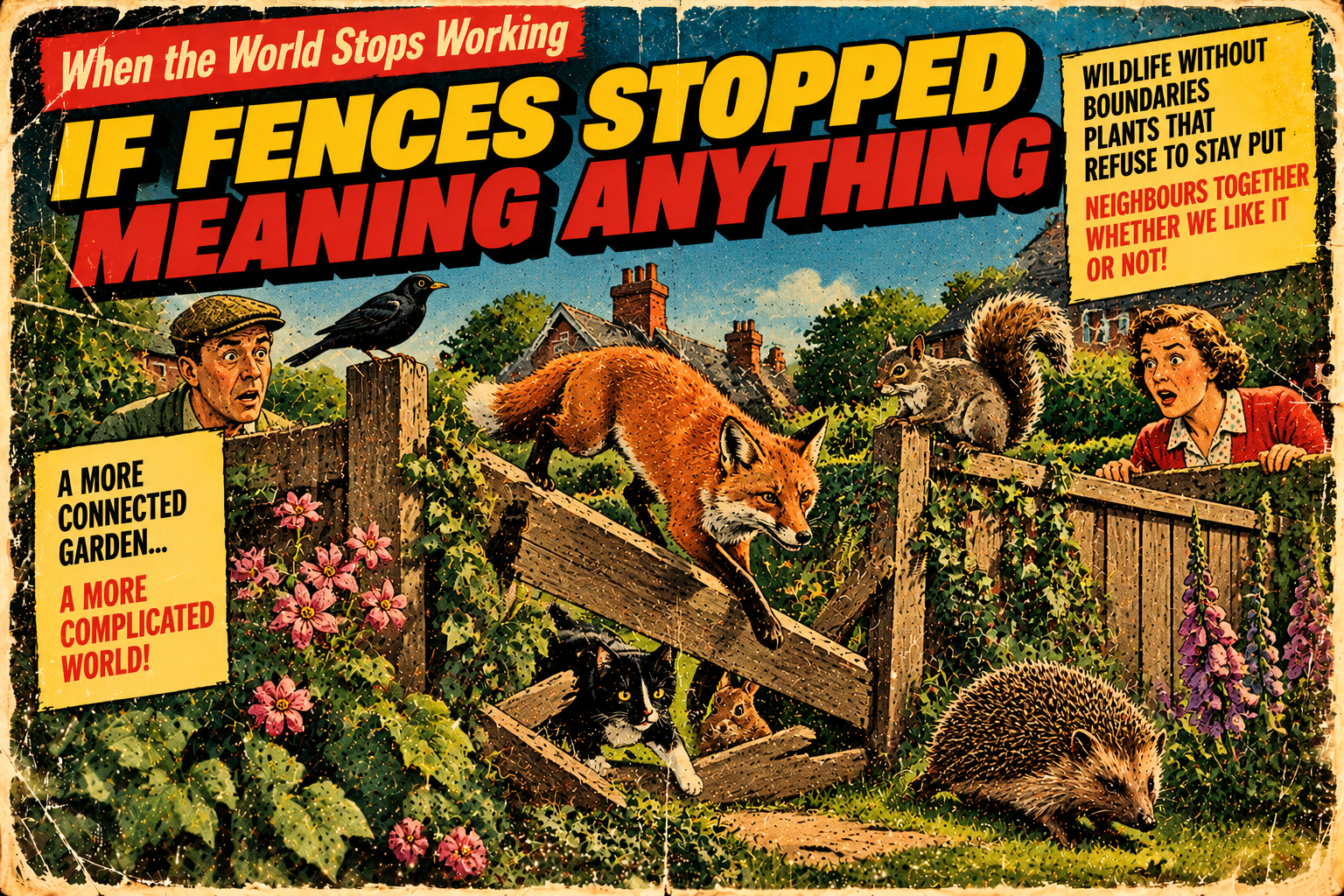
| What happens when the boundaries we build around our gardens matter less than we think? |
| There is something wonderfully British about a garden fence. We may be prepared to tolerate a great many things in life, including unreliable weather, potholes, rising prices, and the occasional questionable decision by the local council, but few things can produce quite the same level of indignation as a neighbour’s fence being six inches out of position. We are a nation that likes its boundaries clearly established, preferably marked by six-foot wooden panels, concrete posts and a respectable gravel board. Once everything is in place, we can sit comfortably in our gardens, secure in the knowledge that whatever is happening on the other side is somebody else’s responsibility. Of course, anyone who has spent much time gardening will know that nature has never shown the slightest interest in these arrangements. The blackbird perched on the fence does not consider itself to be trespassing. The bindweed climbing through the panels has not applied for permission, and the roots of the neighbour’s sycamore are unlikely to stop growing simply because somebody has produced a copy of the Land Registry plan. Even the wind, which regularly demonstrates its opinion of British fencing during winter storms, seems particularly unimpressed by our attempts to divide the landscape into neat little rectangles. But suppose that one day our garden fences stopped meaning anything. Not necessarily because they all collapsed overnight, although that would certainly make for an interesting Monday morning, but because the natural world began behaving in ways that made our boundaries increasingly irrelevant. Plants spread more readily, wildlife moved more freely, water travelled wherever gravity took it, and the distinctions between one garden and another became progressively harder to maintain. What would happen to the way we garden, and perhaps more importantly, to the way we think about the land we occupy? The Great British Boundary The garden fence is a comparatively simple object performing a surprisingly complicated collection of duties. It provides privacy, keeps children and domestic animals within a particular area, offers some protection from the wind and gives climbing plants something to cling to. It also establishes a psychological boundary between what belongs to us and what belongs to somebody else. A well-maintained fence tells the world that this garden has an owner, a purpose and, ideally, somebody prepared to keep the weeds under control. In many older British villages, however, the landscape was not always divided in quite the way we recognise today. Hedges, ditches, walls and living boundaries performed practical functions, often marking agricultural land while simultaneously providing shelter, food and habitat for wildlife. Some ancient hedgerows developed into extraordinarily complicated ecosystems, supporting everything from nesting birds and small mammals to fungi, insects and an astonishing range of plants. They were boundaries, certainly, but they were also living parts of the countryside. Modern domestic fencing is often far less accommodating. A continuous run of close-board panels may provide excellent privacy, but it can also create a remarkably effective barrier to hedgehogs and other ground-dwelling animals. A fence can interrupt the natural movement of wildlife across what was once a connected landscape, particularly when neighbouring gardens are similarly enclosed. We have effectively created thousands of little territories, each managed according to the preferences of its human occupants. At the same time, the wildlife that existed long before the houses were built must somehow find a way around them. John once remarked, while we were struggling to remove an elderly fence post that appeared to have been concreted halfway to Australia, that he had never understood why people spent so much money keeping their neighbours out when they could avoid talking to them. It was a reasonable observation, although I pointed out that a fence also prevents the neighbour’s Labrador from digging up the tulips. John conceded that this was probably worth the expense. When the Garden Begins to Ignore the Fence Imagine a typical row of suburban gardens. Each has its own lawn, borders, shrubs, perhaps a vegetable patch and a collection of garden furniture that spends most of the year waiting for suitable weather. Wooden fencing separates the gardens, and their owners manage them independently. One neighbour favours immaculate lawns and clipped evergreens; another prefers a more natural approach; and a third has apparently decided the entire garden should become a permanent storage facility for unused building materials. Now imagine that the plants begin spreading across these boundaries more successfully than usual. Brambles establish themselves beneath the panels, ivy finds every available gap, and vigorous climbers begin linking neighbouring gardens into one increasingly complicated mass of vegetation. Tree roots extend beneath lawns and patios, while self-seeding plants appear wherever suitable conditions exist. The process would not be particularly mysterious, because all of these things already happen. The difference would be the speed and persistence with which they occurred, gradually making individual garden management more difficult. We have all encountered situations where a plant appears to have developed ambitions considerably beyond those suggested on its nursery label. Bamboo is a familiar example, particularly running varieties that can produce underground rhizomes that travel some distance from the original planting position. Japanese knotweed is another, although its reputation is so formidable that merely mentioning it in conversation can cause a homeowner to look nervously towards the nearest patch of suspicious foliage. Neither plant needs to recognise a property boundary to create problems for the people living on either side. Even perfectly ordinary plants can cause disagreements. An overhanging branch may cast shade over a neighbour’s greenhouse, a vigorous hedge may gradually occupy more space than intended, and the roots of a mature tree can influence soil moisture well beyond its trunk. We often think of gardens as independent spaces, yet their growing conditions are connected in ways that are not immediately visible. Soil, water, sunlight, wind and biological activity operate across boundaries, regardless of who pays the council tax. If the fences themselves remained standing while everything around them became increasingly interconnected, we might eventually discover that the barriers were performing little more than a decorative function. They would still tell us where our gardens ended, but they would no longer tell us where the consequences of our gardening decisions stopped. The Wildlife Has Already Voted Wildlife provides perhaps the clearest demonstration of how little our boundaries matter to the natural world. Birds move between gardens according to food availability, nesting opportunities and shelter. Bees and other pollinating insects visit flowers across entire neighbourhoods, while foxes, squirrels and hedgehogs establish territories that may include several properties. A garden that appears isolated to its owner may be one small part of a much larger ecological network. Hedgehogs are particularly interesting because their survival depends upon being able to move through suitable habitat in search of food, shelter and potential mates. A single enclosed garden, however wildlife-friendly it may appear, cannot necessarily provide everything an individual hedgehog requires. This is why creating small hedgehog highways through garden boundaries has become increasingly important. A gap of about 13 centimetres square at the base of a fence can let hedgehogs travel between neighbouring gardens, provided the opening is safe and accessible. Now suppose that wildlife movement became even more pronounced. Perhaps changing conditions in the countryside encouraged more animals to seek food and shelter in towns and villages. Gardens with ponds, mature shrubs, compost heaps and undisturbed corners might become increasingly valuable refuges, while sterile lawns and tightly enclosed patios offered relatively little. The difference between a garden managed for wildlife and one managed purely for appearance would become more significant, not just for the animals themselves but for the wider neighbourhood. There would inevitably be complications. A fox digging beneath a shed may charm one household and thoroughly unnerve another. Badgers, where present, can cause considerable disturbance while searching for food, and squirrels are not generally known for their respect towards carefully arranged bulb displays. Encouraging wildlife also requires sensible management, particularly around pets, ponds, netting, and garden machinery. The objective is not to surrender every garden to the local animal population, but to recognise that the creatures moving through our properties are part of a much larger system. John has always maintained that squirrels are little more than rats with better public relations. I have suggested this may be unfair. However, watching one excavate a freshly planted container in search of a walnut it buried three weeks earlier makes his argument hard to dismiss. When Water Crosses the Line Plants and animals are only part of the story. Water is another enthusiastic boundary-breaker, and unlike the neighbour’s climbing rose, it can cause considerable damage before anyone has time to complain. Rainwater follows the shape and permeability of the land, travelling across gardens, beneath fences and through the soil according to local conditions. A new patio, an extended driveway, or compacted ground can alter how water moves, sometimes creating consequences well beyond the property where the work was carried out. In a world experiencing more frequent episodes of intense rainfall, the relationship between neighbouring gardens could become increasingly important. One property might have deep borders, mature planting and healthy soil capable of absorbing substantial amounts of water, while the next has been covered almost entirely with paving. During heavy rain, the difference could influence how quickly water accumulates and where it eventually travels. A fence may prevent somebody from seeing the problem developing next door, but it will do very little to stop the water itself. The same principle applies during drought. Trees and large shrubs draw moisture from soil that extends beyond the visible planting area, while neighbouring gardens may experience different levels of shade, evaporation and competition for water. A mature tree growing close to a boundary may provide valuable cooling and shelter to several properties, even though its roots and branches occasionally cause frustration. Remove that tree, and the effects may be felt across more than one garden. This is where the idea of gardens as independent spaces begins to fall apart. Our individual decisions contribute to shared environmental conditions, whether we recognise the connection or not. If rainfall became more unpredictable, drainage problems more frequent and summer temperatures increasingly difficult to manage, the value of cooperation between neighbouring gardeners could become considerably greater. We might eventually find ourselves discussing rain gardens, permeable surfaces, shared planting and water management with the people next door. For some British households, this would be far more alarming than the flooding itself. The Return of the Living Boundary One possible response would be to reconsider what we expect a garden boundary to do. A wooden fence is certainly useful, and there are good reasons to maintain secure, private outdoor spaces. But where circumstances permit, a living hedge can offer benefits that a solid panel cannot. It can provide shelter, nesting opportunities, food for wildlife and a changing appearance through the seasons, while helping to soften the visual divisions between neighbouring gardens. Native hedging plants such as hawthorn, field maple, hazel and blackthorn can be particularly valuable in suitable locations. However, the choice of species must always reflect the space available and the maintenance commitment involved. A mixed hedge requires planning, and some plants are vigorous, thorny or unsuitable for very narrow gardens. There is little sense in replacing an inconvenient fence with a hedge that eventually consumes half the lawn and requires somebody to stand on a ladder every fortnight. The important distinction is that a living boundary performs more than one function. It can provide privacy while supporting wildlife, sheltering planting and contributing to the character of the garden. Even where conventional fencing remains necessary, climbing plants, carefully positioned shrubs and wildlife-friendly openings can make the boundary more useful. The aim is not to remove every fence in Britain but to make the spaces between our gardens less hostile to the life attempting to move through them. There is also something appealing about the idea that boundaries might become shared responsibilities rather than permanent sources of disagreement. Neighbours could cooperate over hedge maintenance, tree planting, drainage improvements or wildlife access, recognising that the benefits extend beyond one property. Naturally, this assumes that everybody involved is reasonably sensible, which may be the most speculative part of the entire article. The Problem With Sharing a Garden Of course, there is a considerable difference between ecological cooperation and actually sharing a garden. Most people value their privacy, and quite rightly so. A garden can be a refuge from work, noise and the general demands of modern life. It may be somewhere to sit quietly with a book, enjoy a family gathering or spend half an hour doing absolutely nothing without having to explain yourself to anybody. If fences genuinely stopped functioning as meaningful barriers, that privacy could become difficult to maintain. Domestic animals might wander between properties, children could stray into unsafe areas, and maintenance disagreements would become more complicated. Some gardens contain ponds, steep changes in level, machinery or plants that require particular care. Boundaries help people manage these risks, and abandoning them without considering the practical consequences would offer little advantage. Ownership and responsibility would also remain important. A property boundary does not disappear simply because a hedge becomes overgrown or a fox digs beneath the fence. Legal boundaries, access rights and maintenance obligations would still exist, and any significant changes to fencing or shared structures would need to respect them. Our imagined scenario is therefore less about the disappearance of ownership and more about recognising that ownership has never provided complete control over the natural processes taking place within it. Perhaps the most realistic future would involve keeping the useful aspects of our boundaries while becoming more thoughtful about their limitations. We could preserve privacy and security without treating every garden as an ecological island. We could acknowledge that a tree, hedge or drainage system may benefit several households, even when it is located entirely within one property. And we could perhaps become a little less enthusiastic about blaming the neighbours whenever a dandelion seed arrives on the breeze. A Garden Without Invisible Walls An interesting contradiction lies at the heart of modern gardening. We often talk about encouraging biodiversity, improving soil health, supporting pollinators, and creating wildlife-friendly spaces. Yet, we manage those spaces as though everything important happens within the boundaries of our own gardens. We may plant flowers for bees without considering where those bees will find food during the rest of the year, or install a hedgehog house without noticing that the surrounding fences prevent a hedgehog from reaching it. A more connected approach to gardening would require us to think beyond the individual plot. A row of gardens containing flowering plants throughout the seasons could provide a more useful network for pollinators than one isolated garden overflowing with summer flowers. Several neighbouring properties with accessible boundaries, sheltered corners and suitable vegetation could support wildlife movement more effectively than a single garden attempting to provide everything. Even small decisions, such as leaving a safe passage beneath a fence or avoiding unnecessary hard landscaping, could contribute to a healthier local environment. None of this means that every garden should look alike. Variety is often beneficial, and the contrast between a sunny vegetable garden, a shaded woodland-style border and a small wildlife pond can create a diverse collection of habitats within a relatively compact area. The key is to keep the different spaces connected wherever possible, so living things can use the opportunities available. Professional gardeners could have an important role in encouraging this change. We move between properties, observe recurring problems and often notice connections that individual householders may not see. A drainage issue in one garden may be related to changes further uphill, while an unusually successful population of pollinators may reflect the planting choices of several neighbouring households. We can explain these relationships, suggest practical improvements and help clients understand that good gardening sometimes involves looking beyond the fence. It would also give John another reason to complain about how much time I spend talking to people when we are supposed to be working. What If the Fences Really Did Stop Mattering? Suppose we reached a point where the most successful gardens were no longer those that operated independently, but those that formed part of a wider, more resilient network. Wildlife could move between suitable habitats, rainwater could be managed more thoughtfully, and planting decisions could contribute to healthier conditions across entire streets and neighbourhoods. Individual gardens would retain their character and purpose, but their owners might begin to recognise that they were looking after small sections of something much larger. It is not an entirely fanciful possibility. Many of the ecological connections already exist, although we do not always notice them. Birds visit several gardens before breakfast, tree roots extend beneath our carefully maintained lawns, and insects travel between flowers without the slightest concern for property deeds. The natural world has always operated across the boundaries we create. What might change is our willingness to acknowledge that fact. Perhaps the most remarkable outcome would be a change in attitude. Instead of seeing the garden fence as the point where our responsibility ends, we might begin to regard it as the place where our influence meets somebody else’s. We would still need boundaries, and we would certainly still need to repair them after a particularly enthusiastic winter storm. Still, we might stop imagining that they separate us from the wider environment. I mentioned this possibility to John while we were replacing a rotten fence panel in a garden where an elderly honeysuckle had managed to weave itself through almost every available opening. Removing the panel without damaging the plant was proving considerably more difficult than either of us had anticipated, and John was becoming increasingly convinced that the honeysuckle had developed a personal objection to our presence. I suggested the plant was showing how little importance it attached to the boundary between the two gardens. John looked at the tangled stems, the broken panel and the pile of tools scattered across the lawn before informing me that if fences ever stopped meaning anything, he would be delighted, because it would mean we could stop repairing the bloody things. And perhaps, in his own way, he had a point. We spend a great deal of time building barriers to keep the natural world neatly organised, only to discover that nature has been moving around, beneath and through them all along. The fences may belong to us, but the garden has always been part of something bigger. |
| Wander through the Article Directory and see where curiosity takes you next. |
| About Our Writing & Imagery Most articles are grounded in our real gardening experience, observations and reflections. AI may assist with research, drafting and editing, but the experiences, opinions and editorial direction are our own. Featured images may include our photography, original AI-generated visuals or, where stated, images credited to others. Earthly Comforts reviews and shapes all published content before it goes live. |

