
| Case File 09 The Skunk Ape — Florida’s Mysterious Swamp Dweller |
| Florida’s Mysterious Swamp Dweller For generations, people have reported encounters with a large, hairy creature in Florida’s swamps. Some describe a towering, upright-walking animal, while others remember an overpowering smell. But when two extraordinary photographs emerged from Sarasota County at the turn of the millennium, the mystery took shape. Twenty-six years later, how much of that face can we trust? |
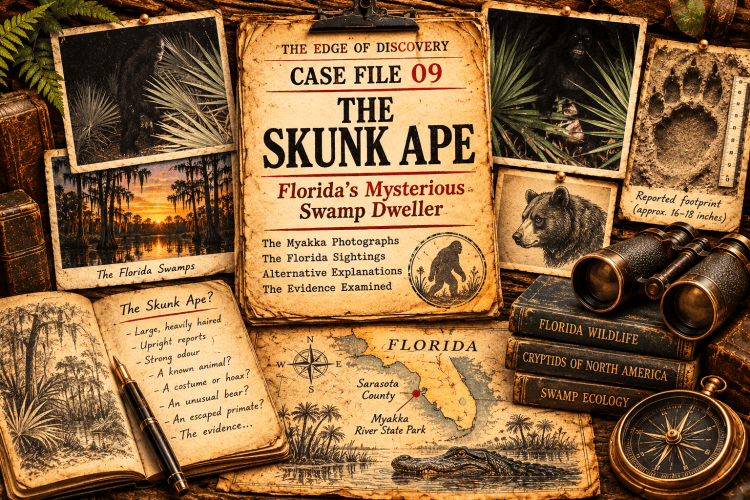
| Something Unusual in the Palmettos Florida’s wetlands are extraordinary places. Beneath the cypress trees, among tangled roots, saw palmettos and dark stretches of water, animals move through landscapes that can be surprisingly difficult to penetrate. Alligators lie almost invisibly beneath the surface, black bears forage through woodland, and the endangered Florida panther survives in habitats where even experienced observers may struggle to catch a glimpse. This environment can produce unexpected encounters, particularly after sunset, when unfamiliar noises and fleeting movements become difficult to identify. Among the creatures allegedly inhabiting these swamps is the Skunk Ape, sometimes called the Swamp Ape or Florida Bigfoot. Descriptions vary, but witnesses commonly report a large, heavily haired animal that can walk upright. Its name comes from an unpleasant odour associated with some encounters, variously compared with rotting vegetation, sewage or animal musk. Reports became especially prominent during the twentieth century, and by the 1970s the Skunk Ape had become one of America’s better-known cryptozoological mysteries. This Case File is going to take a slightly different direction. Rather than simply collecting eyewitness accounts and asking whether an undiscovered primate might inhabit Florida, we’re going to examine the evidence that has helped sustain the legend. In particular, two photographs, reportedly taken in 2000, have prompted a rather more detailed examination than I originally anticipated. And the more closely we look, the more questions emerge. |
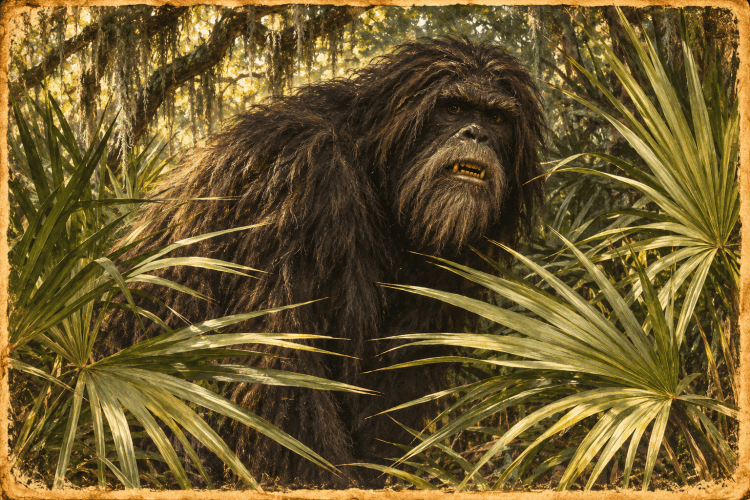
| The Myakka Photographs & Our Artistic Interpretation The two photographs associated with the alleged Myakka Skunk Ape were reportedly submitted anonymously to the Sarasota County Sheriff’s Office in December 2000. They remain among the most widely discussed images in the history of Florida’s mysterious swamp-dwelling creature. We have chosen not to reproduce the original photographs in this article, as we have been unable to verify their copyright status or establish whether we have the legal right to republish them. Although the photographer remains unidentified, this does not necessarily mean the images are free from copyright restrictions. Instead, the illustration displayed above is our own AI-generated artistic interpretation, created specifically for The Gardener’s Curious Journal. It represents our imagined appearance of the creature described in the Myakka photographs and should not be mistaken for an authentic photograph, a scientifically accurate reconstruction or evidence that such an animal exists. Readers who wish to examine the historical photographs for themselves can find them in the following article: Historical image source: Smithsonian Magazine — On the Trail of Florida’s Bigfoot. We encourage readers to examine the original images and consider the competing explanations discussed in this case file. After all, the purpose of The Edge of Discovery is not to tell readers what they should believe, but to explore the evidence, question its interpretation and allow curiosity and critical thinking to lead the investigation. |
| The Myakka Photographs — Twenty-Six Years Under Suspicion In December 2000, two photographs accompanied by an anonymous letter were reportedly sent to the Sarasota County Sheriff’s Office. The writer described herself as a grandmother living near Interstate 75 and claimed that an unfamiliar animal had been visiting her property, apparently attracted by apples. She suggested that it might be an escaped orangutan and expressed concern about its presence. The photographs subsequently entered public circulation in early 2001 and became known as the Myakka Skunk Ape photographs, although the precise location of the encounter was never independently established. The images show a large, dark, heavily haired figure among palmetto foliage. Its face appears partly illuminated by the camera flash, revealing reflective eyes, a prominent mouth and conspicuous teeth. The surrounding vegetation obscures much of its body, preventing a reliable assessment of its height, proportions or posture. At first glance, the subject certainly resembles the popular image of a mysterious ape. But resemblance is not identification, and the photographs’ anonymous circumstances make their evidential value difficult to establish. There is also a distinction between when photographs became known and when they were actually taken. Their receipt around the end of 2000 is part of the documented history of the case. Still, the precise date of exposure, the photographer’s identity, and the circumstances of the alleged encounter have not been independently authenticated. The photographs demonstrate that someone presented images of an unusual-looking subject. They do not establish what that subject was, where it came from or whether the accompanying account was accurate. This uncertainty is important because an extraordinary photograph is only as reliable as the evidence supporting its origin. |
| The Leaves That Conceal More Than They Reveal My first serious reservation concerned the vegetation. Looking at the Myakka photographs, the palmetto leaves seem almost conveniently arranged around the subject, obscuring substantial portions of its body while leaving the face exposed. It is a striking composition, but also a frustrating one, because the very features needed to distinguish a genuine animal from a costume are hidden behind overlapping fronds. Saw palmetto (Serenoa repens) naturally produces dense clusters of fan-shaped leaves supported by long, often sharply toothed stalks. In Florida’s undergrowth, these leaves overlap at different heights and angles, sometimes concealing most of an animal while leaving its head visible. We compared the Myakka photographs with ordinary wildlife images showing bears and deer among similar vegetation, and that comparison introduced an important caution. An apparently convenient arrangement of leaves is not necessarily artificial. Nature can produce remarkably theatrical compositions without assistance. Nevertheless, the original photographs do not let us trace every visible frond back to its growing point or establish whether any leaves were repositioned. Nor do we possess a verified photograph of the same scene without the subject. The foliage therefore cannot be presented as proof of staging, but neither does it help authenticate the encounter. It conceals important anatomical evidence and leaves us unable to reconstruct the animal’s position with confidence. Another peculiar feature is the green material apparently crossing the mouth. Could the subject have been feeding? Florida wildlife certainly consumes saw palmetto fruit, while some animals eat tender growing parts of the plant. Mature leaves, however, are tough and fibrous, and the photograph shows no clear evidence of an animal deliberately grasping or chewing a frond. The green material could be vegetation crossing in front of the face. Without clearer imagery, its significance remains uncertain. A Face That Raises Questions The creature’s face presents further difficulties. The exposed teeth appear unusually prominent, particularly the pointed structures associated with the lower jaw. A greyish, beard-like area surrounds the chin, contrasting with the darker hair elsewhere. The combination creates a memorable, almost theatrical appearance, but the photographic detail is insufficient to determine whether the teeth and surrounding facial structures are anatomically consistent with a recognised primate. Large canine teeth are not unusual among great apes. Adult male orangutans, gorillas and chimpanzees possess formidable canines, despite having diets that are not predominantly carnivorous. Consequently, prominent lower teeth do not establish that an animal is a predator, nor do they demonstrate that the subject is artificial. What matters is the complete relationship between the teeth, jaws, lips and surrounding facial anatomy, and the Myakka photographs do not reveal these features clearly enough for a dependable identification. The grey facial hair is similarly ambiguous. Some primates develop conspicuous beards or lighter facial hair, while camera flash and differences in hair texture can exaggerate colour contrasts. An elaborate costume could reproduce the same effect, particularly if separate materials were used around the jaw. But no definitive costume seam can be established from the available images, and it would be misleading to claim that the beard alone exposes a hoax. The apparent behaviour also deserves consideration. Across the two photographs, the subject seems to change position while remaining close to the foliage. If the accompanying account were genuine, an animal investigating food near a residence might approach cautiously and then withdraw. Equally, a person wearing a costume could reproduce that movement. Two still photographs cannot establish a continuous behavioural sequence, and we do not know what occurred between exposures. Looking Through Familiar Eyes During my years working with exotic animals, I had considerable experience with primates, although the largest I worked with closely were lemurs. I also lived in Malaysia, where macaques and dusky leaf monkeys were familiar sights around Penang, and I occasionally encountered gibbons and orangutans elsewhere. That experience does not make me a specialist in great-ape anatomy, but it has given me opportunities to observe primates beyond the familiar images encountered in books and documentaries. Looking at the Myakka subject, my initial impression is that it is more ape-like than an ordinary bear. Yet that impression does not convince me that the photographs depict a genuinely unknown animal. The face, teeth, greyish hair and obscured body invite questions rather than provide answers. Two alternatives particularly interest me: an elaborate costume, perhaps created for theatrical or film use, and a bear whose appearance had been altered by injury, disease or some other physical abnormality. A costume would explain why the subject appears so conveniently framed and why its face possesses such conspicuous features. It could also account for the absence of clearly visible anatomical details. But we have no evidence linking the photographs to a particular costume, production, or prank, and we cannot establish whether the anonymous correspondent knowingly participated in any deception. A physically unusual bear is another possibility, although it remains speculative. Muzzle injury, dental disease, congenital abnormalities, or severe skin conditions can alter an animal’s appearance. Florida black bears can stand upright, and a fleeting encounter with an unusually formed individual might cause considerable confusion. However, the photographs do not demonstrate any particular medical condition, and the subject’s apparent facial proportions are not easily reconciled with those of an ordinary black bear. Neither explanation can be confirmed. Both are worth considering because they involve recognised possibilities rather than requiring an entirely unknown species. |
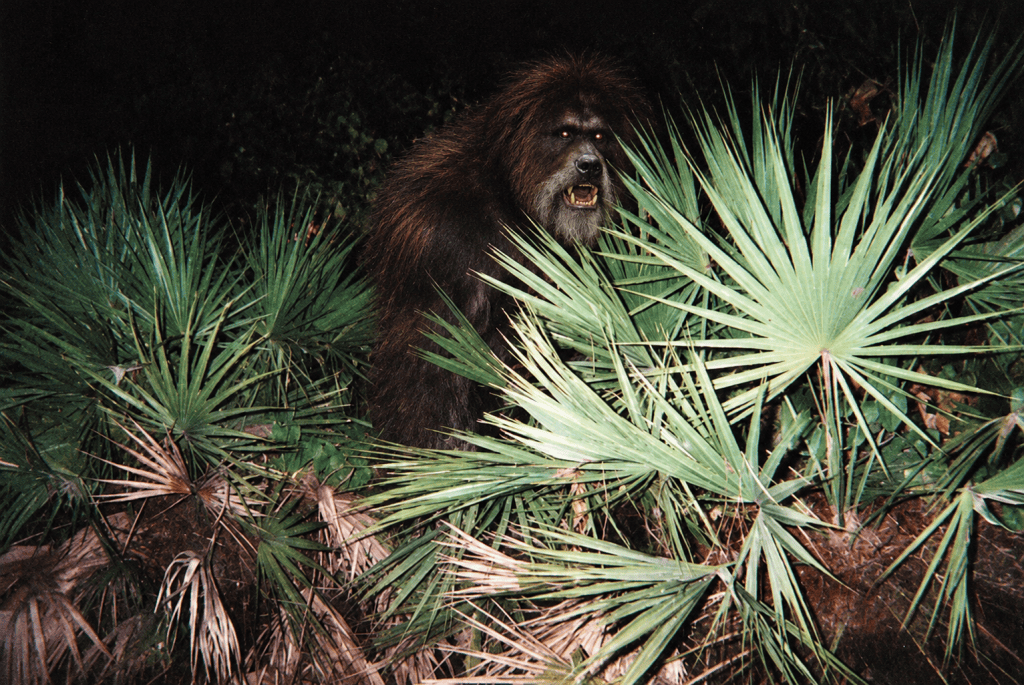
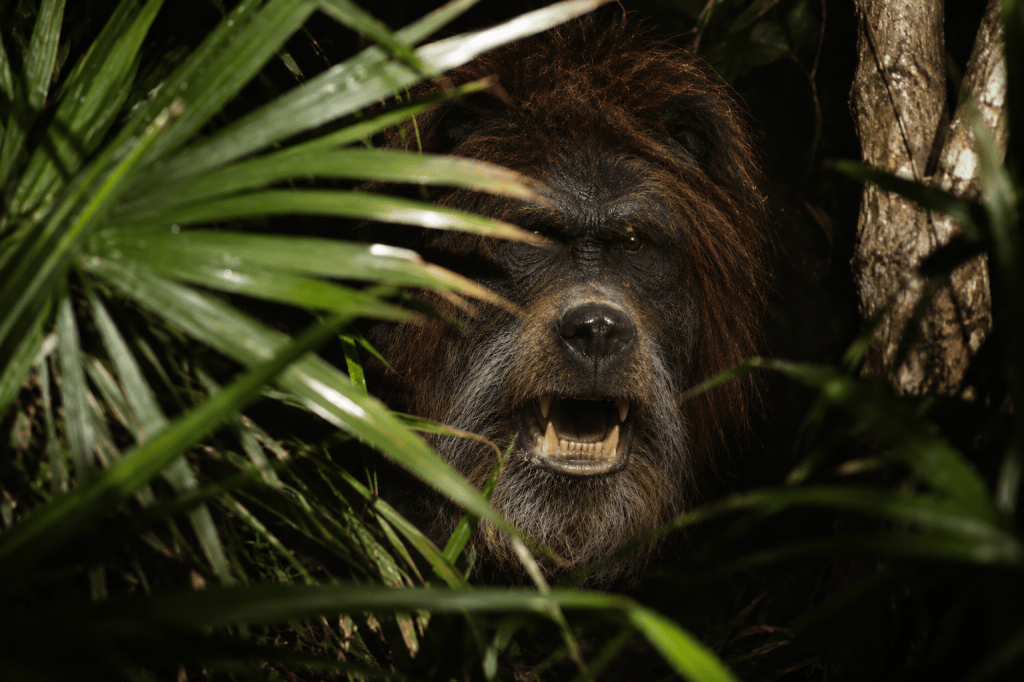
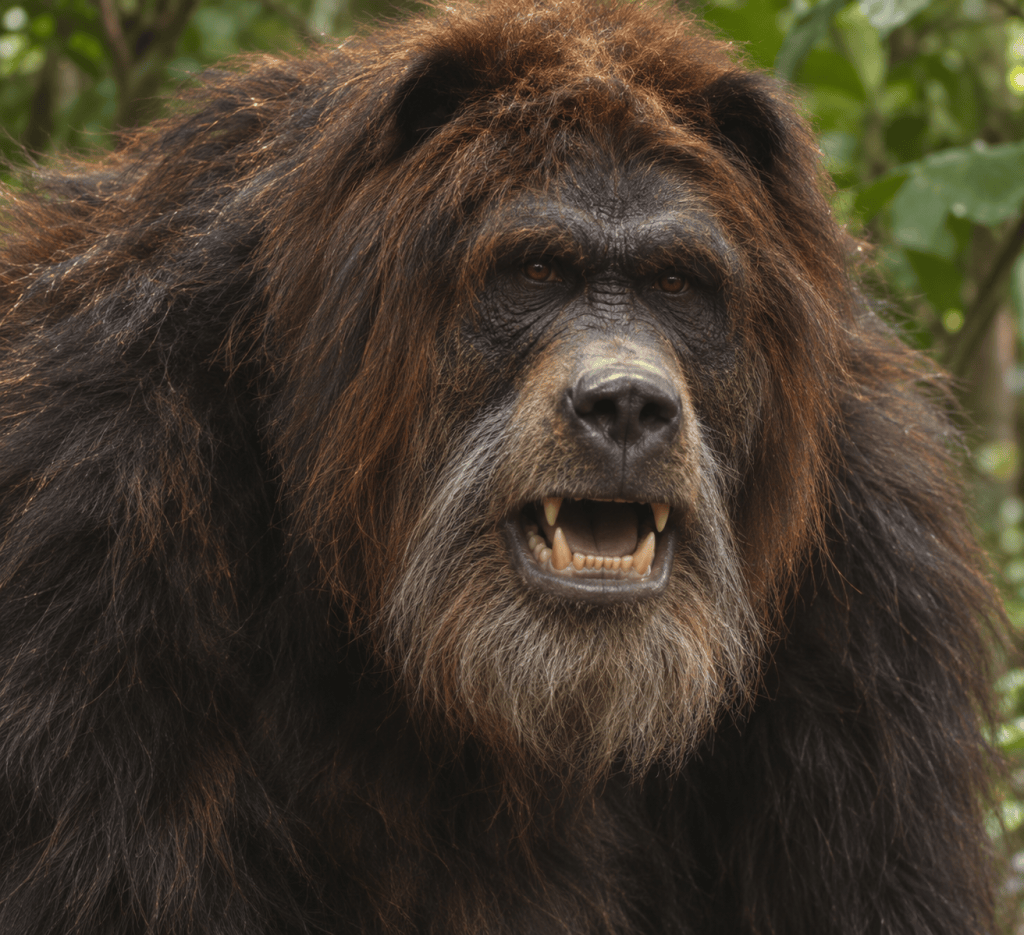
| Our Photographic Experiment To explore how an unfamiliar-looking creature might appear in the Myakka setting, we conducted a simple visual experiment. Using AI image generation, we created an imaginary mammal combining selected visual characteristics of a black bear and an orangutan. The resulting creature possessed a broad, bear-like muzzle, deep-set eyes, prominent canine teeth, shaggy hair and a greyish beard. We then placed this entirely fictional animal among palmetto leaves, first in a relatively clear reconstruction and subsequently in a darker composition resembling the original photographs. The result was revealing, although not in the sense of proving anything about the Myakka subject. Our invented creature looked surprisingly plausible when surrounded by dense foliage and illuminated against a dark background. Once much of its body was concealed, familiar mammalian features became harder to interpret, while the face attracted most of the viewer’s attention. The experiment demonstrated how lighting, vegetation and composition can make an imaginary animal appear mysterious. It did not establish that the original photographs were fabricated, nor did it suggest that a bear and an orangutan could produce a genuine hybrid. Such an animal does not exist, and the images are artistic constructions rather than biological evidence. Their purpose was to illustrate the difficulty of identifying a subject when most of its anatomy is hidden. There is also a limitation worth acknowledging. AI-generated imagery is designed to produce convincing visuals, and its ability to create a plausible fictional animal does not tell us how likely a real animal is to have those characteristics. The comparison is therefore an exercise in visual interpretation, not a forensic reconstruction. Nevertheless, it reinforces a useful investigative principle: an unfamiliar appearance does not necessarily indicate an unfamiliar species. |
| Could an Escaped Primate Explain the Encounter? The anonymous Myakka correspondent reportedly suggested that the animal might be an escaped orangutan. This explanation deserves consideration because Florida has a documented history of introduced and escaped exotic wildlife, including established populations of non-native monkeys. The presence of such animals demonstrates that some primates can survive outside their natural geographical ranges when environmental conditions are suitable. An escaped orangutan would be a different proposition from a population of unknown swamp apes. Adult orangutans are generally more solitary than chimpanzees or gorillas, particularly mature males, although they still maintain social relationships. A solitary individual could theoretically survive for years if it found sufficient food, water and shelter. Its lifespan would depend upon age, health, environmental conditions and previous experience, and there is no reliable average for the survival of an escaped great ape living alone in Florida. We also considered whether an animal approaching a residence might have been elderly, injured, malnourished or otherwise unwell. Illness and stress can alter behaviour, while dental disease or previous injury might affect facial appearance. These are biologically possible explanations, but the photographs provide no dependable evidence of such conditions. Missing or damaged teeth would not, by themselves, indicate that an animal had come from an experimental laboratory, and no documented escaped great ape has been connected with the Myakka encounter. Most importantly, a solitary escaped primate would not establish the existence of a breeding population. It might explain an isolated encounter, but it could not account for generations of sightings without additional animals and supporting evidence. The Problem of an Entire Population This brings us to what may be the strongest scientific objection to the Skunk Ape hypothesis. If a large, unknown primate species has inhabited Florida for generations, it must exist as a viable breeding population. There would need to be males, females, offspring of different ages and sufficient genetic diversity to sustain the species. Those animals would require substantial food resources, occupy territories, reproduce, die and interact with their environment in ways that should occasionally leave identifiable evidence. Florida’s wetlands are difficult environments to survey, and the absence of a particular photograph does not prove that an animal is absent. Remains may disappear through decomposition, scavenging or flooding, while even familiar mammals can avoid direct observation for long periods. Nevertheless, the state has studied it extensively through wildlife surveys, camera traps, genetic monitoring, and conservation programmes. Black bears and Florida panthers may be elusive, but photographs, biological samples, carcasses and documented populations support their existence. The Skunk Ape has not produced comparable evidence. Alleged sightings, photographs and videos have continued since the Myakka images became public. Still, no independently authenticated specimen, diagnostic genetic evidence or convincing body of physical material has established the existence of an unknown large primate in Florida. Modern cameras have become far more widespread over the intervening decades, making the continuing absence of reliable evidence increasingly difficult to reconcile with the proposed animal’s size and supposed distribution. A single unusual animal can remain elusive. It is considerably harder to explain how an entire breeding population could persist across generations without leaving scientifically recognisable traces. The Wider Skunk Ape Tradition The Myakka photographs are only one part of the Skunk Ape story. Reports of large, hairy creatures have circulated in Florida for decades, particularly around the Everglades and Big Cypress region. Some witnesses describe upright movement, unusual vocalisations or strong odours, while others report fleeting roadside encounters. The descriptions are not entirely consistent, and the quality of the evidence varies considerably. One prominent figure in the modern tradition is Dave Shealy, whose Skunk Ape Research Headquarters near Ochopee has helped maintain public interest in the mystery. Shealy has reported encounters and promoted photographic and video claims, although these have not resulted in independently accepted zoological confirmation. His activities also illustrate how cryptozoology can exist simultaneously as investigation, regional folklore and visitor entertainment. There is nothing inherently wrong with enjoying a local mystery. Stories of unfamiliar creatures can encourage curiosity about wildlife and preserve a region’s distinctive cultural identity. The difficulty arises when folklore, eyewitness testimony and disputed imagery are treated as equivalent to scientifically verified evidence. A witness may sincerely believe they encountered something extraordinary while still being mistaken about what they saw, and an intriguing photograph can remain unconvincing even after decades of public attention. Our task is not to ridicule those accounts, but neither is it to accept them without scrutiny. |
| Case Assessment |
| STATUS: UNCONFIRMED — NO SCIENTIFICALLY ACCEPTED EVIDENCE OF AN UNKNOWN LARGE PRIMATE The Skunk Ape remains an established part of Florida’s cryptozoological folklore, supported by decades of eyewitness reports, alleged footprints and disputed imagery. The Myakka photographs are among its most recognisable pieces of purported evidence, but their anonymous origins, incomplete anatomical detail and uncertain circumstances prevent reliable identification of the subject. Our examination considered the arrangement of palmetto foliage, the apparent teeth and facial hair, the subject’s possible behaviour and the absence of independently verifiable biological evidence. We also explored alternative explanations, including an elaborate costume, an unusually formed bear and an escaped captive primate. None can be demonstrated from the photographs, although each offers a possibility that does not require discovering a new species. The existence of a self-sustaining population of large unknown primates in Florida remains highly improbable on the available evidence. The continuing absence of authenticated biological material is particularly significant given the size of the proposed animal and the extent of modern wildlife monitoring. Our assessment: The Myakka photographs do not provide convincing evidence of an unknown primate. Staging remains a plausible explanation, but the photographs have not been conclusively exposed as fraudule |
| Closing the File — What Are We Really Seeing? Our investigation began with a mysterious animal supposedly lurking among the palmettos of southern Florida. It ended with questions about teeth, vegetation, photographic provenance, animal behaviour and the biological requirements of an undiscovered species. Along the way, we created an imaginary mammal. We placed it into a reconstruction of the alleged encounter, demonstrating just how readily a familiar-looking collection of features can become something apparently extraordinary when viewed through darkness and foliage. That experiment did not solve the Myakka mystery. It was never intended to. It illustrated the importance of questioning not only the subject of a photograph but also the circumstances in which the image was created. A convincing appearance is not the same as convincing evidence, and an unexplained image does not automatically represent an undiscovered animal. The Skunk Ape may continue to wander through Florida’s folklore for generations to come. Whether anything resembling it has ever wandered through the state’s wetlands remains another matter entirely. Listen. Investigate. Reach your own conclusion. Case File 09 — Closed, pending further evidence. |
| Research Notes Case File 09: The Skunk Ape Geographical focus: Southern Florida, especially the Everglades, Big Cypress and the Sarasota–Myakka region. Reported characteristics: Large, hairy, sometimes upright-walking mammal, occasionally associated with a strong unpleasant odour. Historical context: Reports became prominent during the twentieth century, particularly the 1970s. Principal photographic evidence: Two anonymous photographs received by the Sarasota County Sheriff’s Office around December 2000 and publicised in early 2001. Photographic concerns: Unverified provenance, obscured anatomy, uncertain scale, ambiguous facial features and incomplete documentation of the alleged encounter. Alternative explanations examined: Costume or staged encounter; black bear, potentially with an unusual physical condition; escaped captive primate; wildlife misidentification. Biological difficulty: No demonstrated breeding population, verified specimen or diagnostic genetic evidence. Scientific classification: Unconfirmed cryptozoological claim. |
| Selected Research References National Park Service — Everglades National Park Official information on wetland ecology, wildlife and the habitats associated with Skunk Ape reports. https://www.nps.gov/ever/ National Park Service — Big Cypress National Preserve Background on the region’s habitats and recognised wildlife. https://www.nps.gov/bicy/ Florida Fish and Wildlife Conservation Commission Information on Florida black bears, wildlife management and non-native species. https://myfwc.com/ USDA Forest Service — Fire Effects Information System Botanical and ecological information on saw palmetto (Serenoa repens), including wildlife interactions. Fire Effects Information System | US Forest Service Research and Development Loren Coleman — Contemporary reporting on the Myakka photographs (2001) Historical accounts of the photographs, anonymous correspondence and their early circulation. The photographs’ authenticity remains unverified. Bigfoot Field Researchers Organisation — Florida reports and Myakka commentary A collection of eyewitness reports and investigator interpretations. These represent claims and assessments rather than independently verified zoological evidence. https://www.bfro.net/ Skunk Ape Research Headquarters — Ochopee, Florida Regional cryptozoological visitor attraction associated with Dave Shealy and the Skunk Ape tradition. |
| About Our Photographic Experiment For this investigation, we created an imaginary mammal combining selected visual characteristics of a black bear and an orangutan. AI-generated images then placed this fictional creature among palmetto foliage in a setting resembling the Myakka photographs. The resulting illustrations are artistic reconstructions produced for comparison and discussion. They do not depict a real hybrid, a documented animal or the actual subject of the original Myakka photographs. Their purpose is to demonstrate how lighting, vegetation and partial concealment can influence visual interpretation. The experiment should not be regarded as proof that the original photographs were staged. |
| About our writing & imagery The Edge of Discovery explores cryptozoology and unexplained encounters through research, scientific understanding and critical investigation. AI may assist with research, drafting, editing and imagery, but all editorial direction and final content are shaped and reviewed by Earthly Comforts. Images may include historical photographs, credited third-party material or original AI-generated illustrations. AI artwork is an artistic interpretation, not authentic evidence. Our aim is to explore the mysteries fairly and encourage readers to reach their own conclusions. |

