| Episode 10 The Marsh Tit: A Woodland Bird With a Misleading Name |
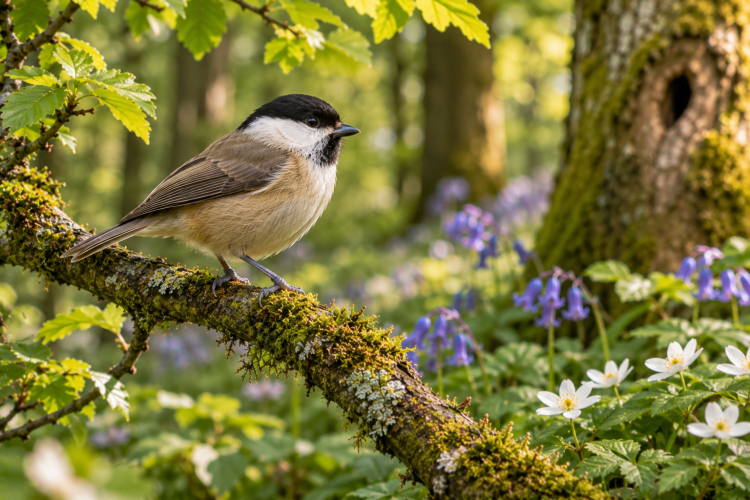
| There comes a point in the life of a garden when the trees begin making decisions of their own. The little sapling planted twenty years earlier has become a substantial presence; its roots have extended into places nobody anticipated, and the shade beneath its branches has changed what can reasonably be grown nearby. Shrubs that once enjoyed full sunshine are now competing for light, the lawn has become increasingly reluctant to grow, and the gardener finds themselves reconsidering a planting scheme that seemed perfectly sensible at the time. It is one of the more entertaining aspects of gardening: we make our plans, plant accordingly, and then spend the following decades negotiating with the consequences. Yet those same changes are part of what makes an established garden increasingly interesting to wildlife. As trees mature, their bark becomes more textured, branches develop hollows, dead wood accumulates, and countless small habitats begin appearing. Insects occupy crevices, fungi work through ageing timber, and birds discover feeding and nesting opportunities that did not exist when the trees were young. The value of an old tree is therefore not measured entirely by its height, beauty or the amount of shade it provides. Much of its importance lies in the small imperfections that develop over time. One bird that benefits from established woodland is the Marsh Tit (Poecile palustris), a small, quietly attractive member of the tit family whose name has confused generations. Despite what it suggests, the Marsh Tit is not primarily a bird of marshes. It is much more closely associated with deciduous woodland, mature trees, woodland edges and established habitats containing suitable feeding and nesting opportunities. The bird itself is hardly flamboyant. With its glossy black cap, pale cheeks, small black bib and soft brownish-grey upperparts, it looks rather like a modestly dressed relative of the more familiar Blue Tit and Great Tit. It is also easily confused with the Willow Tit, a closely related species with a remarkably similar appearance. But beneath that understated exterior is a bird with a fascinating relationship with woodland, memory and the slow development of natural habitats. A Bird That Belongs to the Trees Unlike the Willow Warbler and Wood Warbler, which arrive in Britain during spring and depart later in the year, the Marsh Tit is a resident species. It remains here throughout the seasons, dealing with whatever the British weather decides to provide. That distinction changes almost everything about its life. A summer migrant can take advantage of the abundance of insects during the breeding season before departing as autumn approaches. A resident bird must survive the shorter days, colder nights and reduced food availability of winter. It needs to know where food can be found, where shelter is available and how to make the most of a landscape that changes considerably throughout the year. Marsh Tits are particularly associated with established deciduous woodland, although they also use woodland edges, mature hedgerows, scrub and occasionally suitable gardens. They favour habitats containing a mixture of trees and understorey vegetation, providing opportunities to search for insects, spiders and seeds. Their movements can be surprisingly discreet. While Blue Tits and Great Tits frequently make themselves obvious around garden feeders, Marsh Tits are often less conspicuous, moving through branches and shrubs without attracting much attention. They are also strongly territorial, with established pairs maintaining areas of woodland throughout much of the year. Rather than wandering randomly across the countryside, they develop a close familiarity with particular places. And that familiarity becomes especially valuable when winter arrives. The Remarkable Business of Remembering One of the Marsh Tit’s most interesting behaviours is its habit of storing food. When seeds are available, particularly in autumn, Marsh Tits may carry individual food items away and conceal them in bark crevices, among vegetation, or in other suitable hiding places. This behaviour is known as caching, and it provides a food reserve that can be retrieved later when conditions become less favourable. The remarkable part is that the bird must remember where it has hidden those supplies. We are accustomed to thinking of memory as something associated with larger, supposedly more intelligent animals, yet food-caching birds demonstrate extraordinary spatial abilities. A Marsh Tit may store numerous individual seeds across its territory, relying upon memory to relocate at least some of them when needed. For a creature with a brain weighing only a tiny fraction of a gram, that is quite an achievement. It also raises an interesting question about how we judge intelligence in the natural world. Human beings tend to value abilities that resemble our own, particularly language, reasoning and the use of tools. Yet a small bird that can remember the locations of hidden food supplies across a woodland demonstrates a form of intelligence precisely suited to its circumstances. I occasionally struggle to remember where I put a particular hand tool ten minutes earlier, despite having considerably more storage space available between my ears. The Marsh Tit, meanwhile, can conceal seeds amongst dozens of trees and return to retrieve them later. There is probably a lesson in that somewhere, although I am not entirely sure I want to explore it. The Importance of a Suitable Nesting Place When spring arrives, Marsh Tits begin breeding, and suitable nesting cavities become particularly important. Unlike the Willow Tit, which often excavates its own nesting hole in soft, decaying wood, the Marsh Tit generally uses an existing cavity. These may occur in ageing trees, damaged branches, old woodpecker holes or other natural openings that provide a sheltered space for nesting. The female constructs the nest using materials such as moss, plant fibres and animal hair, creating a soft lining in which to lay her eggs. This dependence upon cavities is one reason mature woodland can be so valuable. Older trees are more likely to contain the hollows, cracks and areas of decay that cavity-nesting birds require. A newly planted woodland may provide food and shelter, but it can take decades before suitable natural nesting sites become abundant. That distinction matters because planting trees and preserving woodland are not quite the same thing. New planting is valuable, particularly where it creates future habitat or connects existing woodland. But a hundred young trees cannot immediately replace all the ecological functions of a hundred-year-old tree. The older tree may already support fungi, insects, nesting birds, lichens and a complicated network of relationships that have developed over many years. This is not an argument against planting. It is an argument for recognising the importance of what already exists. In gardens, we encounter the same issue when dealing with ageing trees. A mature specimen may have developed a hollow branch or an area of decaying timber, and the immediate temptation can be to remove every imperfection in the interests of tidiness. Safety must always come first, particularly where trees overhang paths, buildings or places used by people. Dangerous limbs and unstable trees require appropriate professional assessment and management. But not every piece of dead wood is a problem. Where it is safe to do so, retaining standing dead wood, damaged branches or fallen timber can provide valuable habitat. A log left beneath a hedge may support beetles and fungi. At the same time, a cavity in an established tree can offer nesting opportunities that no amount of decorative planting can immediately reproduce. Sometimes the most useful thing we can do for wildlife is recognise that an ageing tree is not necessarily a failing tree. The Difference Between Marsh and Willow The Marsh Tit’s resemblance to the Willow Tit has confused for a very long time. Both species are small, brownish-grey birds with black caps, pale cheeks and dark bibs, and separating them by appearance alone can be difficult even for experienced observers. The Willow Tit (Poecile montanus) was not formally recognised as a separate species from the Marsh Tit until the nineteenth century, which suggests how similar the two birds appear. Their names do not make matters especially straightforward either. The Marsh Tit is primarily associated with mature deciduous woodland. At the same time, the Willow Tit is often found in damp scrub, young woodland and areas containing soft or decaying timber suitable for excavating nesting cavities. There is some overlap in their habitats, but their nesting behaviour provides an important distinction. The Willow Tit is particularly notable for excavating its own cavity, whereas the Marsh Tit generally occupies an existing hole. Their calls are often more useful for identification than their plumage. Marsh Tits have a distinctive sharp, explosive pitchou call, while Willow Tits produce different nasal and buzzing notes. Both species have additional vocalisations, so learning their calls is often the most reliable approach. I find it rather amusing that two birds with such similar appearances can lead such different lives. It is another reminder that wildlife identification is not simply a matter of matching colours and markings to pictures in a book. Behaviour, habitat, voice and season can be equally important. And occasionally, the most useful identification feature is knowing where a bird has chosen to make its home. A Decline Hidden Amongst Familiar Birds The Marsh Tit has undergone a substantial long-term population decline in Britain, particularly since the latter part of the twentieth century. Although it remains present in suitable areas, it is much less widespread and abundant than it once was. Its decline has attracted less public attention than that of some more conspicuous species. There is something unfortunate about that, because the Marsh Tit’s story reveals important changes taking place within our woodlands. The reasons are not entirely straightforward. Research has examined the influence of woodland structure, changes in the understorey, habitat fragmentation and other ecological pressures. The availability of suitable vegetation and the quality of woodland habitat appear to be particularly important. It would be misleading to suggest that the loss of old trees or nesting cavities alone can explain every Marsh Tit decline. The species depends upon a combination of habitat features, and the relationship between those features can be complicated. For example, a woodland may contain plenty of mature trees but relatively little shrub cover. Another may have abundant understorey vegetation but insufficient suitable nesting opportunities. A third may offer both, yet be isolated from other woodlands by surrounding land uses. Each situation presents different challenges. The broader lesson is that woodland quality cannot be judged simply by counting trees. The arrangement of vegetation, the age of trees, the availability of food and the connections between habitats all contribute to the wildlife a woodland can support. Gardeners can appreciate this on a smaller scale. A garden containing several mature trees may appear wonderfully established. Still, if the ground beneath them is kept completely bare and the surrounding boundaries offer little cover, some wildlife opportunities may be limited. Equally, a garden filled with shrubs but lacking taller vegetation may support a different collection of species. Variety matters, but so does the relationship between the different elements. The Woodland That Takes Generations to Grow One difficulty with woodland conservation is that trees operate on timescales much longer than most of our gardening plans. We plant a shrub and expect it to establish within a few years. We sow annual flowers and enjoy their results within months. Even a newly planted hedge can begin providing useful shelter relatively quickly. A mature woodland is another matter entirely. Its ecological character develops over decades and centuries. Trees grow, branches die, cavities form, fungi establish, soil conditions change, and different generations of plants and animals occupy the developing habitat. Some species can adapt readily to newly created woodland, while others depend upon conditions that take much longer to develop. The Marsh Tit is a useful example of why continuity matters. Established woodland provides not only mature trees but also a familiar network of feeding places, shelter and breeding opportunities. Where woodland becomes fragmented or loses important structural features, the effects can extend beyond the immediate loss of individual trees. This does not mean every woodland should be left untouched. Appropriate management can improve habitat conditions, particularly where excessive shade or changes in vegetation structure are reducing opportunities for certain species. But management should begin with an understanding of what is already there. I sometimes think gardening would benefit from a similar approach. We are often encouraged to redesign, replace and improve, as though every established feature is simply waiting for somebody to make it better. Yet an old hedge, mature shrub or ageing tree may already be performing ecological functions that are not immediately obvious. Before removing something, it is worth asking what might be using it. A Place for the Less Obvious Wildlife The Marsh Tit is not likely to become the star attraction of every garden bird table. It is too localised and too closely associated with suitable woodland for that. Nevertheless, gardeners living near established woodland may occasionally encounter one, particularly where gardens contain mature trees, shrubs and suitable feeding opportunities. A garden feeder can sometimes attract Marsh Tits, especially where sunflower seeds are available, although their visits may be brief. They often take a seed and leave to eat or store it elsewhere rather than staying conspicuously at the feeder. Watching this behaviour can be fascinating. A bird arrives, selects a seed, disappears into the surrounding vegetation and returns a short while later. It may appear to be behaving nervously, but it is often simply following a feeding strategy that differs from that of more familiar garden visitors. For gardeners hoping to support woodland birds, the most useful approach is generally to provide a varied habitat rather than concentrating entirely upon feeding stations. Native shrubs, mature trees where space allows, sheltered vegetation, reduced pesticide use and the retention of safe dead wood can all contribute to a healthier environment. There is also considerable value in maintaining connections between gardens and surrounding habitats. A mature hedge linking a garden to nearby woodland can provide shelter and movement opportunities for birds and other wildlife. Not every garden can accommodate a large tree, and not every property has the space to create substantial woodland planting. But even smaller gardens can contribute through thoughtful choices. A mixture of shrubs, a less intensively managed boundary and a willingness to tolerate a little natural ageing can make a difference. The Value of Growing Old Modern life tends to associate age with decline, particularly when something begins to look less tidy or predictable than it once did. We replace worn materials, remove damaged plants and often regard the appearance of decay as evidence that maintenance has been neglected. Nature has a rather different relationship with ageing. An old tree may be hollow yet remain alive for decades. Its decaying wood supports fungi and insects, its cavities shelter birds, and its rough bark provides countless places for small creatures to hide. What appears imperfect to us may be precisely what makes it valuable. The Marsh Tit belongs to that world of mature habitats and accumulated opportunities. Its life depends on features that cannot simply be manufactured overnight, no matter how much money or enthusiasm we invest. Perhaps this is one reason I find established gardens so interesting. They contain a history of decisions, successes, failures and natural changes. Some plants have outgrown their original positions, others have disappeared, and a few have quietly become far more important than anyone anticipated when they were first planted. A garden that has been allowed to mature develops a character that cannot be purchased fully formed. And within that character, wildlife finds opportunities. A Quiet Bird Worth Remembering The Marsh Tit is not a spectacular bird, at least not in the conventional sense. It does not possess the colours of a Kingfisher, the aerial abilities of a Swallow or the remarkable song of the Wood Warbler. Its appeal lies in something quieter. It is a small woodland resident that knows its territory, remembers hidden food supplies, raises its young in natural cavities, and depends on the complex structure of established habitats. Its decline reminds us that even apparently familiar woodland birds can become less common when the environments supporting them change. And its behaviour demonstrates that the natural world contains extraordinary abilities in creatures we might otherwise overlook. The next time you walk through mature woodland, consider how much is happening beyond the obvious movement of birds amongst the branches. Seeds are being hidden, insects are searching through bark, fungi are working through dead timber, and small cavities may be sheltering the next generation of woodland birds. The trees themselves may have been standing for longer than many of us have been alive. They have witnessed generations of wildlife arriving, breeding, surviving and disappearing, all within a landscape that changes so gradually we sometimes forget it is changing at all. Perhaps the Marsh Tit’s quiet life offers a useful reminder that conservation is not always about creating something new. Sometimes it is about recognising the value of what has taken a very long time to grow. Watching For… Marsh Tits can be encountered throughout the year in suitable deciduous woodland, particularly established woods containing mature trees and a well-developed understorey. They are also occasionally found in mature hedgerows, woodland edges and gardens close to suitable habitat. Look for a small, brownish-grey bird with a glossy black cap, pale cheeks and a relatively small black bib. Its resemblance to the Willow Tit makes identification challenging, so listening for its characteristic sharp pitchou call is particularly useful. Avoid relying upon a single plumage feature, as appearance can vary with lighting and individual birds. If you are fortunate enough to see a Marsh Tit visiting a feeder, watch what it does after collecting a seed. It may carry the food away to a nearby hiding place rather than eating it immediately. Observing this behaviour provides a glimpse into the remarkable memory and winter survival strategies of a bird that spends its entire life amongst our woodlands. And perhaps, when walking beneath mature trees, take a moment to appreciate the cavities, rough bark and ageing branches that make such habitats valuable. They may not be the features we first admire, but for woodland wildlife they can be amongst the most important. |
| About our writing & imagery The Quiet Lives of Britain’s Birds explores the lives, behaviour, habitats and conservation of Britain’s birds through natural-history research, gardening experience and a shared curiosity about the wildlife around us. AI may assist with research, drafting and editing, but the observations, reflections and editorial direction are shaped and reviewed by Earthly Comforts. Images may include original photography, credited third-party photographs or AI-generated wildlife illustrations. AI-generated images are artistic interpretations of the species discussed and should not be regarded as photographs of living birds. |

