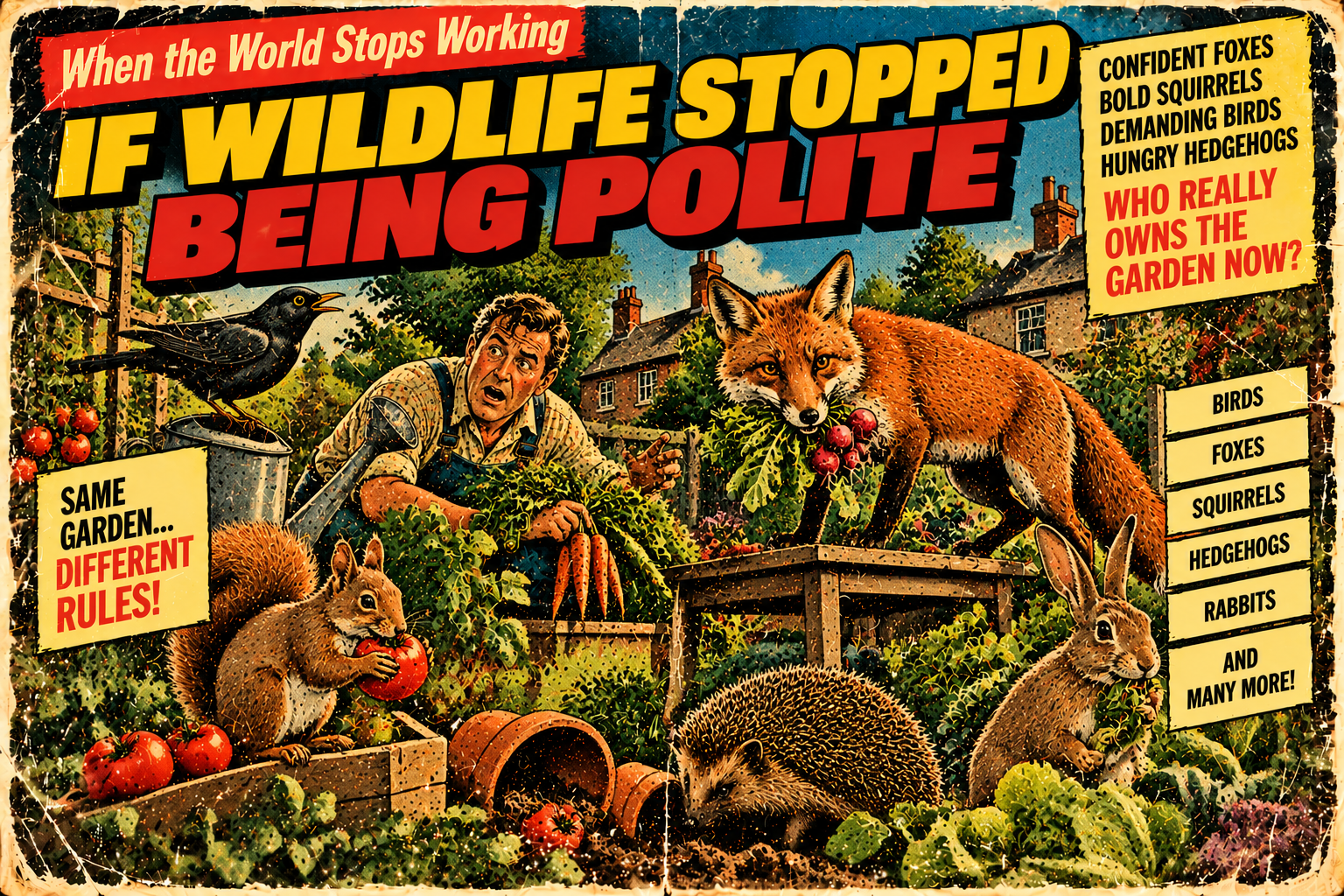
| What if the creatures sharing our gardens decided that humans were no longer entitled to the best seats? |
| An unspoken arrangement between gardeners and wildlife has served us reasonably well for generations. We provide the plants, dig the borders, maintain the lawns and occasionally leave out something edible, while the local wildlife is expected to behave with a certain amount of discretion. Birds may visit the feeders, provided they do not empty them quite so quickly. Hedgehogs are welcome to wander through the borders, preferably without falling into anything. Butterflies may settle wherever they please, and even the occasional fox can be tolerated, so long as it refrains from dismantling the rubbish bags or leaving something unpleasant on the lawn. Of course, the wildlife has never actually agreed to the arrangement. It exists entirely in the minds of human beings, who have developed the peculiar habit of believing that owning a piece of land gives them some authority over everything living upon it. A blackbird does not recognise the difference between a private garden and a public park. At the same time, a squirrel is unlikely to appreciate that the expensive tulip bulbs it has just dug up were planted for decoration rather than buried as a convenient winter food supply. Nevertheless, we keep expecting a certain level of cooperation, and most of the time we convince ourselves we are getting it. But suppose something changed. Not in the dramatic fashion of a science-fiction film, where every creature suddenly develops an unnatural intelligence and begins plotting humanity’s downfall, but through a gradual shift in behaviour. Animals that once kept their distance become increasingly comfortable around people. Birds defend their feeding territories more vigorously, foxes begin treating suburban gardens as permanent residences, and squirrels develop the sort of confidence normally associated with somebody who has just discovered that the restaurant is offering an unlimited buffet. What would happen if the wildlife in our gardens stopped being polite? The Uninvited Guests Most gardeners already know that wildlife can cause inconvenience without any imaginary catastrophe. A pair of woodpigeons can reduce a carefully cultivated row of brassicas to something resembling a collection of green skeletons. At the same time, a determined squirrel can empty a bird feeder with astonishing efficiency. Slugs and snails need no encouragement to explore the vegetable patch, and anyone who has tried to protect newly emerging seedlings from hungry birds will appreciate that the natural world has never valued our gardening ambitions. The interesting thing is that many of these encounters occur because gardens provide precisely the conditions animals are looking for. We create shelter with shrubs and hedges, supply water through ponds and birdbaths, and grow plants that attract insects, seeds and fruit. We then express surprise when the creatures we have encouraged begin using everything available. It is rather like opening a café, putting a large sign outside inviting everybody in, and then complaining when the customers sit down. In our imagined future, the balance would begin to shift as wildlife became more accustomed to human presence. Blackbirds might continue searching for worms while somebody worked only a few feet away, and foxes might become increasingly reluctant to abandon their favourite sleeping places simply because the gardener had arrived with a lawnmower. Squirrels, already among the most audacious visitors to British gardens, might start treating human activity as a minor inconvenience rather than a reason to retreat. John would probably argue that squirrels reached this stage some years ago. He has never been particularly impressed by their intelligence. However, I have pointed out that any animal capable of remembering numerous food-storage locations while simultaneously stealing from a supposedly squirrel-proof feeder deserves at least a little professional respect. He said the feeder had cost nearly thirty pounds, and the squirrel had worked out how to open it in less than ten minutes. When Familiarity Replaces Fear Wild animals generally assess danger through a combination of instinct, experience and learned behaviour. Some species are naturally cautious around people, while others can become remarkably tolerant when human activity is predictable and doesn’t seem threatening. This process, known as habituation, is already visible in many urban environments, where animals regularly encounter people without necessarily experiencing harmful consequences. Urban foxes provide a particularly familiar example. Although foxes remain wild animals and usually avoid unnecessary confrontation, individuals living in towns can become accustomed to people, traffic and domestic activity. Some will rest in gardens during daylight, particularly where suitable shelter is available, while others travel through residential streets in search of food. Their apparent confidence does not mean they have become domesticated, nor does it mean that they are necessarily aggressive. It simply reflects their ability to adapt to environments shaped by human behaviour. Now imagine that this adaptability became more widespread. Animals that previously visited gardens only during quiet periods might begin using them throughout the day, and species that once avoided busy residential areas could gradually become more comfortable living alongside people. We might see more birds nesting close to houses, mammals establishing regular routes through gardens, and wildlife using structures never intended for their benefit. The difficulty would arise when human expectations failed to change at the same pace. A gardener might be delighted to discover a fox sleeping beneath the shrubs until the animal began returning every afternoon and refusing to move when the border needed attention. A family might enjoy watching squirrels visit their garden until the squirrels began excavating containers, damaging bird feeders and helping themselves to anything remotely edible. The creatures would not necessarily be behaving badly by their own standards. They would simply be behaving naturally in an environment where the usual reasons for keeping their distance had diminished. There is a considerable difference between an animal becoming accustomed to people and an animal becoming safe to approach. Even apparently relaxed wildlife can react defensively when frightened, cornered or protecting young. Our imaginary change would therefore require more caution from gardeners, not less, particularly when working around nesting sites, enclosed spaces or animals that had become unusually confident. The Birds Take Possession Birds would probably be among the first creatures to make their increased confidence obvious. Many garden species already show remarkable adaptability, particularly where food is regularly available. Robins are famous for following gardeners in search of disturbed insects and other small invertebrates, while blackbirds frequently investigate freshly turned soil. Tits, finches and sparrows quickly learn the location of reliable feeding stations, and woodpigeons have developed an extraordinary ability to identify precisely which plants a gardener would most prefer them not to eat. If birds became less inclined to retreat from human activity, gardens might become increasingly complicated places to work. A robin could decide that the freshly cultivated border belonged to it for the afternoon, while a blackbird might object to somebody clearing vegetation near its nest. Territorial behaviour could become more noticeable during the breeding season, when some birds already defend nesting areas vigorously against perceived threats. The consequences would not necessarily be disastrous. A garden with a healthy population of insect-eating birds can benefit from their feeding activity, particularly when caterpillars and other invertebrates are abundant. Birds also contribute to seed dispersal and form part of the wider ecological relationships that help gardens function. The problem is that we tend to see these benefits as something we should receive without accepting any inconvenience in return. Imagine planting a carefully arranged vegetable garden only to discover that the local woodpigeons had established a daily feeding routine involving the brassicas. Protective netting might become essential, provided it was correctly installed, securely tensioned and checked to prevent wildlife becoming trapped. Fruit cages could become more common, while gardeners might need to reconsider how they protect ripening berries, young seedlings and other vulnerable crops. John once suggested that woodpigeons must be the only birds in Britain capable of eating their own body weight in somebody else’s vegetables before breakfast. I suspect his estimate was scientifically questionable, but having seen the damage a small group can cause to unprotected young cabbages, I understood the sentiment. The Mammals Move In While birds might dominate the air and the upper branches, mammals would present an entirely different set of challenges. Hedgehogs, foxes, squirrels, rabbits, mice, and other small mammals already use gardens to feed, shelter, and travel. Their presence is often welcome, although the relationship becomes more complicated when their activities interfere with planting, structures or domestic routines. Hedgehogs are generally among the more appreciated visitors, partly because they feed on a variety of invertebrates and partly because they possess the considerable advantage of looking rather endearing while doing so. They are not, however, employed as a reliable slug-control service, and their diet is much more varied than popular gardening folklore sometimes suggests. In our imagined future, hedgehogs might become more visible as they moved through gardens, although their normal activity patterns and welfare needs would still matter. A hedgehog wandering about in daylight should not automatically be assumed to be confident and healthy, particularly if it appears weak, injured or disoriented. Foxes would probably create more debate. A family of foxes establishing a den beneath a garden building might provide wonderful opportunities for observation, but their presence could also produce concerns about disturbance, pets, digging and hygiene. Rabbits, where they occur, could transform productive gardens into remarkably efficient feeding grounds. At the same time, squirrels would continue their long-established campaign against bird feeders, bulbs and anything resembling a carefully arranged container. The more wildlife became accustomed to gardens, the more important sensible management would become. Compost heaps would need proper maintenance, food waste secured, and wildlife feeding approached with care rather than enthusiasm alone. Deliberately encouraging animals to depend on people could create problems for both the animals and the households involved. A confident fox is still a fox, and a squirrel that has learned to approach people for food may become more vulnerable to injury or conflict. The sensible response is not to chase every creature away, but it’s also not to encourage unrestricted access to everything in the garden. We would need to understand the difference between providing habitat and creating dependency, between tolerating natural behaviour and allowing preventable problems to develop. When the Garden Becomes a Territory One of the more interesting consequences of our imagined scenario would involve territorial behaviour. Many animals already defend feeding areas, nesting sites or territories against members of their own species. Food availability, breeding requirements, and competition shape these behaviours, and they can become particularly noticeable during certain seasons. Suppose that animals became more willing to defend familiar garden spaces in the presence of people. A nesting bird might become unusually persistent in its attempts to discourage activity nearby, while a fox could be reluctant to leave a sheltered resting place. We might temporarily avoid particular corners of the garden because wildlife has established breeding sites or because disturbance would create unnecessary stress. In reality, responsible gardeners already make these adjustments. We avoid disturbing active bird nests, take care when cutting hedges during the breeding season and check vegetation before carrying out potentially harmful work. Hedgehogs may shelter beneath piles of leaves or within dense planting, and amphibians can occupy damp corners, ponds and composting areas. Much of what might appear extraordinary in our imaginary future is therefore an exaggeration of the care we should already be taking. The difference would be scale. If wildlife occupied more of our gardens more consistently, routine maintenance could become increasingly dependent upon observation and timing. Hedge cutting might require more careful planning, clearance work could be delayed, and certain areas might need to remain undisturbed longer. The professional gardener’s diary, already at the mercy of British weather, would acquire another collection of variables. I can imagine explaining to a client that we couldn’t complete the work because a blackbird had taken possession of the shrub border and refused to negotiate. John would undoubtedly insist that we charge the bird for the wasted time. The Uncomfortable Question of Who Belongs Perhaps the most revealing part of this imagined change would be the way it challenged our assumptions about ownership. We often describe wildlife as visiting our gardens, as though the animals were temporary guests entering a space that belongs exclusively to us. Yet many species may have used the same area long before the house was built, and their descendants continue to occupy the remaining patches of suitable habitat. A mature tree can provide nesting opportunities, food and shelter for numerous organisms, while a garden pond may become part of the breeding habitat for amphibians and aquatic invertebrates. Even a small area of undisturbed vegetation can support a surprisingly complicated community of living things. The garden may belong to us in a legal sense, but ecologically it is shared by creatures whose requirements do not always align with our preferences. This does not mean that gardeners should abandon their responsibilities or allow every plant and animal to do precisely as it pleases. Gardens are managed environments, and management is often necessary to maintain safety, access, plant health and the balance between different uses. A wildlife-friendly garden can still contain productive beds, paths, seating areas and carefully maintained borders. Indeed, thoughtful management can create a greater variety of habitats than either extreme neglect or excessive tidiness. What might change is our willingness to accept that wildlife sometimes causes inconvenience simply by existing. A few damaged leaves, disturbed patches of soil or missing berries may be reasonable consequences of sharing a garden with other living things. Not every problem requires a chemical treatment, a trap or a determined campaign of exclusion. There are, of course, limits. Serious damage, health and safety risks, or conflicts involving protected species require appropriate advice and lawful management. The objective is coexistence, not the romantic notion that every animal is harmless and every encounter will end happily. The Gardeners Adapt If wildlife genuinely became more confident, professional gardening would need to adapt in practical ways. We might spend more time inspecting areas before starting work, identifying nesting sites, checking compost heaps, and considering how to maintain the garden without unnecessary disturbance. Clients might become more interested in wildlife management, not simply to attract more animals but because they need help living alongside the creatures already present. Plant selection could become increasingly important. Dense shrubs, native hedges, flowering perennials and carefully positioned trees can provide habitat while also contributing to attractive garden design. Fruit and vegetable production might require better physical protection, and ponds would need safe access and escape routes for wildlife. The aim would be to create gardens that function well for their human occupants while supporting a sensible range of other species. There would also be opportunities to explain the ecological relationships that make gardens interesting. A robin following a gardener is not expressing affection in the human sense; it is taking advantage of feeding opportunities. A fox sleeping beneath a hedge is not necessarily planning to move into the house, and a squirrel burying food in a flowerpot is not deliberately insulting the person who planted it. Understanding behaviour can make wildlife encounters more enjoyable and reduce unnecessary conflict. John might find this educational approach rather exhausting. He has always preferred gardening problems that can be resolved with a spade, a pair of secateurs or a straightforward explanation involving somebody having planted the wrong thing in the wrong place. Convincing him that we should accommodate an unusually determined squirrel would require considerably more patience than I suspect either of us possesses. When the Wildlife Wins There is something rather amusing about imagining a world in which garden wildlife gradually becomes more assertive. We could picture robins supervising the digging, foxes occupying the warmest corners of the lawn, squirrels inspecting newly planted containers and woodpigeons treating vegetable gardens as publicly funded catering establishments. The humans would continue mowing, pruning, weeding and planting, but increasingly they would find themselves working around the preferences of the creatures sharing the space. Yet beneath the humour lies a more serious possibility. As landscapes change, suitable habitats become fragmented and environmental conditions place pressure on wildlife; gardens may become increasingly important refuges for certain species. Animals that can adapt to human environments may become more familiar. In contrast, others struggle because they cannot adjust as easily. Increased confidence around people does not necessarily indicate that wildlife is thriving. It might simply reflect shifting resource distributions and the pressures animals face elsewhere. Our responsibility is to respond thoughtfully rather than assume that every animal appearing in the garden is either a delightful visitor or an unwelcome pest. We would need to observe, understand, and make sensible decisions about how we manage our gardens. Some creatures would benefit from additional habitat, others from being left undisturbed, and a few would require carefully considered measures to prevent genuine problems. Perhaps the biggest adjustment is accepting that the garden is not a private kingdom over which we exercise complete authority. It is a living environment in which our choices influence countless other organisms, many of which have their own perfectly reasonable ideas about how the space should be used. I was reminded of this one afternoon while working in a garden where a robin had developed an extraordinary interest in everything we were doing. Each time we moved to another border, the bird appeared almost immediately, inspecting the disturbed soil and watching proceedings with the expression of a particularly demanding site supervisor. John eventually stopped digging, looked directly at the robin and asked whether it intended to do any of the work itself. The robin, unsurprisingly, offered no assistance whatsoever. It simply hopped into the freshly cultivated soil, collected something edible and departed towards the hedge, leaving John to resume digging. I suggested we might have misunderstood the arrangement all along. We thought we were gardening for the property owners’ benefit. In contrast, the robin appeared to regard us as a convenient pair of employees responsible for maintaining its feeding grounds. John considered this for a moment before informing me that if the wildlife was taking over, he hoped somebody had explained to it that the minimum wage was going up. And perhaps that is how it would happen. Not with an uprising, an invasion or a dramatic confrontation between humanity and the natural world, but through a gradual realisation that the animals sharing our gardens had never considered themselves guests in the first place. They had simply been waiting for us to understand the arrangement. |
| Wander through the Article Directory and see where curiosity takes you next. |
| About Our Writing & Imagery Most articles are grounded in our real gardening experience, observations and reflections. AI may assist with research, drafting and editing, but the experiences, opinions and editorial direction are our own. Featured images may include our photography, original AI-generated visuals or, where stated, images credited to others. Earthly Comforts reviews and shapes all published content before it goes live. |

