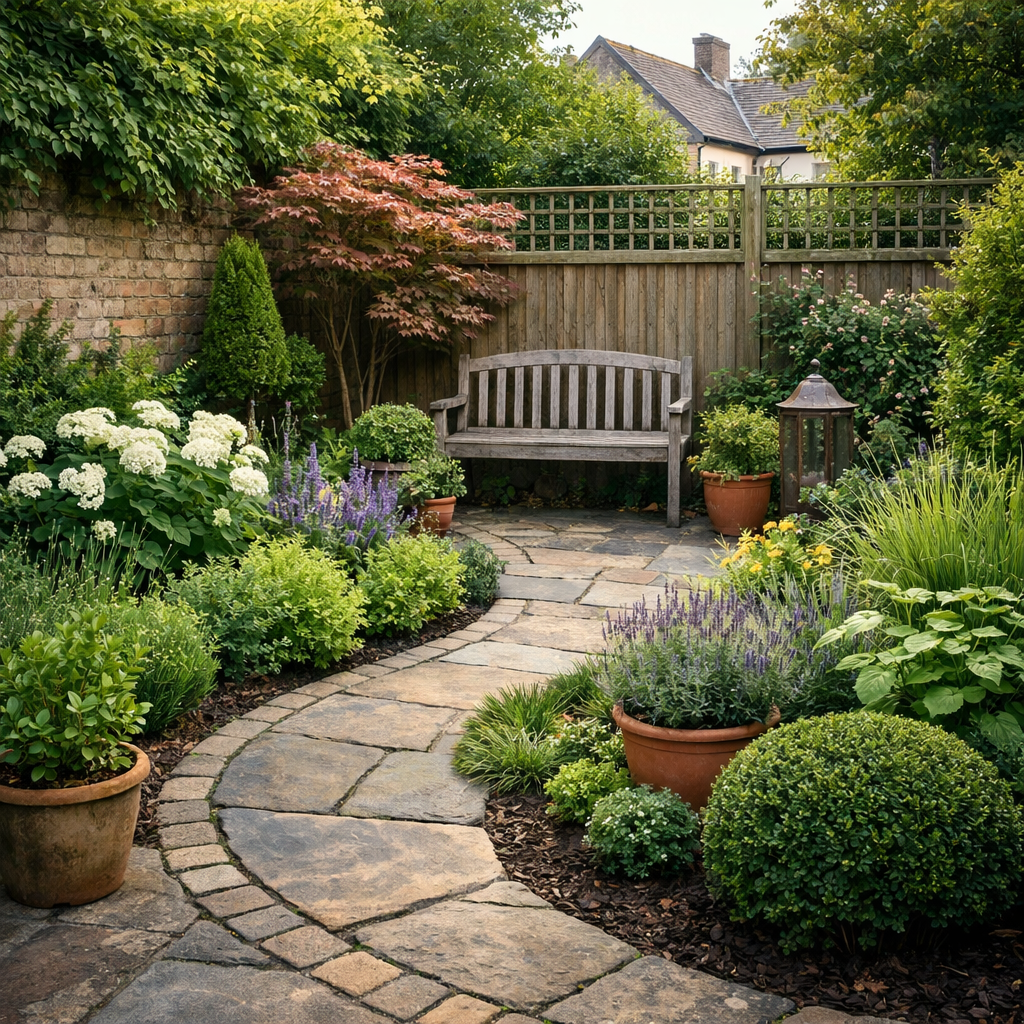
| Part 1 What Makes a Small Garden Work (and What Ruins It) Small gardens rarely fail all at once. More often, they drift. One new plant here, a missed tidy-up there, a decision made with good intentions but no long view. Over time, the space begins to feel tighter, busier, and harder to manage — even though nothing dramatic has gone wrong. When I describe a small garden as unsettled, I mean a garden that never quite feels calm, finished, or easy to keep on top of. The plants grow, money gets spent, work is done — yet the space never really settles into itself. In my experience, the difference between a small garden that works and one that doesn’t has very little to do with style, budget, or enthusiasm. It comes down to a handful of quiet fundamentals. Small gardens that work have a clear structure In a small space, structure does most of the heavy lifting. This doesn’t mean formality or rigid layouts. It means the garden has a readable shape — borders that know where they begin and end, paths that clearly guide movement, and plants that relate to one another rather than compete. Sometimes, structure is as simple as a clean edge, a clear path line, and one main planted area that isn’t constantly being nibbled away or reworked. When structure is missing, everything else has to shout. Plants sprawl, edges blur, and the garden begins to feel busy even when little is actually happening. A small garden needs clarity, not complexity. Small gardens that struggle are often overcrowded Overcrowding is one of the most common reasons a small garden feels permanently unsettled. Plants are added with good intentions — a gift, a bargain, a moment of enthusiasm — without thinking about what they’ll become. In a tight space, plants grow into one another quickly. Light is lost, airflow decreases, and maintenance costs increase. That’s when you start to see mildew, legginess, and plants that never quite look happy. Ironically, overcrowding often makes a garden look smaller. The more crammed a space becomes, the less room there is for plants to show their shape or for the eye to rest. Small gardens benefit from space between things. Gaps allow plants to breathe, soil to recover, and the whole garden to feel calmer and more deliberate. Working in small gardens respects limits. A small garden that works is one that accepts its limits early on. Limits of space, sunlight, storage, time, energy, and budget. In courtyards, especially, light is often the real boss. Fighting it — with unsuitable plants or constant correction — quickly becomes exhausting. Successful small gardens work within their constraints. They choose plants that behave, layouts that allow access, and maintenance routines that fit real lives. Gardens that ignore limits tend to demand constant intervention, which rarely feels sustainable over time. Respecting limits isn’t giving up. It’s designed for longevity. In small gardens, maintenance matters as much as planting — sometimes more Planting gets attention because it’s visible and satisfying. Maintenance is quieter, repetitive, and often overlooked — yet in a small garden, it’s the deciding factor. Regular light maintenance keeps a garden steady. It prevents small issues from compounding and allows plants to mature without tipping into chaos. Missed maintenance, on the other hand, shows up quickly in compact spaces. The most settled small gardens aren’t those that were planted perfectly. They’re the ones consistently cared for. What ruins small gardens is rarely dramatic. Small gardens are usually undone by accumulation rather than catastrophe. Too many plant types. Too many ideas are introduced at once. Too many exceptions were made to the original plan. Each individual decision feels minor, but together they create visual noise and practical difficulty. The garden slowly becomes harder to read, harder to care for, and harder to enjoy. At that point, it stops feeling like a garden and becomes a collection. A working small garden has fewer ideas, but they are carried through properly. A small garden that works feels intentional. When a small garden works, you can feel it. It doesn’t demand attention or explanation. It feels settled, usable, and quietly confident. There’s room to move, space for plants to breathe, and a sense that everything belongs where it is. This isn’t about perfection. It’s about coherence. In the posts that follow, I’ll explore these fundamentals in more detail — from focusing on single borders, to choosing plants that earn their place, to understanding why restraint is one of the most powerful tools a small garden owner has. Because when a small garden is done properly, it doesn’t need fixing. It simply needs continuing. |
The Small Garden