| A Seven-Part Exploration of Resilience, Climate, and the Future of Earthly Comforts |
| Part VII — Designing Earthly Comforts for the Next Twenty Years |
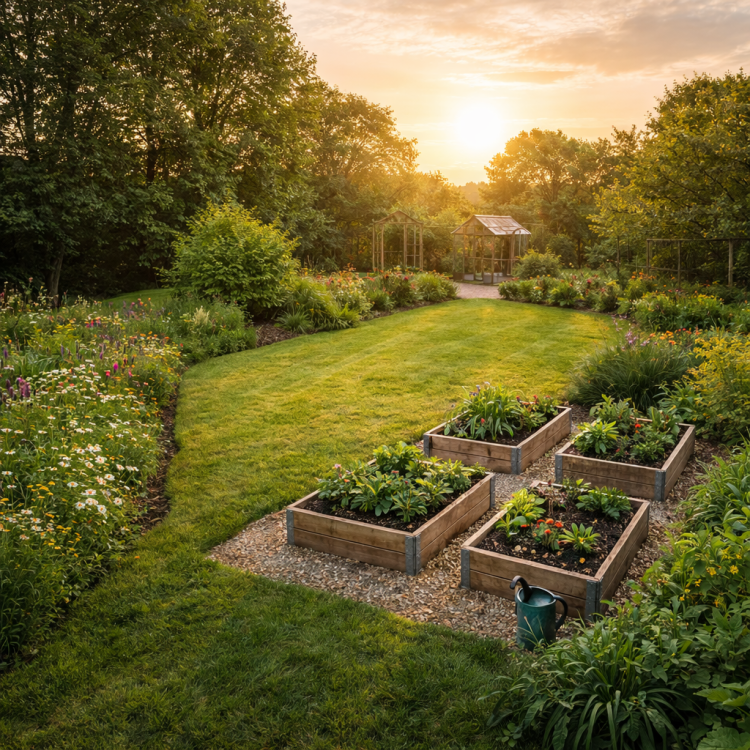
| Restraint, resilience, and deliberate evolution Over the course of this series, we have examined climate volatility, the global shift away from lawn-first models, modular micro systems, economic diversification, experimental plant trials, and ecological stewardship. Each strand points toward the same conclusion: gardening is changing structurally, not cosmetically. Part VII draws these strands together and asks a practical question. What does Earthly Comforts become if it responds deliberately rather than reactively? Designing for the next twenty years requires resisting two temptations. The first is complacency — the assumption that environmental instability will moderate and that traditional maintenance structures will remain sufficient. The second is overreach — attempting radical transformation without the capacity, coherence, or restraint to sustain it. Resilience lies between those extremes. The starting point is proportionality. Lawns will remain part of many domestic gardens. They provide play space, visual openness, and cultural continuity. However, reliance on turf as the dominant service anchor introduces concentration risk. A future-proof model reduces that dependency without abandoning it entirely. Gradual lawn reduction packages, soil improvement programmes, and modular planting zones rebalance rather than replace. The second principle is containment. Micro systems — pallet collar beds, defined planting modules, controlled irrigation — offer contained resilience. Expanding these selectively across appropriate client sites distributes environmental risk. At scale, a network of such systems across multiple gardens forms a decentralised infrastructure. No single bed determines viability; each contributes incrementally. The third principle is soil primacy. Climate volatility repeatedly manifests as soil stress. Designing for 20 years prioritises soil health over surface appearance. Mulching, compost cycling, aeration, and organic matter integration become non-negotiable practices rather than optional enhancements. Investment in soil reduces long-term vulnerability. The fourth principle concerns knowledge. Experimental beds and propagation trials transform gardens into living laboratories. Over time, this builds a locally specific performance library. Plant choices shift from catalogue preference to observed resilience. Advisory services become evidence-based rather than aspirational. This intellectual capital strengthens competitive differentiation. Economic architecture underpins all of this. Diversification does not require expansion into unrelated services. It requires layering complementary revenue streams. Installation work balances maintenance volatility. Membership models distribute income throughout the year. Ecological stewardship packages create structured oversight beyond mowing frequency. Each layer reduces exposure to climate-induced income swings. Equally important is restraint in scale—growth for its own sake risks fragility. Expanding geography or workforce without maintaining service coherence undermines resilience. A twenty-year horizon favours depth over breadth. Increasing value per client, strengthening existing relationships, and refining skill sets often prove more stable than rapid client acquisition. There is also an ethical dimension. As environmental awareness deepens, clients increasingly seek service providers who demonstrate responsible practices. A business that integrates biodiversity support, water efficiency, and soil regeneration aligns with broader societal direction. This alignment is not performative; it is pragmatic. Environmental responsibility and economic resilience increasingly intersect. However, clarity about limits remains essential. Earthly Comforts need not become a large-scale ecological consultancy or commercial landscape contractor. Its strength lies in locality, relationship, and deliberate craft. Designing for the future means preserving that identity while adapting its structure. Over a twenty-year horizon, climate volatility may intensify. Water restrictions may become more frequent. Public discourse around biodiversity and resource use will likely sharpen. In that context, a garden business structured around diversified services, modular systems, soil-first practice, and ongoing learning stands on firmer ground than one reliant on predictable growth cycles. The image of the “Garden Butler” evolves accordingly. No longer solely a caretaker of surfaces, the role becomes integrative. It balances aesthetic order with ecological function. It advises as well as maintains. It anticipates rather than reacts—professional gardening shifts from repetitive routine toward informed stewardship. Designing Earthly Comforts for the next twenty years, therefore, involves a series of measured adjustments rather than dramatic declarations. Introduce modular systems where appropriate. Expand soil programmes gradually. Formalise ecological services. Develop propagation capacity modestly. Build membership layers with clear limits. Evaluate each addition against capacity and coherence. Resilience is cumulative. Each structural refinement strengthens the whole. Each diversification reduces dependency on a single variable. Each season of observation informs the next. Gardening as it is becoming is neither nostalgic nor radical. It is adaptive. It recognises that environmental conditions are shifting and that professional practice must shift alongside them. By grounding change in structure, knowledge, and restraint, Earthly Comforts positions itself not merely to survive volatility but to operate confidently within it. This concludes the series, but not the process. Adaptation is ongoing. The climate will continue to evolve. So too must the garden — and the business that tends it. |
| About our writing & imagery Most articles reflect our real gardening experience and reflection. Some use AI in drafting or research, but never for voice or authority. Featured images may show our photos, original AI-generated visuals, or, where stated, credited images shared by others. All content is shaped and edited by Earthly Comforts, expressing our own views. |

