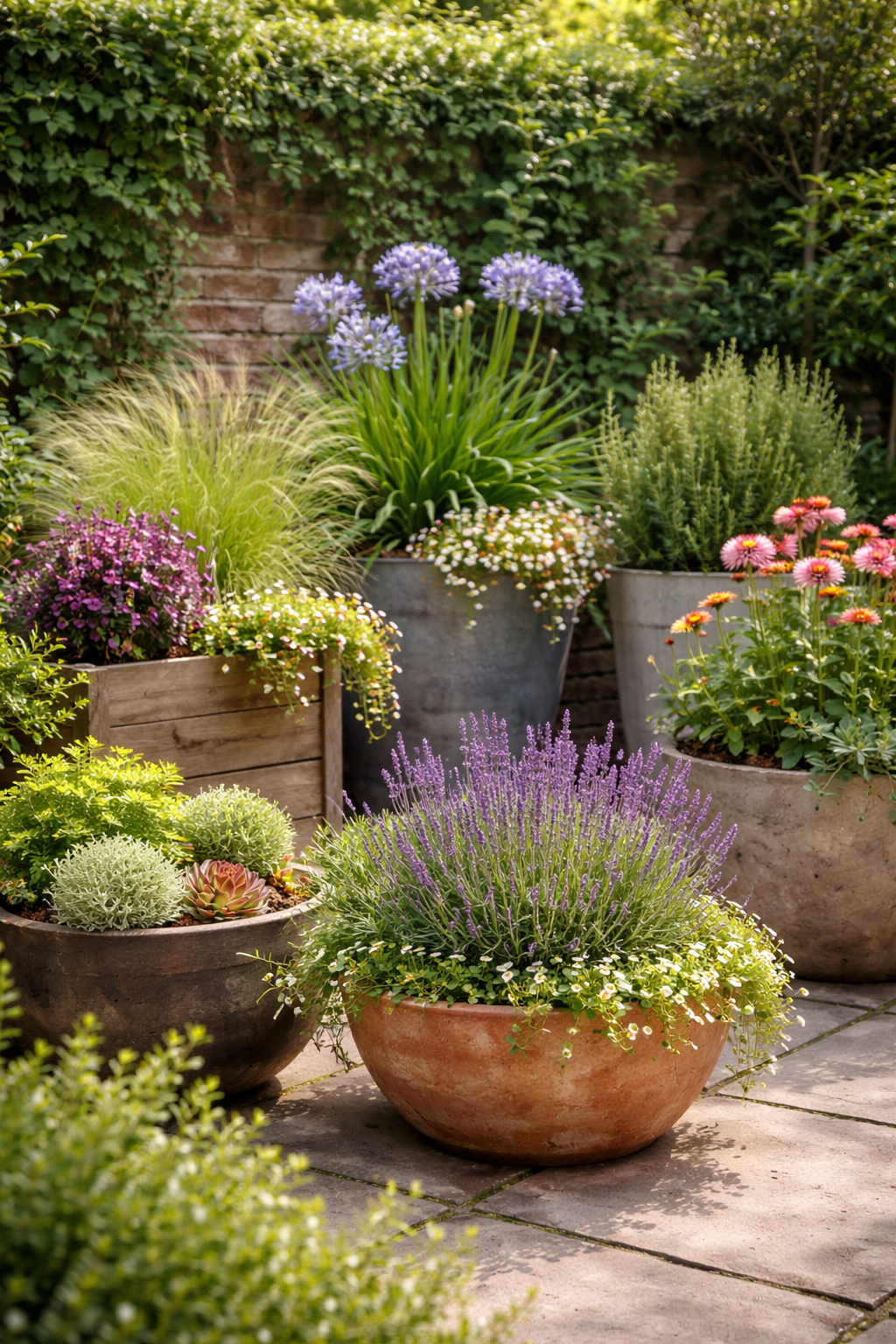
| Choosing Patio Containers for Dry Times If containers teach us anything, it is that choice matters long before care does. When people speak about “low-maintenance” planting, what they often mean is reduced intervention. Less watering. Less feeding. Fewer replacements. In practice, that ease does not come from luck or miracle varieties, but from alignment. Plant to place. Root to volume. Leaf to light. On patios and terraces across the UK—particularly in town gardens where paving holds heat and wind moves freely—the question is not simply what will survive in a pot, but what will remain composed when the weather turns abrupt. Because it will. In recent summers, I’ve noticed a quiet divide between plants that endure dry spells with dignity and those that falter at the first missed watering. The difference is rarely about toughness alone. It is about origin and design. Many of the most reliable patio plants come from climates where scarcity is normal. They have evolved mechanisms for restraint. Container gardening, in that sense, is not about indulgence. It is about selection. Mediterranean Temperament Lavender has become shorthand for drought tolerance, and understandably so. But what interests me about lavender is not merely its ability to survive dryness; it is its refusal of excess. Overwater it, and it declines. Feed it heavily, and it grows soft. It performs best when treated with a degree of respectful neglect. Rosemary behaves similarly. Now reclassified botanically, though still known to most of us as rosemary, it carries the architecture of a small shrub even in a pot. Its leaves are narrow, leathery, and designed to conserve moisture. In a sunny container with sharp drainage, it can persist for years with minimal fuss. In a damp, shaded corner, it quietly resents you. Thyme and oregano follow the same principle. They are not naturally thirsty plants. Given full sun and lean compost, they remain compact and aromatic. Treated as bedding subjects in rich, water-retentive mixes, they become floppy and short-lived. The broader lesson here is not about specific species, but about temperament. Mediterranean plants evolved in thin soils and bright light. Containers, when prepared with good drainage, replicate those conditions surprisingly well. It is not indulgence they require. It is clarity. Plants That Store Their Own Insurance Sedums, stonecrops, and sempervivums fascinate me for their self-sufficiency. Their leaves hold water in reserve. Their growth is measured rather than exuberant. They do not protest loudly when neglected for a week. In shallow containers or troughs where other plants might sulk, these species often thrive. They create texture rather than spectacle. A low mat of sedum softens a pot’s edge. A cluster of sempervivums settles into crevices with quiet confidence. Yet there is a subtle trap here. Because succulents tolerate dry conditions, people assume they require none. Even drought-tolerant plants benefit from occasional thorough watering. The difference is frequency, not absence. Containers exaggerate neglect. A sedum will endure, but it will also tell you—through diminished colour or reduced growth—when it has been stretched too far. Perennials That Understand Restraint Catmint is one of those plants that seems perpetually relaxed. Its foliage releases scent when brushed. Its flowering period is generous without being demanding. In a container with adequate depth and drainage, it handles dry spells with composure. Agapanthus, by contrast, carries drama. Strappy leaves, bold stems, spherical blooms. It is often associated with seaside towns and sunlit terraces. In truth, it appreciates confinement. Slight root restriction can encourage flowering. But it does require warmth and good drainage. In a cold, waterlogged pot, it will not forgive easily. Echinacea has grown in popularity in recent years, and for good reason. It tolerates heat and supports pollinators. In containers, it performs best when given space for its roots to develop. Too small a pot, and it becomes short-lived. Adequate depth, and it establishes a rhythm. Verbena, too, relishes sun and copes with leaner conditions. Its wiry stems and airy flowers bring movement to a grouping. It is less about mass and more about lightness. What unites these perennials is not merely drought tolerance, but proportion. They do not immediately attempt to outgrow their environment. They adapt. Evergreen Composure Rock roses—Cistus—are perhaps underused in containers. Their flowers are brief but vivid. More importantly, their evergreen foliage maintains structure through winter. They evolved in poor, dry soils and dislike heavy feeding. In a generous pot with sharp drainage, they form resilient mounds. Ornamental grasses such as Stipa or Molinia introduce movement without thirst. They respond to wind rather than resist it. In windy patios, this quality matters. A plant that yields slightly is often more durable than one that insists on rigidity. Heucheras offer another approach. They are not strictly drought-tolerant plants, but once established, they tolerate moderate dryness, particularly in partial shade. Their appeal lies in their foliage rather than their blooms. In containers, foliage often outperforms flowers over time. Hardy geraniums can be similarly dependable, though in pots they benefit from occasional refreshment of compost. Their root systems are more expansive than one might assume. The Myth of “Low Maintenance” There is an assumption that choosing drought-tolerant plants eliminates the need for care. It does not. It refines it. A well-drained compost mix remains essential. Without it, even the most resilient lavender will fail. Grouping plants with similar water needs prevents confusion. A thirsty fern beside a sedum creates an inevitable compromise. Mulching the surface of pots—gravel for Mediterranean species, organic matter for others—helps regulate evaporation. It also stabilises temperature at the root zone. But none of this removes the gardener from the equation. It simply changes the frequency and intensity of intervention. Low maintenance is not the absence of maintenance. It is the alignment of plant choice with the environment. Sunlight as Arbiter Most drought-tolerant patio plants prefer sun. That seems straightforward, yet patios are rarely uniform. Shadows shift across walls. Reflected heat from the brick intensifies certain corners. A north-facing terrace behaves very differently from a south-facing courtyard. Before selecting plants, I have learned to observe light patterns across a full day. Not all sun is equal. Morning light is gentler. Afternoon sun can scorch. Lavender in half shade becomes elongated. Heuchera in full midday sun may bleach. Agapanthus in insufficient light produces foliage without flowers. Containers magnify these responses because roots cannot travel in search of better conditions. They are dependent on the gardener’s foresight. Grouping for Resilience One of the most practical adjustments I have made in container arrangements is grouping plants by water requirement. It sounds obvious, yet I have seen many patios where Mediterranean herbs sit beside moisture-loving annuals. The result is chronic overwatering of one and underperformance of the other. By grouping drought-tolerant plants, watering becomes deliberate rather than anxious. They can be allowed to dry slightly between soakings. Thirstier plants, grouped separately, receive appropriate attention. This subtle organisation reduces labour and improves plant health simultaneously. Containers as Climate Adapters There is a broader context to all this. As weather patterns shift, gardens must adapt. Containers offer a degree of control that borders sometimes lack. Soil composition can be tailored precisely. Drainage can be engineered. Plants can be relocated if exposure proves unsuitable. Drought-tolerant species are not merely fashionable; they are pragmatic. They reduce water consumption. They endure intermittent neglect. They align with paved environments that radiate heat. But we must avoid romanticising toughness. A container is still a contained system. Even the hardiest plant depends on periodic care. Quiet Companions In the end, selecting patio plants for lower water use is less about chasing the toughest species and more about choosing companions suited to constraint. Lavender, rosemary, thyme, sedum, catmint, agapanthus, echinacea, verbena, rock rose, ornamental grasses, heuchera, and hardy geraniums—each brings a different quality. Fragrance. Structure. Movement. Colour. Texture. What unites them is not invincibility but proportion. They do not demand constant indulgence. They respond to the clarity of conditions. Containers, when planted thoughtfully, can hold these species for years. They become steady presences on patios, softening hard surfaces and moderating space. In a time when water is no longer something to assume but something to steward, that feels quietly significant. A patio planted with restraint is not austere. It is attentive. |
| About our writing & imagery Most articles reflect our real gardening experience and reflection. Some use AI in drafting or research, but never for voice or authority. Featured images may show our photos, original AI-generated visuals, or, where stated, credited images shared by others. All content is shaped and edited by Earthly Comforts, expressing our own views. |

