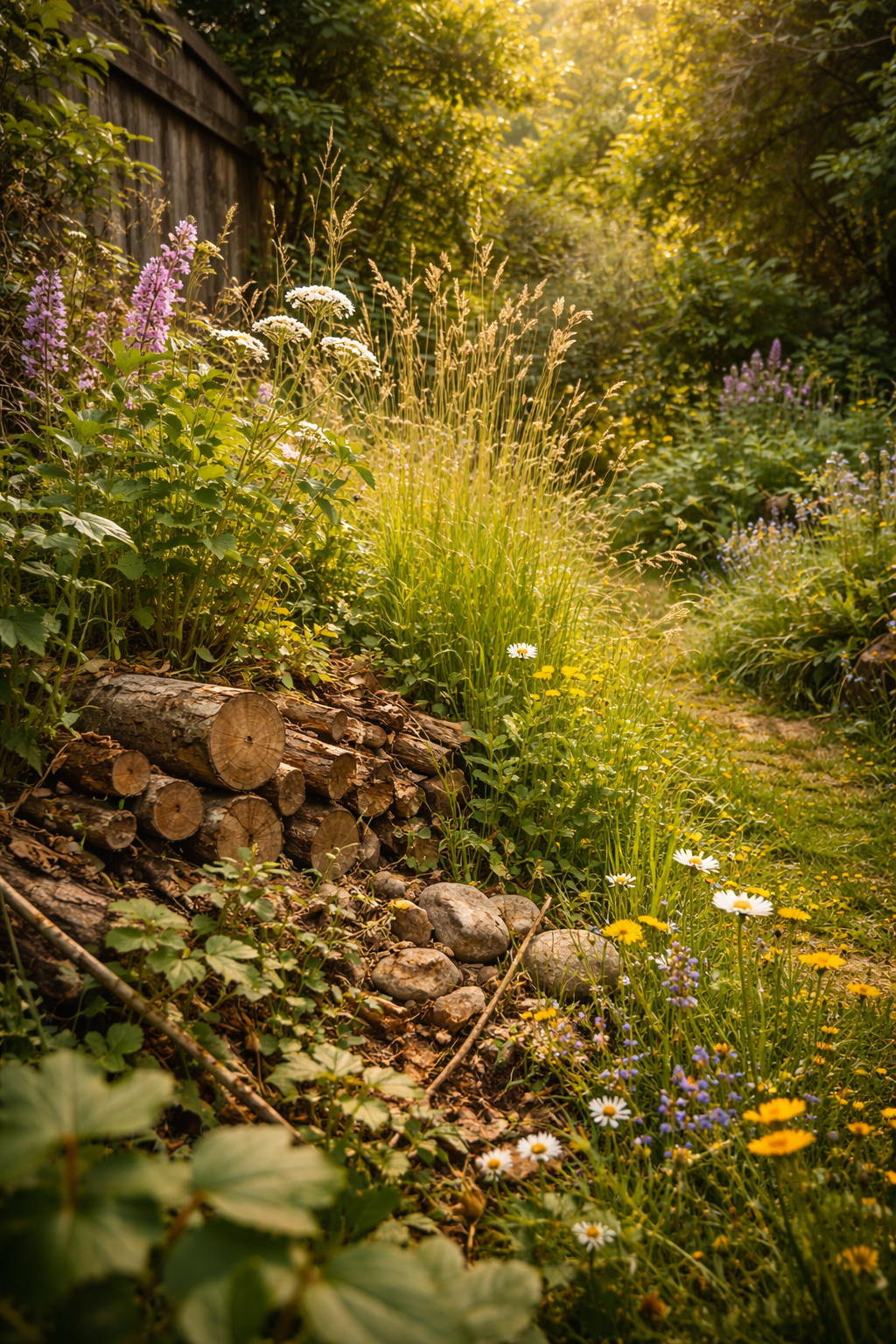
| Wild Corners & Rewilding Small Spaces How untidy gardens quietly support the most life There is often a moment — usually in spring — when a gardener pauses at the edge of a bed or fence and hesitates. The grass is longer there. Leaves have gathered. A bramble shoot or self-seeded plant has appeared where it wasn’t planned. The question arises almost automatically: Should I tidy this up? Wild corners begin exactly at that moment of hesitation. They are not about abandoning the garden, nor about recreating wilderness. They are about allowing small areas to soften, to grow at their own pace, and to provide what much of the modern landscape no longer does: continuity, cover, and choice. In a season defined by growth and renewal, these quieter spaces often support more life than anywhere else in the garden. |
| What “rewilding” really looks like in gardens. Rewilding, in a garden context, is often misunderstood. It does not mean letting everything run unchecked. It does not require large spaces, rare species, or dramatic transformation. In most gardens, rewilding is subtle — even accidental. It looks like: A corner left unmown. A hedge allowed to thicken. Old stems are standing a little longer. Leaves gathered rather than removed. Edges that blur instead of being sharpened These small decisions create habitat. Not all at once, but cumulatively. Wild corners are not chaotic. They are simply less managed, and that difference matters. |
| Why edges matter more than centres Much of garden life concentrates on the edges. Where lawn meets hedge. Where the fence meets the border. Where soil meets stone. These transition zones — known ecologically as margins — offer a variety of conditions within a small space. Wild corners tend to form naturally at these boundaries, and they provide: Shelter from wind Shade and warmth in close proximity Multiple feeding opportunities Safe movement routes In spring, when wildlife is emerging, nesting, and feeding under pressure, these layered spaces are invaluable. A single softened edge can support more life than a large open lawn. |
| Shelter in a season of exposure Spring is a time of vulnerability. Young animals are born. Insects emerge. Bird’s nest. The weather shifts rapidly between warmth and cold. Shelter becomes as important as food. Wild corners provide: Protection from late frosts Cover from predators Places to rest unseen Stable microclimates Dense vegetation, leaf piles, log stacks, and long grass all create conditions that buffer extremes. These areas warm more slowly, cool more gently, and hold moisture longer — offering refuge when the rest of the garden feels exposed. |
| Rewilding small spaces works because scale doesn’t matter. One of the most powerful aspects of wild corners is that they don’t need to be big. A square metre of long grass. A single log pile. A narrow strip behind a shed. A tangle of climbers at the base of a fence. These spaces may feel insignificant, but to small creatures, they are entire worlds. In urban and suburban areas, especially, gardens form a patchwork. Wildlife moves from one small refuge to another. What feels minimal in isolation becomes meaningful when connected. Small spaces matter because they join up. |
| The role of time Wild corners are not instant. They improve as: Plants mature Insects establish Soil life increases Routes become familiar Spring is often when these spaces first show their value — when insects reappear, birds forage more frequently, and mammals move through with confidence. Removing or resetting them every year breaks this continuity. Leaving them in place allows memory to build — not human memory, but ecological memory. Life remembers where it was safe. |
| Letting plants choose Wild corners often reveal what a garden truly wants to grow. Self-seeded plants appear because conditions suit them. Native species arrive because they recognise the environment. Over time, a natural balance develops — one that reflects soil, light, moisture, and the needs of local wildlife. These plants are often: Excellent for insects Well adapted to local conditions. Resilient without intervention They may not fit traditional planting schemes, but they perform vital roles — holding soil, feeding pollinators, and providing structure when cultivated plants fade. |
| Rethinking “untidy” Untidy is often a visual judgement, not an ecological one. What appears messy may be: Nesting material Overwintering habitat Food source Shelter Wild corners ask us to expand our definition of care. To recognise that restraint can be an active choice rather than a lack of attention. A garden can be intentional without being immaculate. |
| The quiet confidence of leaving something alone There is a particular confidence in choosing not to intervene. Wild corners do not announce their value. They reveal it slowly — through increased bird activity, more insects, subtle movement, and a sense that the garden feels calmer, more settled. Spring highlights this difference. Where everything else is cut back and reset, wild corners remain steady. They offer familiarity in a season of change. |
| A garden that breathes Gardens with wild corners tend to feel different. They breathe more easily. They recover more quickly from extremes. They require less correction. They support life without constant input. This is not because they are unmanaged, but because they are managed with patience. |
| Choosing space over control Wild corners are not about neglect. They are about trust. Trust that life will use what is available. Trust that beauty does not always need arranging. Trust that the garden can support more than we can see. In spring, when growth surges and everything seems to demand attention, choosing to leave a small space alone can be one of the most meaningful decisions we make. Because sometimes, the most generous thing a garden can offer is room. |

