
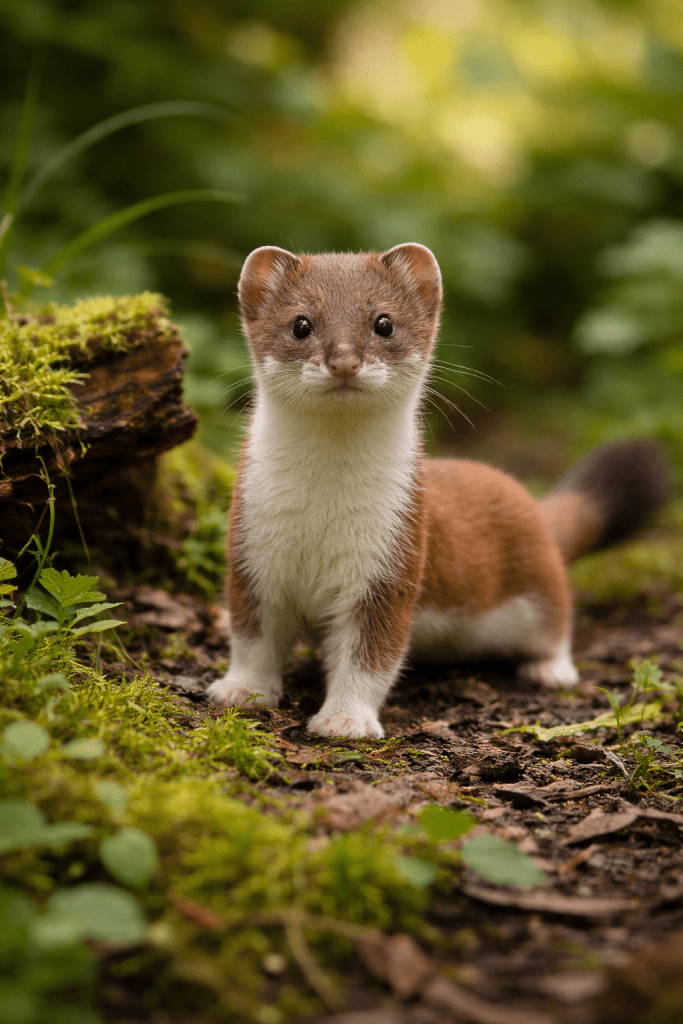
| AI Generated Image of English Stoat |
| The Secret Life of Stoats in the UK Stoats are among the most charismatic and misunderstood mammals in the UK. Agile, expressive, and astonishingly athletic, they move through the countryside with a confidence that seems out of proportion to their size. One moment, they are upright and curious, the next, they are a streak of motion flowing through grass, stone walls, or woodland edge. Often confused with weasels, stoats are a distinct species with their own behaviours, rhythms, and ecological importance. To understand stoats is to understand how precision predators shape balance at ground level—and how personality can exist even in the smallest of wild hunters. |
| What Is a Stoat? The stoat is a small carnivorous mammal with a long, flexible body, short legs, and a characteristically bold posture. In its summer coat, it is rich chestnut-brown on the back with a creamy white underside, cleanly divided along the sides. Its most reliable identifying feature is the black tip at the end of its tail, which is present year-round. In winter, some stoats change into a white coat, known as ermine, retaining the black tail tip. This colour change is more common in northern and upland areas of the UK, where snow cover is more consistent, but even where full whitening is rare, lighter winter coats may still appear. Stoats are larger and more robust than weasels, with a slightly heavier build and a more bounding, energetic gait. Built for Speed, Strength, and Surprise Stoats are specialist hunters, designed for pursuit in tight spaces and open ground alike. Their bodies allow them to enter burrows, run through vole tunnels, climb, leap, and twist with ease. They are capable of sudden changes in direction and impressive vertical jumps, often leaping upright to survey their surroundings. One of the most remarkable aspects of stoat behaviour is their use of rapid, erratic movement when hunting. This can confuse prey, momentarily overwhelming it with motion. What looks playful or chaotic is actually a highly refined hunting strategy. Stoats hunt with confidence, but not recklessness. Every movement is measured against energy cost and reward. Diet: Skilled and Selective Predators Stoats feed primarily on small mammals, especially rabbits, voles, and mice. Unlike weasels, stoats are large enough to regularly take rabbits—prey that can outweigh them significantly. This makes them particularly important in controlling rabbit populations, especially in rural landscapes. They will also take birds, eggs, insects, and occasionally amphibians, adapting their diet to what is available. Stoats may cache surplus food during times of abundance, storing prey to eat later when hunting is less successful. This ability to plan ahead sets stoats apart from many small predators and contributes to their resilience in challenging conditions. Territory and Daily Life Stoats are solitary animals for most of the year. Each individual maintains a territory that it patrols regularly, marking boundaries with scent and revisiting key hunting routes. They do not dig extensive burrows of their own but make use of existing rabbit holes, stone piles, tree roots, and dense vegetation for shelter. Their dens are often lined with fur and feathers, providing warmth and insulation. Stoats are active both day and night, with peaks at dawn and dusk. Their visibility during daylight is one reason people are more likely to notice stoats than weasels, despite both being elusive. Breeding and an Unusual Life Cycle Stoats have one of the most unusual reproductive strategies among UK mammals. Mating typically occurs in summer, but embryo development is delayed. This means the young are not born until the following spring. As a result, females give birth to a litter—often six to twelve kits—at a time when prey is most abundant. The kits are born blind and helpless, and they develop rapidly in a well-hidden nest. Young stoats grow quickly and begin learning to hunt within weeks. By autumn, many will disperse to find territories of their own, navigating a landscape full of risk and competition. Stoats and the Wider Ecosystem Stoats play a crucial role in maintaining ecosystem balance. By controlling rabbit and small rodent populations, they help prevent overgrazing, soil erosion, and damage to young trees and crops. Their presence supports healthier grasslands, woodlands, and farmland systems. Where stoats are absent, prey populations can grow unchecked, leading to cascading effects on vegetation and other wildlife. Stoats themselves are prey for larger predators, including birds of prey and foxes, placing them firmly within the middle of the food web. Stoats in Gardens and Human Landscapes Stoats do occasionally pass through gardens, particularly those near open countryside, farmland, or wildlife corridors such as hedgerows and railway embankments. Their visits are usually brief and purposeful. They do not damage plants, dig lawns extensively, or pose a threat to people. Their presence often goes unnoticed, except for a sudden glimpse of movement or a reduction in rabbit or rodent activity. Gardens that support stoats are typically rich in biodiversity, offering cover, prey, and connectivity to the wider landscape. Misunderstanding and Reputation Stoats, like many predators, have suffered from misunderstanding and persecution. Their efficiency as hunters has sometimes been viewed as excess or aggression, rather than necessity. In reality, stoats are finely balanced animals, living close to energetic limits. They hunt because they must, and they do so with remarkable skill and restraint. Their expressive movements—leaping, bounding, standing upright—often appear playful or cheeky, contributing to their reputation as lively characters of the countryside. Seasonal Changes and Winter Survival Winter is a challenging time for stoats. Cold increases energy demands, making prey harder to find. Those that change into white coats benefit from camouflage in snowy conditions, while others rely on speed and shelter. Stoats remain active throughout winter, using cached food, well-insulated dens, and relentless hunting to survive. Sightings during this season are particularly special, offering a glimpse into the determination required to persist through scarcity. Why Stoats Matter Stoats remind us that small predators can have a large impact. Their role in controlling prey populations supports entire ecosystems, from plant communities to birds and insects. They also remind us that wild animals are not defined by human labels of good or bad. They exist within systems of balance, responding to conditions with intelligence and adaptability. To value stoats is to value function, movement, and ecological connection. Learning to Watch the Quick and the Quiet Seeing a stoat is often a momentary experience—a flash of brown, a black-tipped tail, a sudden pause before motion resumes. These brief encounters stay with people because they reveal something rare: wild confidence at a small scale. Stoats do not linger or announce themselves. They move through the landscape as skilled specialists, shaping it quietly as they go. In learning about stoats, we learn to appreciate the fast, the subtle, and the essential. |

