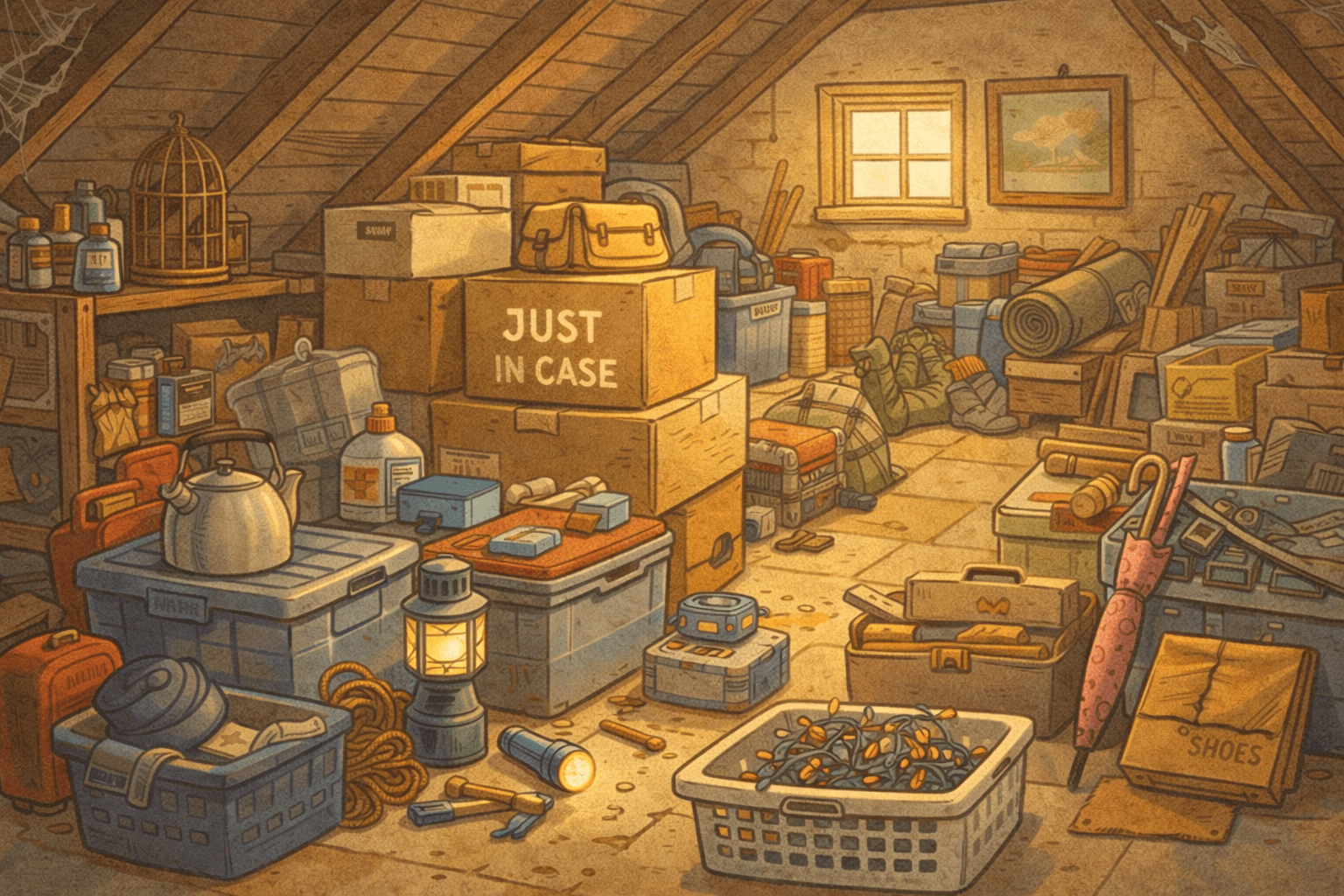
| The Things We Keep “Just in Case” |
| There is a category of objects that live permanently on standby. They aren’t useful day to day, but they aren’t finished either. We keep them not because we need them now, but because we might need them later. The phrase that protects them is always the same: just in case. I didn’t notice how many of these things I owned until I started working with spaces that had to function correctly. Sheds, cupboards, vans, garages. Places where every item either earns its keep or quietly gets in the way. “Just in case” objects accumulate slowly, almost politely, until they form a parallel inventory of imagined futures. Old cables. Spare fittings. Bits of timber cut to no particular length. Half-used tins. Containers that once held something important enough to warrant saving the container itself. Each item carries a story of preparedness. Or anxiety. Often both. There’s a common assumption that keeping things “just in case” is irrational — a failure to declutter properly. But that misses the point. Most people don’t keep these objects out of laziness. They keep them out of responsibility. The discomfort of being unprepared is often greater than the discomfort of holding onto a bit too much. Gardening sharpens this instinct. Experience teaches you that the thing you threw away last month is exactly the thing you’ll need next week. A particular fixing. A short length of wire. A tool you didn’t think you’d use again. Over time, you develop a respect for contingency. You learn that usefulness is not always immediate. But “just in case” has limits. One of the quieter lessons of working with physical systems is that preparedness can tip into drag. Objects kept for hypothetical futures begin to slow down the present. Drawers become harder to open. Shelves bow. Time is lost searching for things instead of using them. What once felt prudent starts to feel heavy. This is the trade-off few people talk about. Keeping something is an ongoing decision, not a one-off act. Every object retained requires space, attention, and occasional reassessment. When those costs outweigh the likelihood of use, preparedness becomes inertia. I’ve noticed that “just in case” objects often cluster around uncertainty—periods of transition. Projects left unfinished. Skills half-learned. We keep the materials because letting them go feels like admitting something didn’t happen. The object becomes a placeholder for intention. This is why clearing these things can feel strangely emotional. You’re not just discarding an item; you’re closing a door on a possible version of events. A job you might have done yourself. A repair you meant to learn. A habit you never quite formed. The mistake is thinking that decisiveness requires harshness. It doesn’t. In gardening, the most effective pruning isn’t aggressive. It’s selective. You remove what’s no longer serving growth, not everything that might one day be useful. The same approach works indoors. What matters isn’t whether you keep something, but whether you know why it’s there. Objects with a clear purpose — even a future one — tend to stay useful. Objects kept out of vague unease tend to multiply. There’s also a difference between keeping and storing. Keeping implies a relationship. Storing implies postponement. “Just in case” items often live in permanent postponement, neither used nor released. Over time, they stop being resources and start becoming background noise. Gardening has taught me that readiness isn’t about holding onto everything. It’s about knowing what you can source again, what you can adapt, and what genuinely matters to keep close. Most systems fail not because something is missing, but because too much is in the way. Letting go of “just in case” things doesn’t mean abandoning preparedness. It means refining it and trusting that future problems will not require every past solution. Allowing space for response rather than stockpiling reassurance. When I look at the shelves and cupboards I’ve thinned over time, I don’t miss what’s gone. I notice what’s left more clearly. The tools that earn their place. The materials I actually use. The space to move, to think, to respond when something unexpected does happen. In the end, the most helpful thing you can keep “just in case” isn’t an object at all. It’s confidence in your ability to adapt, repair, and respond without needing to surround yourself with every possible answer in advance. |
| About our writing & imagery Most articles reflect our real gardening experience and reflection. Some use AI in drafting or research, but never for voice or authority. Featured images may show our photos, original AI-generated visuals, or, where stated, credited images shared by others. All content is shaped and edited by Earthly Comforts, expressing our own views. |


That’s me! I have so many- just in case things and whenever I throw them away, I feel that they could have been useful.
LikeLiked by 1 person
Hey Sadje, yes, Suze and l both as well. You never know when you need that ‘just item!’ 🙂
LikeLiked by 1 person
Exactly. 👍🏼
LikeLiked by 1 person