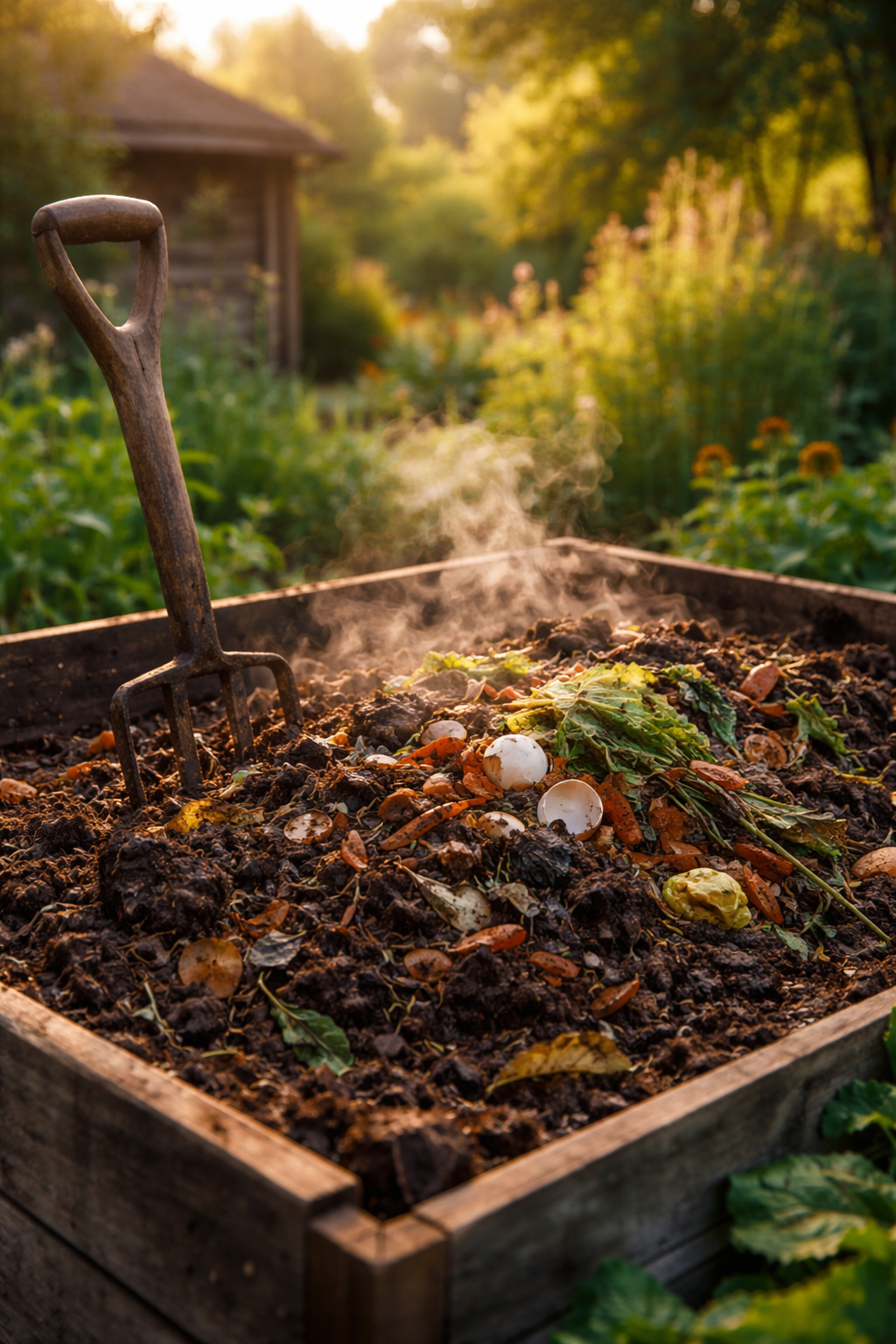
| Compost is rarely admired. It sits at the edge of gardens, tucked behind sheds or fenced into corners, quietly doing work that most people would rather not think about. It smells sometimes. It steams. It attracts insects. It is made of things that are finished, spent, or unwanted. And yet, if you spend enough time around soil, compost becomes one of the most honest teachers there is. At its simplest, compost is decay with purpose. Leaves fall, stems snap, peelings are discarded, and time takes over. What once had structure and usefulness breaks down. It loses its original identity. But nothing is wasted. The breakdown is not an ending; it is a transformation. Compost shows us that renewal does not come from holding on, but from letting go at the right moment. In gardening, we are often tempted to tidy too soon. We remove dying plants because they look untidy. We clear beds because they appear finished. Compost asks for patience. It reminds us that value is not always immediate or visible. A heap of rotting matter looks like failure if you expect perfection. It looks like potential if you understand the process. One of compost’s quiet lessons is that everything returns in a different form. A tomato plant that has finished fruiting is not useless. A lawn clipping is not waste. Even diseased or damaged material, when handled correctly, becomes part of a wider cycle. Compost does not judge the quality of what goes in. It works with what it is given. That has wider implications than gardening alone. We live in a culture that prizes constant productivity and clean outcomes. Compost operates on a different rhythm. It accepts pauses. It requires rest. It needs an imbalance before it can correct itself. Too much green material, and it turns slimy. Too much brown and it stalls. Progress only comes when opposing elements are allowed to coexist. Second chances are built into this system. Material that has failed once often performs better the second time around. Tough stems soften. Hard shells break down. What resists change eventually yields. Compost doesn’t rush this process or force it. It creates the conditions and then allows time to do the rest. Heat is part of that story, too. Compost warms from the inside, not because it is burning, but because life is working. Bacteria and fungi consume what is discarded, releasing energy as they do so. That warmth is a sign of activity, not destruction. It is an internal correction rather than an external intervention. Nothing is added for show; everything has a function. There is also humility in composting. Once broken down, you cannot tell where one thing ends and another begins. Rose pruning is no longer separate from vegetable peelings or fallen leaves. Everything merges. Compost teaches that contribution matters more than recognition. The final result is richer precisely because no single element dominates. In practical terms, good compost improves soil structure, holds moisture, feeds microorganisms, and supports plant health over the long term. But those benefits are not instant. Compost works slowly, quietly, and cumulatively. It does not provide quick fixes. It improves resilience rather than appearance. You don’t always see its impact straight away, but you notice when it’s missing. Gardens that rely solely on quick nutrients often look impressive for short periods, then struggle. Compost-fed gardens tend to be steadier. Plants cope better with stress. Soil stays workable. Life below ground flourishes. Compost builds foundations rather than facades. This long view is another lesson. Compost rewards consistency, not intensity. Small additions over time matter more than occasional grand gestures. A handful of peelings added weekly outperforms a single large dump once a year. Renewal happens through habit, not drama. Compost also teaches restraint. Not everything belongs in the heap at every moment. Some materials need time elsewhere before they are ready. Some conditions require adjustment. Composting is not about throwing everything together and hoping for the best; it is about paying attention. You learn by observing what happens when things go wrong. A compost heap that smells bad is not failing; it is communicating. It tells you something is out of balance. Too wet. Too compacted. Too much of one thing. The solution is rarely removal. More often, it is an adjustment. Add air. Add carbon. Turn gently. Compost responds to care, not force. There is something reassuring in that. Many systems punish imbalance. Compost absorbs it. It adapts. It corrects itself if given space. It doesn’t erase mistakes; it incorporates them. Seasonality plays its part as well. Compost behaves differently in winter than in summer. Cold slows it down. Heat accelerates it. Both are necessary. Dormancy is not failure; it is part of the cycle. Compost reminds us that pauses are productive, even when nothing appears to be happening. When compost is finally ready, it no longer resembles what went into it. It is dark, crumbly, and alive. You cannot trace the original forms, only the result. That transformation is complete. What was once rejected becomes central. Compost moves from the margins of the garden to the heart of it. Applied to soil, compost does not dominate. It blends. It supports. It feeds without overwhelming. Plants respond not by growing wildly, but by growing steadily. Roots explore more deeply. Leaves become thicker. Growth becomes balanced. Second chances often look like this. Not a dramatic restart, but a quiet re-entry. Compost doesn’t announce itself. It simply makes everything around it work better. There is also an ethical dimension to composting. It asks us to reconsider what we throw away. It challenges the idea of waste. When you compost, disposal becomes participation. Responsibility replaces removal. You stay connected to the outcomes of what you consume. That connection changes behaviour. You notice what breaks down easily and what doesn’t. You become more selective. Compost encourages awareness without demanding perfection. It allows learning through repetition rather than guilt. Over time, compost becomes less of a task and more of a relationship. You recognise its rhythms. You understand its needs. You adjust without thinking too much. It becomes part of the background practice of care, rather than a chore. In that sense, compost mirrors many natural recovery processes. Healing is rarely neat. Renewal is rarely quick. What looks like decay is often preparation. Compost teaches us to trust that transformation can happen even when things appear to be falling apart. The garden does not succeed despite compost. It succeeds because of it. Life depends on what has already lived. Growth is built on breakdown. There is no clean separation between endings and beginnings. Compost does not promise perfection. It offers continuity. It shows that second chances are not about returning to what was, but about becoming something else entirely. And in a world increasingly focused on instant results and visible success, that may be its most important lesson of all. |
Unless stated, featured images are my own work, created independently or with the assistance of AI.

