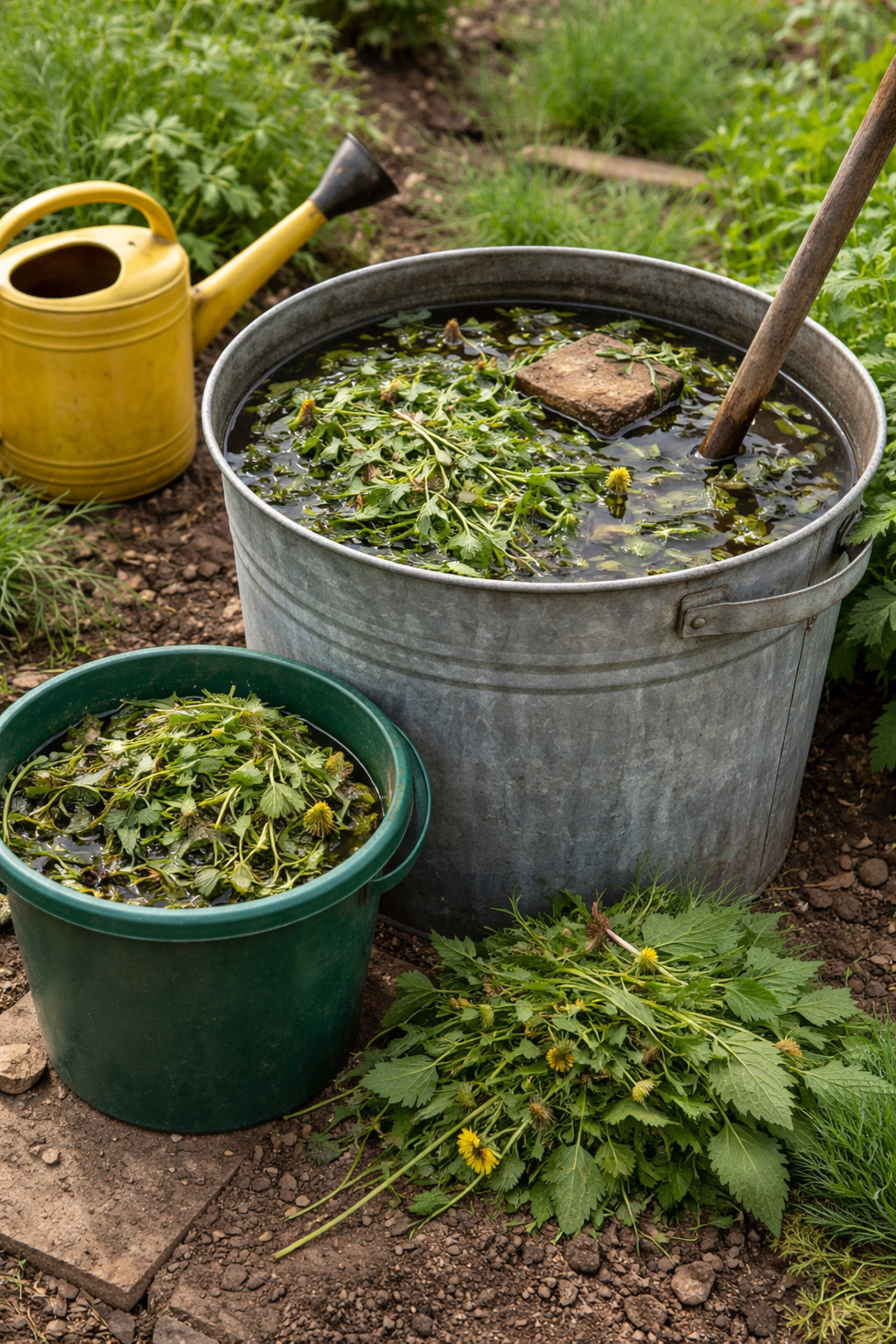
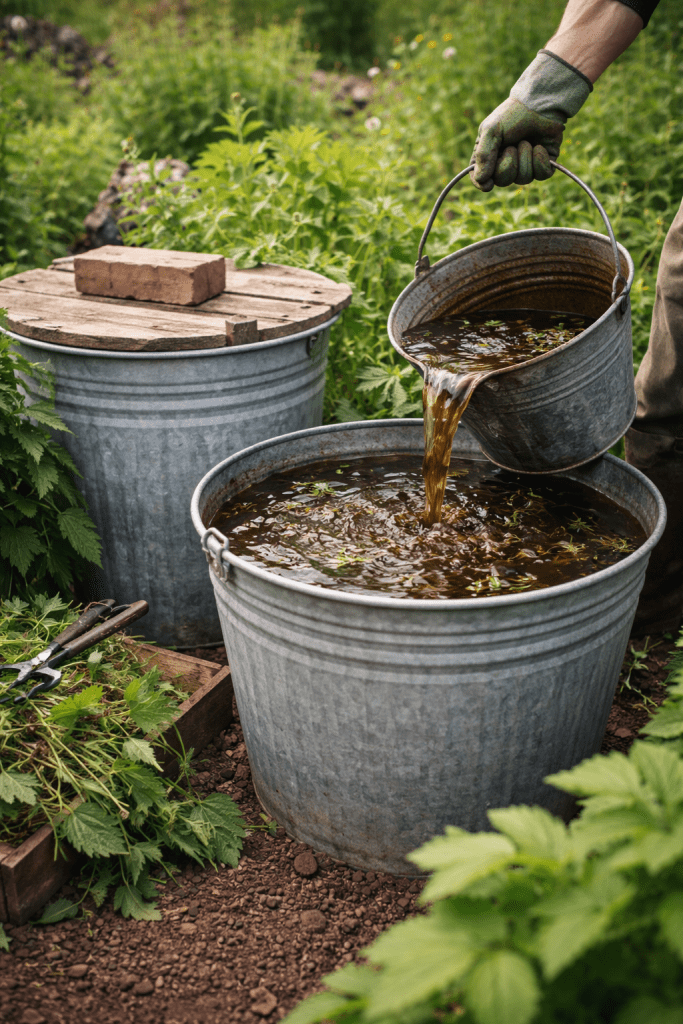
| Drowning Weeds, Feeding Soil, and Letting Time Do the Work I was asked about “weed tea” the other day. Not in a theoretical way, but practically — does it work, is it safe, and is it worth the effort? My answer was simple: I make weed tea regularly, even during periods when I can’t get down to the allotment as often as I’d like. It’s one of those methods that doesn’t rely on precision or constant attention. It just relies on patience. At the allotment, we have two large metal bins, always filled with water. When we weed beds or clear paths, the weeds don’t go into sacks or piles. They go straight into the bins. They are fully submerged. Weighted down. Left alone. What follows is less a process and more a quiet transition. This is the core of weed tea: drowning weeds, letting them break down, and returning what they held back into the soil system. Weeds are often framed as a problem to be removed, but in reality, they are temporary storage vessels. They’ve already done the work of extracting nutrients from the soil. Making weed tea is simply a way of reclaiming that work rather than discarding it. The first and most important part of weed tea isn’t the liquid — it’s the drowning. Drowning weeds matters because it removes ambiguity. A weed that has been fully submerged for weeks is no longer viable. Roots die. Seeds lose their ability to germinate. Cell structures soften and collapse. There is no question of regrowth later on. This is especially important with persistent or fast-spreading plants. Partial drying or wilting leaves too much room for survival. Water finishes the job cleanly. When weeds are submerged, oxygen is excluded. Anaerobic conditions take over. This changes how the plant material breaks down. Instead of slowly drying or composting, nutrients begin to leach directly into the surrounding water. Nitrogen, potassium, trace minerals — all released gradually as the plant matter softens. No chopping, shredding, or processing is required. The weeds collapse under their own biology. The bins we use aren’t special. They’re simply metal containers with rainwater. The weeds are pushed down and held under the surface with whatever weight is to hand — a stone, a lid, a piece of timber. The lid isn’t sealed tight. Gases need to escape. Beyond that, nothing is done. No stirring. No additives. Time does the work. After a few weeks, the smell changes. It’s not pleasant, but it’s not alarming either. It smells of breakdown. Of fermentation. Of something being undone. That’s how you know it’s working. The liquid darkens. The weeds lose structure. Leaves become unrecognisable. Stems soften and bend. At this stage, you have weed tea. Weed tea isn’t refined fertiliser. It isn’t balanced, measured, or predictable in the way shop-bought feeds are. It’s variable. It reflects whatever went into the bin. Nettles produce a different brew than chickweed or dock. Mixed weeds produce mixed results. That unpredictability is not a flaw — it’s a feature. Soil doesn’t require uniformity. It responds well to diversity. When using weed tea, dilution matters. Straight from the bin, it is too strong. I dilute roughly one part tea to ten parts water. It doesn’t need to be exact. The goal isn’t feeding plants directly, but feeding the soil around them. Weed tea should be applied to the soil, not the foliage. Around the base of plants. Into beds that are actively growing. Onto the ground that has been worked and exposed. It’s especially useful on hungry crops, newly planted areas, or soil that’s been disturbed. It’s less about immediate visual results and more about restoring momentum underground. What’s often overlooked is what happens next. Once the liquid has been taken, the spent weeds remain. This material is no longer alive. It’s been submerged, weakened, and partially broken down. At this stage, it is safe to compost. There’s a lot of anxiety around composting weeds, and most of it stems from adding them too early or too intact. Drowned weeds are different. Seeds have been rendered inert. Roots no longer function. What remains is soft, nitrogen-rich organic matter. When added to compost, these spent weeds act as green material. They heat quickly. They integrate fast. Mixed with cardboard, leaves, or woodier material, they disappear into the heap without incident. I always bury them rather than leaving them exposed, but turning isn’t essential. They’ve already done part of the composting work before they even arrive. There’s also a microbial benefit. The organisms that developed during fermentation carry over into the compost system. This helps kick-start activity, especially in slower heaps. For me, this is where weed tea really proves its worth. It closes the loop. Weeds are drowned, nutrients are extracted into liquid feed, and the remaining matter feeds the compost, which eventually feeds the soil again. Nothing leaves the system unless it absolutely has to. This approach suits people who garden in fragments of time. You don’t need to be present every week. The bins don’t care if you miss a visit. They sit quietly doing what biology has always done. It also suits gardens where waste removal is limited or undesirable. Less bagging. Less hauling. Less dependency on green waste disposal. It also changes how you view weddings. Instead of a chore that produces waste, it becomes a harvest. You’re collecting material that already belongs to the soil cycle. There are, of course, a few quiet cautions. Weed tea smells strongly. Placement matters. Containers should be away from doors, seating, or neighbouring boundaries where possible. The liquid should never be poured undiluted onto soil, and certainly never into drains or watercourses. Invasive species need longer submersion to ensure full breakdown. But these are common-sense considerations, not reasons to avoid the practice. I’ve found that weed tea works best when it’s not overthought. It’s not a product. It’s not a formula. It’s simply a way of allowing time and water to unlock what plants have already gathered. Even when I can’t get down to the allotment regularly, the bins are there, quietly doing their job. Weeds go in. Nutrients come out. The soil benefits later. Nothing dramatic. Nothing rushed. Just a slow, effective return. That, for me, is the point. |
Unless stated, featured images are my own work, created independently or with the assistance of AI.

