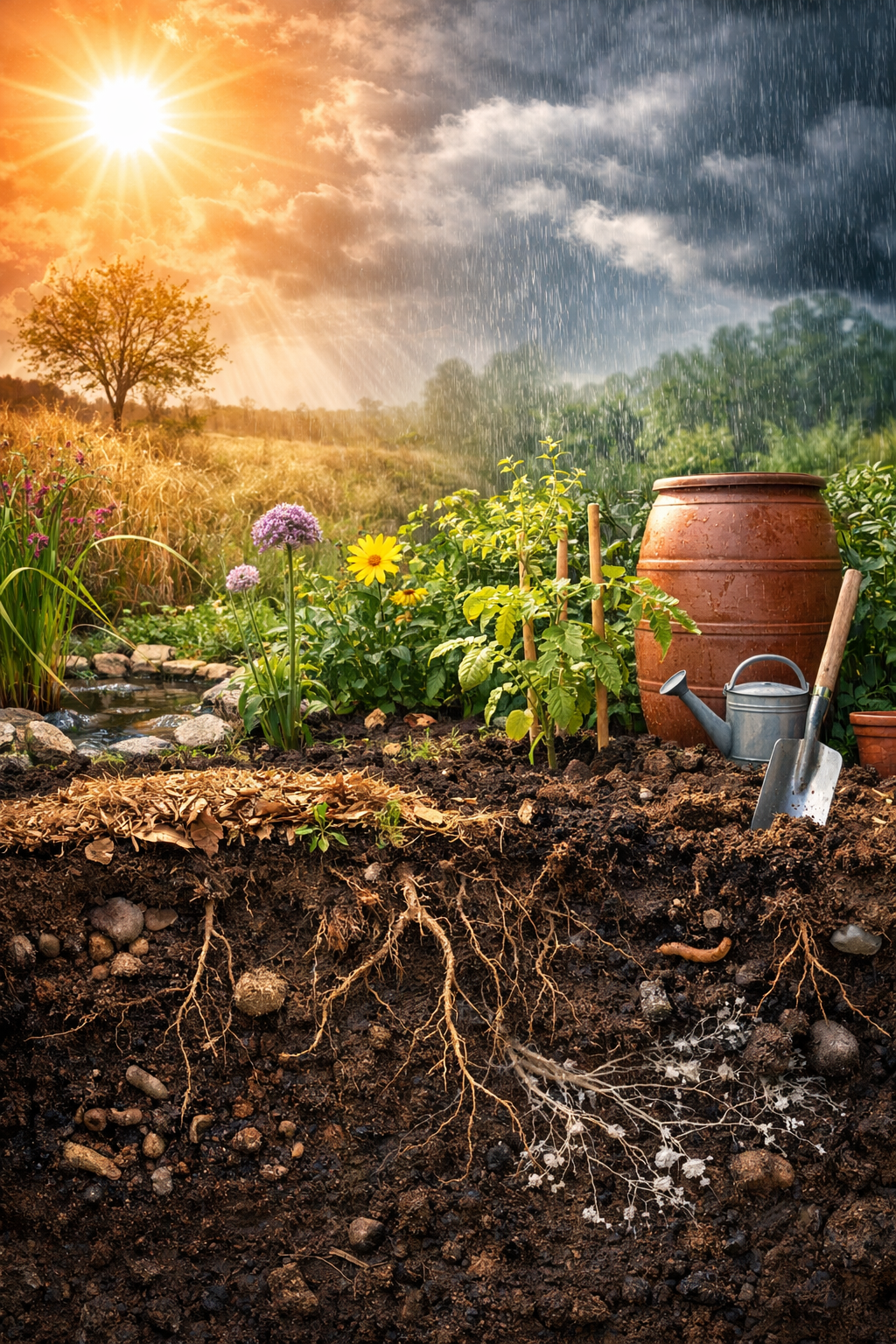
| Part 1 There was a time when the garden year felt dependable. Not easy, not gentle, but legible. You could read it. Winter cleared its throat and stepped aside. Spring arrived with hesitation, then commitment. Summer made demands. Autumn closed things down. Even when the weather misbehaved, it usually returned to the script. That sense of legibility has gone. What we have now is not simply warmer summers or wetter winters, but a steady erosion of rhythm. The cues still exist, but they no longer arrive in sequence. Growth surges early and stalls. Soil dries hard, then floods. Winters hover in a long grey half-state, neither dormant nor active. Summers compress stress into shorter, sharper bursts. For gardeners, this isn’t theoretical. It shows up underfoot. In the way lawns scorch and then struggle to recover. In borders that slump not from neglect, but from exhaustion. In plants that behave oddly — racing, retreating, or refusing to perform at all. For those of us running gardening businesses, it also shows up in quieter, less visible ways: in scheduling headaches, in difficult conversations, in the growing gap between what clients expect and what conditions allow. This piece isn’t an argument, and it isn’t a manifesto. It’s a reflection on what it feels like to garden — and to garden professionally — when the seasons no longer behave as they once did, and what that means for how we think about our work. The loss of predictability The biggest change is not temperature. It’s trust. Gardening has always involved risk, but it used to be a negotiated one. You could make decisions with a reasonable expectation of what would follow. Plant now, settle in, establish roots before summer. Prune at this point to avoid sap bleed and encourage structure. Cut the lawn regularly, keep it neat, keep it strong. Those expectations are now provisional. Spring warmth arrives early and encourages growth that later frost punishes. Summer heat arrives in blocks intense enough to shut plants down entirely. Rain falls when the soil can’t absorb it, then disappears when it’s needed most. The calendar still exists, but it’s no longer a reliable guide. This doesn’t mean gardening is broken. It means it has become more conditional. The work now demands observation before action. Decisions are made closer to the moment, with less certainty attached. The gardener becomes less of a scheduler and more of a reader — of soil, of stress, of timing windows that open briefly and close without warning. That shift alone changes the nature of the job. When effort no longer guarantees outcome One of the quieter frustrations of recent years is the way effort and result have become uncoupled. There are gardens that receive regular care and still struggle. Lawns that are mown correctly, fed lightly, and yet burn back in prolonged heat. Beds that are weeded and mulched, only to slump under sudden extremes. This can feel unsettling, particularly for clients who equate visible labour with control. From a gardener’s point of view, this is not failure. It’s physics and biology colliding with expectation. Plants respond to stress, not to instruction. They conserve energy, shorten their cycles, and retreat underground. Some recover quickly. Others take a full season, or longer. In wetter periods, the opposite happens: roots sit in cold, airless soil and simply wait. The old assumption — that consistent effort guarantees consistent performance — is becoming unreliable. That matters because so much of professional gardening has been built around visible activity rather than invisible resilience. Heat, saturation, and the limits of work There are times when gardening simply isn’t appropriate. Extended heat makes physical work unsafe and worsens plant stress. Cutting lawns in peak heat weakens them. Pruning encourages soft growth that can’t cope. Working bare soil accelerates moisture loss. At a human level, sustained heat turns routine labour into risk. At the other end of the year, prolonged saturation creates its own constraints. Waterlogged ground compacts easily. Foot traffic damages the structure. Machinery leaves ruts that persist long after the rain has gone. Borders collapse under the weight. Lawns are smeared rather than cut. In both cases, restraint becomes part of professionalism. This is a difficult adjustment, especially in a culture that still equates reliability with turning up regardless of conditions. But turning up and doing harm is not reliable. It’s a habit. The more extreme the conditions become, the more important it is for gardeners to recognise when “not now” is the most responsible decision available. The lawn problem No part of the garden exposes this tension more clearly than the lawn. Lawns sit at the intersection of nostalgia, control, and visibility. They are expected to look a certain way and to be maintained according to a rhythm that many people learned decades ago. Regular cutting. Short growth. Clean edges. In a changing climate, that model strains. During heatwaves, lawns benefit from rest. Longer growth shades the soil, reduces evaporation, and protects roots. Cutting short at the wrong moment turns stress into damage. During prolonged wet periods, lawns suffer from traffic and cutting just as badly, smearing and compacting under pressure. The idea that a lawn must always be cut on schedule is becoming one of the more damaging assumptions in domestic gardening. Letting go of that idea doesn’t mean abandoning care. It means redefining it. This is often where the sharpest conversations happen. Not because people don’t care about their gardens, but because lawns have become symbols of order in an increasingly disordered seasonal world. Soil is the quiet constant. If there is one part of the garden that has gained importance as everything else has become less predictable, it is soil. Healthy soil absorbs shock. It holds moisture even after the rain stops. It drains when rain overwhelms. It moderates temperature at the root zone. It gives plants time — time to recover, to pause, to re-enter growth when conditions allow. Poor soil amplifies extremes. It dries hard. It floods easily. It compacts under pressure. It turns stress into failure. For a long time, soil was treated as background. Something to plant into, something to tidy, something to cover. In a changing climate, it becomes infrastructure. This shift also changes what gardening work looks like. Some of the most valuable interventions now happen quietly: mulching, improving structure, protecting ground cover, and reducing disturbance. These are not dramatic jobs. They don’t always read as progress in the short term. But they underpin everything else. The changing role of the professional gardener All of this reshapes what it means to be a professional gardener. The role is drifting away from task delivery and towards judgment. Away from fixed seasonal routines and towards condition-based decision making. Away from visible output and towards long-term stewardship. This can be uncomfortable. Judgement is harder to quantify than hours worked. Restraint is harder to sell than activity. Explaining why something hasn’t been done takes more confidence than simply doing it. But as seasons destabilise, this judgement becomes the core of professional value. Clients don’t just need work carried out. They need interpretation. They need someone who understands why a garden is behaving the way it is, and what can — and cannot — be done in response. In that sense, gardening businesses are becoming translators between climate reality and domestic expectation. A quiet shift in aesthetics There is also an aesthetic shift underway, whether people acknowledge it or not. Gardens that cope well with extremes tend to look different. They rely more on shade, structure, and diversity. They tolerate variation. They recover slowly rather than instantly. They often look calmer, less forced, less tightly controlled. This doesn’t mean abandoning beauty. It means redefining it. The old ideal of constant peak performance — lush growth, tight lines, immediate recovery — is expensive in water, energy, and intervention. In a volatile climate, it becomes fragile. Resilient gardens accept ebb and flow. They have moments of retreat as well as abundance. They prioritise function alongside form. For some, this is a relief. For others, it feels like a loss. Both reactions are understandable. Trade-offs and honesty There is no version of climate-aware gardening that avoids trade-offs. Working less aggressively means accepting periods when gardens look quieter or less finished. Protecting soil means delaying work. Allowing lawns to rest challenges long-held habits. Prioritising safety over output disrupts schedules. None of this is neat. What matters is honesty — about limits, about context, about what care actually looks like under changed conditions. Gardening has always involved negotiation with nature. That negotiation is simply more visible now. The danger lies not in adapting, but in pretending adaptation isn’t necessary. Looking ahead The future of gardening — particularly professional gardening — will not be defined by new plants or new tools alone. It will be defined by how well we adjust our expectations, our working practices, and our definitions of success. Businesses that rely on rigid seasonal promises will struggle. Those who build flexibility, judgement, and soil-led thinking into their work will cope better — not because they are idealistic, but because they are realistic. Gardening in a changing climate is not about doing more. It is about doing less at the right time, and more where it genuinely helps. It is slower. Quieter. More thoughtful. And in many ways, closer to what gardening was always meant to be: a conversation with conditions, rather than an attempt to dominate them. |
| About our writing & imagery Many of our articles are written by us, drawing on real experience, reflection, and practical work in gardens and places we know. Some pieces are developed with the assistance of AI, used as a drafting and research tool rather than a voice or authority. Featured images may include our own photography, original AI-generated imagery, or—where noted—images kindly shared by other creators and credited accordingly (for example, via Pixabay). All content is shaped, edited, and published by Earthly Comforts, and the views expressed are our own. |

