| A 5-Part Series |
| A curated exploration of Australia’s most iconic, curious, and ecologically important insects |
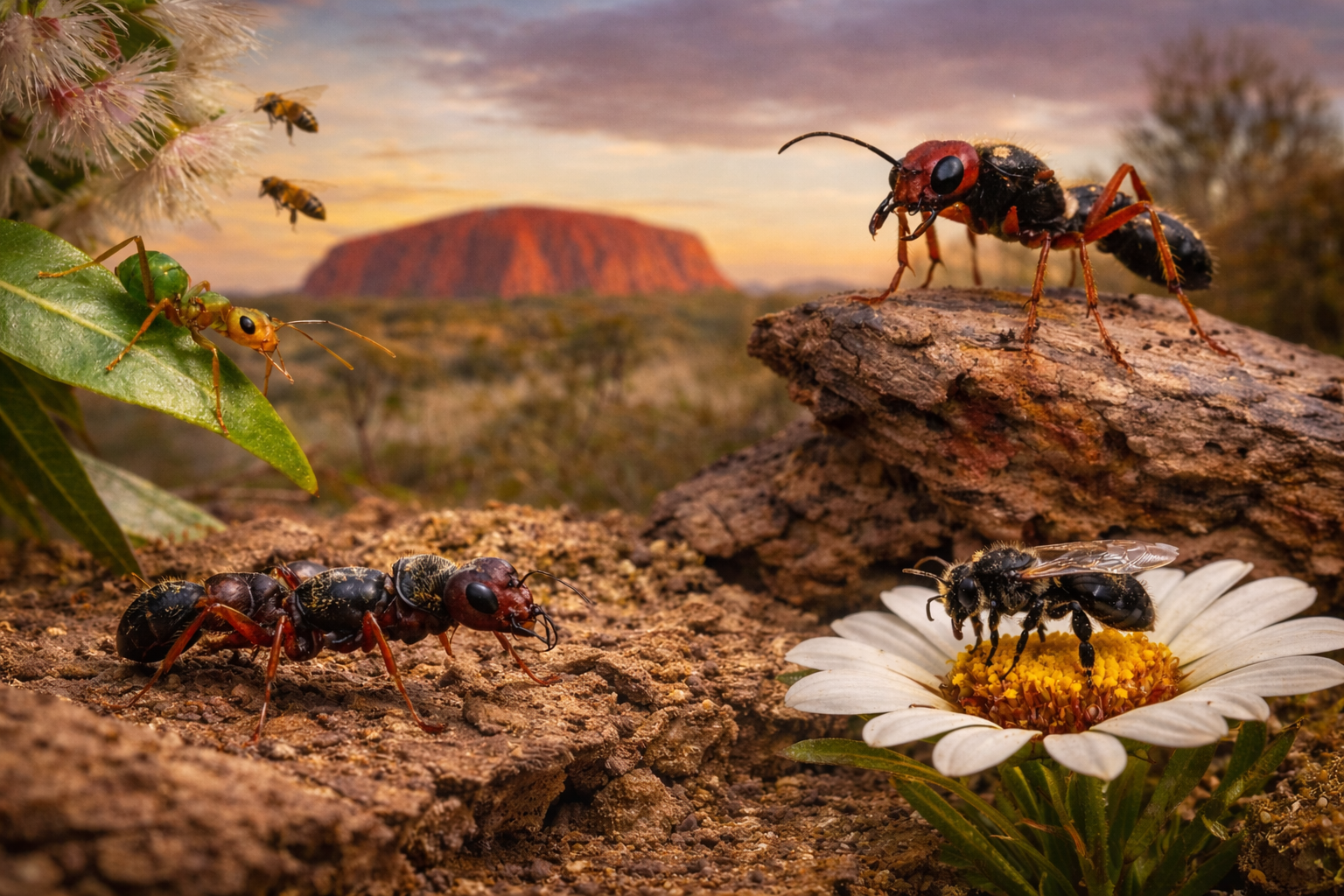
| Part 1 Ants, Bees & Wasps: Architects of the Land Ants, bees, and wasps are among the most influential insects in Australia. Long before agriculture, fencing, or roads, these insects were engineering the landscape — moving soil, shaping plant communities, recycling nutrients, and maintaining ecological balance. Their collective biomass outweighs that of many vertebrates, and their influence is quiet, constant, and profound. Australia’s harsh climates, ancient soils, and long isolation have produced insects of exceptional resilience and specialisation. In this first part of the series, we explore five species that exemplify intelligence, cooperation, aggression, and ecological necessity. |
| Green Ant (Weaver Ant) The green ant is one of Australia’s most remarkable natural engineers. Rather than nesting underground, these ants live in the canopy, weaving living leaves into strong, weather-resistant nests. Workers pull leaves into position while others use their larvae as biological glue guns—gently squeezing them so the larvae secrete silk to bind the leaves. Highly territorial and fiercely protective, green ants patrol their trees relentlessly, attacking intruders in coordinated waves. Their communication is sophisticated, relying on chemical signals and physical cues to organise defence, foraging, and construction. Beyond their engineering skill, green ants play a crucial ecological role. They act as natural pest controllers, reducing populations of leaf-eating insects and benefiting native vegetation. Indigenous Australians have long recognised their value — both as indicators of seasonal change and as a food source — with the ants’ sharp, citrus-like flavour prized in bush tucker traditions. |
| Jack Jumper Ant Small in size but formidable in reputation, the jack jumper ant is one of the most dangerous ants on Earth. Native primarily to southern Australia and Tasmania, it is known for its powerful venom, which can trigger severe allergic reactions — including fatal anaphylaxis — in susceptible individuals. What sets the jack jumper apart is not just its sting, but its behaviour. These ants are highly visual hunters, using excellent eyesight to track movement. They leap toward threats or prey with sudden, spring-loaded agility, delivering fast, repeated stings. Despite their aggression, jack jumper ants are ecologically important predators that help regulate populations of other insects. Their colonies are relatively small compared to other ants, but each individual displays a high degree of independence and problem-solving ability — traits that have made them a subject of scientific research into insect cognition and navigation. |
| Bull Ant Bull ants are among Australia’s most iconic insects — large, glossy, and unmistakably intimidating. Some species reach lengths of over four centimetres, with powerful mandibles and excellent binocular vision uncommon among ants. Unlike many ant species that rely heavily on pheromone trails, bull ants often forage alone, navigating long distances with remarkable spatial memory. Studies have shown they can remember landmarks and return to the nest with precision even after extended journeys. Their lifespan is equally impressive. While most insects live for weeks or months, some bull ant workers can survive for many years, and queens may live for decades. This longevity allows colonies to maintain stable territories over long periods, contributing to soil turnover and nutrient redistribution. Though aggressive when threatened, bull ants are not indiscriminate attackers. Their presence is a reminder that size, intelligence, and patience can coexist in the insect world. |
| Meat Ant Meat ants are masters of organisation and dominance. Found across much of mainland Australia, they form vast colonies that can span large areas, with multiple nests connected by well-worn foraging trails. Their name comes from their attraction to protein-rich food sources, particularly carrion. By rapidly dismantling dead animals, meat ants perform an essential sanitation role, returning nutrients to the soil and preventing the spread of disease. Territory is everything to a meat ant colony. They aggressively defend their range against rival colonies, often engaging in ritualised displays or full-scale battles. These territorial boundaries can remain stable for years, effectively dividing landscapes into invisible insect-controlled zones. Despite their aggression, meat ants contribute to seed dispersal and soil aeration, making them a key species in maintaining healthy open ecosystems. |
| Native Stingless Bee Australia’s native stingless bees represent a gentler side of insect society. Small, dark, and non-aggressive, these bees live in highly structured colonies within tree hollows, rock crevices, and even wall cavities. Although they produce only small amounts of honey, it is highly valued for its antibacterial and medicinal properties. More importantly, stingless bees are vital pollinators of native plants, many of which have coevolved with them over millions of years. Their colonies are models of efficiency and cooperation, with complex social roles and long-lived queens. Unlike introduced honeybees, stingless bees are finely adapted to Australia’s climate and flora, making them irreplaceable contributors to biodiversity. Their quiet work sustains forests, woodlands, and gardens alike — often unnoticed, yet indispensable. |
| Closing Reflection Together, ants, bees, and wasps form the living infrastructure of Australia’s ecosystems. They build, defend, recycle, pollinate, and regulate the natural world at a scale that belies their size. Without them, landscapes would unravel. In the next part of this series, we turn our attention to Australia’s beetles — the armoured recyclers, jewel-coloured icons, and unsung custodians of decay and renewal. |
| Ants, Bees & Wasps: Architects of the Land These insects shape soil, ecosystems, and even human history in Australia. Green ant (Weaver ant) Known for stitching leaves together to form nests using larval silk. Highly territorial and surprisingly intelligent. Jack jumper ant One of the world’s most dangerous ants due to its venom. Agile, aggressive, and infamous in Tasmania. Bull ant Large, long-lived ants with excellent eyesight. Some individuals live for over a decade. Meat ant Highly organised scavengers that dominate open landscapes and aggressively defend territory. Native stingless bee Gentle, social pollinators producing small amounts of medicinal honey — vital to native ecosystems. |
Unless stated, featured images are my own work, created independently or with the assistance of AI.

