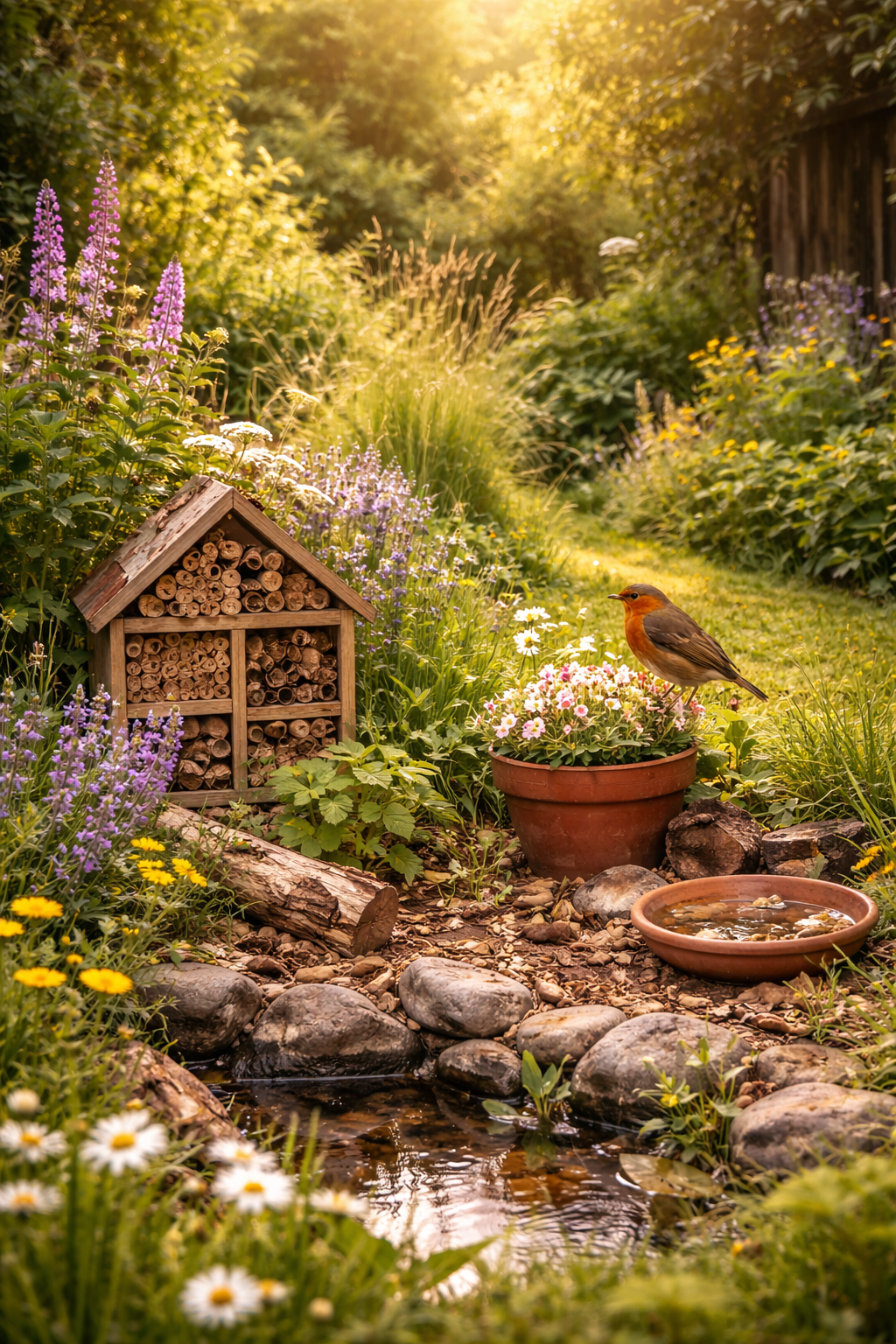
| One Step at a Time A gentle guide for real people and real gardens There is a quiet misconception that wildlife-friendly gardens must look a certain way. That they must be large, rural, densely planted, or deliberately “wild”. That supporting nature requires specialist knowledge, wholesale change, or a willingness to let everything run unchecked. In reality, most wildlife-friendly gardens are built slowly, through small decisions made over time. They are ordinary gardens — shaped by people, routines, weather, and habit — that simply make room for other lives alongside our own. Spring is where that process often begins. |
| Letting go of the all-or-nothing idea One of the biggest barriers to wildlife-friendly gardening is the idea that you must do everything at once. This can feel overwhelming. Where do you start? What if you get it wrong? What if the garden becomes unmanageable? But gardens are not fixed systems. They are always in motion. Wildlife responds not to perfection, but to continuity — the sense that spaces remain usable long enough to matter. A wildlife-friendly garden is not created in a weekend. It is created in moments of pause. |
| Step one: notice what is already there Before changing anything, it helps to observe. Spring reveals a great deal: Which areas warm first Where birds linger Which corners stay damp or sheltered Where do insects appear earliest? These patterns are already telling you what works. Gardens often support more life than we realise. The first step is not adding, but recognising — noticing that the hedge is busy, the compost heap is alive, the grass edge hums when the sun hits it. Working with what already exists is easier — and more effective — than starting from scratch. |
| Step two: leave something alone The simplest wildlife-friendly action is often restraint. Leaving: Some leaf litter Old stems into spring A patch of long grass A pile of logs or stones A dense hedge untrimmed …creates immediate benefit. These spaces offer shelter, food, and continuity at exactly the moment many animals need it most. They also cost nothing, require no expertise, and can be adjusted gradually if needed. Leaving one thing alone is often more impactful than adding several new features. |
| Step three: soften the edges Wildlife thrives at boundaries. Where lawn meets border. Where fence meets hedge. Where soil meets stone. Softening these edges — rather than sharpening them — increases the number of usable niches within the garden. This might mean: Allowing grass to creep slightly into borders Letting climbers fill gaps rather than cutting them back hard Leaving seed heads and stems standing. Accepting irregular shapes Edges that blur provide shelter, movement routes, and variety — all within a small footprint. |
| Step four: think in layers, not features Wildlife-friendly gardens are often described in terms of features — ponds, feeders, boxes. While these can be helpful, they matter less than layers. Layers include: Ground cover Low plants Shrubs Trees or climbers Soil and leaf litter Each layer supports different lives, and the overlap between them is where most activity occurs. You don’t need every layer everywhere. Even one well-layered area can support a surprising range of species. |
| Step five: allow imperfect beauty One of the most important shifts is aesthetic. Wildlife does not respond to neatness. It responds to function. A chewed leaf, fallen petal, or uneven patch of growth is often evidence that the garden is being used. Accepting imperfection is not the same as neglect. It is an understanding that the garden’s role is broader than visual appeal alone. Beauty, in a wildlife-friendly garden, often arrives later — as movement, sound, and familiarity rather than instant polish. |
| Step six: change slowly, not constantly Gardens that are constantly reset are difficult for wildlife to rely on. Many species depend on: Returning to the same places Using familiar routes Finding shelter where it existed before Frequent, dramatic changes — even well-intentioned ones — can disrupt these patterns. Making one or two small adjustments each season, then allowing time for life to respond, builds resilience far more effectively than constant intervention. |
| Step seven: Remember that connection matters No garden exists in isolation. Birds, insects, and mammals move through neighbourhoods, not just plots. What you allow in your garden may support life that depends on other spaces — and vice versa. This means that even modest gardens play a role. A single hedge gap, wild corner, or patch of long grass can act as a stepping stone in a much larger network. Wildlife-friendly gardening is a collective effort, even when it doesn’t feel like one. |
| A garden that grows with you Perhaps the most reassuring truth is this: wildlife-friendly gardens evolve. What works one year may change the next. Some things will thrive. Others will fade. New arrivals will appear without invitation. This is not failure — it is responsiveness. The goal is not control, but relationship. A garden that supports wildlife does not demand constant effort. It asks for attention, patience, and a willingness to share space. |
| Starting where you are You do not need: More land More time More money More knowledge You need only to start where you are, with what you have, and allow one small change to settle before making another. Spring is full of energy and urgency. But wildlife-friendly gardening moves at a gentler pace — one that values steadiness over speed. And often, the most meaningful changes are the ones that feel almost too small to matter. Until, quietly, they do. |

