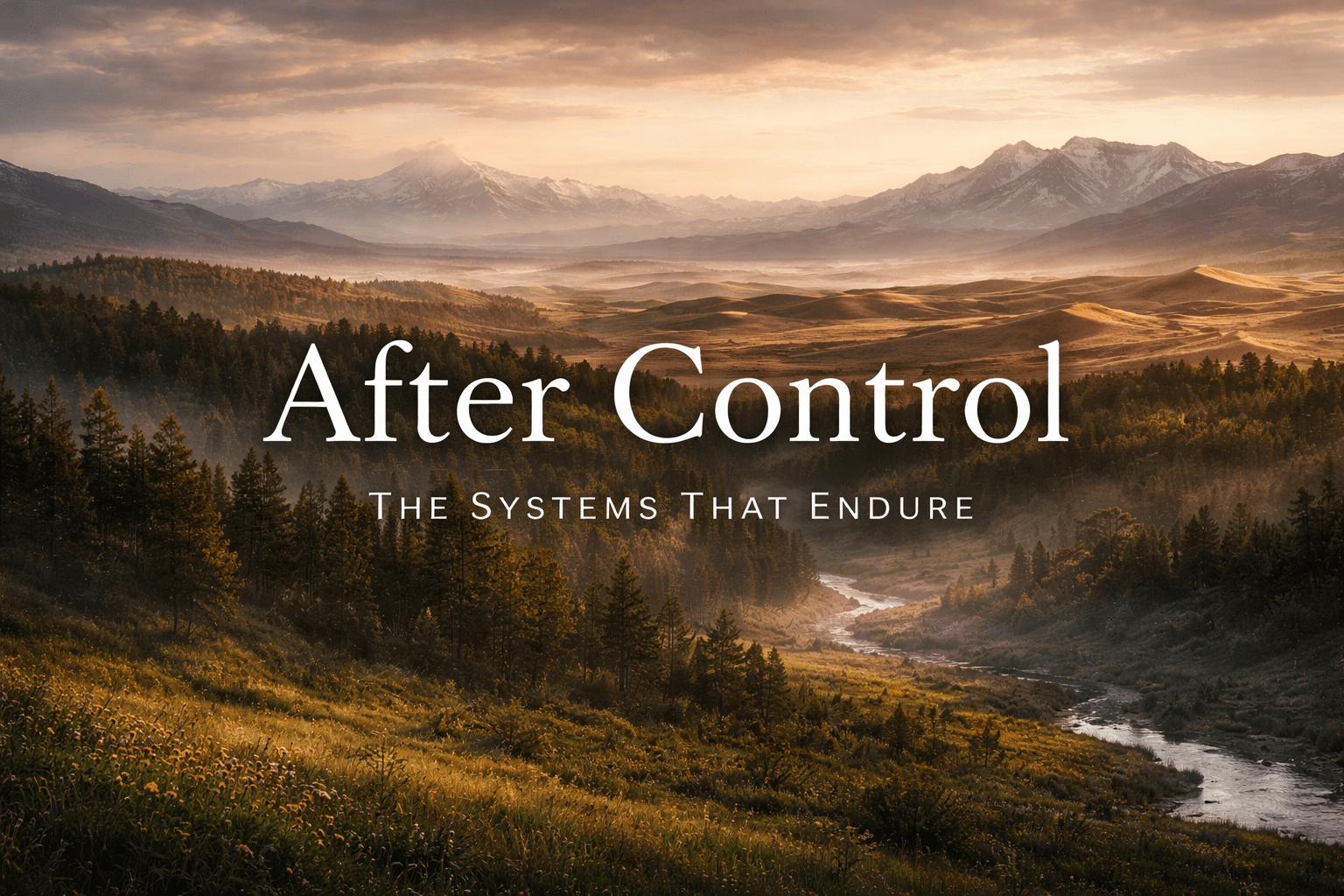
| Series Introduction This series begins with a simple recognition: Humans are unlikely to disappear, but our ability to control systems at scale is neither permanent nor guaranteed. Much of modern thinking imagines the future in extremes — collapse or continuity, apocalypse or progress. Reality is quieter. Civilisations thin before they vanish. Supply chains fray before they break. Management fails unevenly, not everywhere at once. And when pressure lifts — even slightly — the living world responds immediately, not with recovery or revenge, but with reorganisation. After Control is not about a planet without people. It is about a planet where human dominance weakens, fragments, and becomes local rather than global. The landscapes explored in this series — deep ocean, deep soil, forest canopy, grassland, desert, tundra — are not chosen for spectacle. They are chosen because they reveal what persists when oversight fades, energy becomes scarce, and systems are left to operate according to their own rules. These are not pristine worlds waiting to be restored, nor damaged worlds waiting to be saved. They are working systems — some resilient, some fragile, all governed by limits that humans did not design. Across history, humans have mistaken visibility for importance. We focus on what is fast, loud, and productive, while the foundations of life operate slowly, invisibly, and without acknowledgement. Soil decides whether forests return. Oceans regulate climate regardless of politics. Grasslands absorb shock long after infrastructure fails. Deserts and tundra remind us that not all land is meant to yield. This series does not argue for retreat, nor does it advocate control. It observes what happens when control is no longer total — when management becomes patchy, when pressure drops unevenly, and when living systems are allowed to express their own priorities. Nature does not heal. It adapts. It reallocates energy. It fills gaps. Humans remain part of this picture — fewer in number, more constrained, more local. The question is not whether life continues, but which systems endure, and on what terms. After Control is an attempt to look steadily at those systems — not as metaphors, warnings, or fantasies, but as realities already shaping the future beneath our feet, beyond our cities, and far below the surface of the sea. The world after control is not empty. It is structured differently. |
| About our writing & imagery Many of our articles are written by us, drawing on real experience, reflection, and practical work in gardens and places we know. Some pieces are developed with the assistance of AI, used as a drafting and research tool rather than a voice or authority. Featured images may include our own photography, original AI-generated imagery, or—where noted—images kindly shared by other creators and credited accordingly (for example, via Pixabay). All content is shaped, edited, and published by Earthly Comforts, and the views expressed are our own. |


Interesting observations, Rory. I enjoyed:
“Nature does not heal.
It adapts.
It reallocates energy.
It fills gaps“
Humans could learn so much from nature if only they would take the time observe.
LikeLiked by 1 person
Oh indeed so Eugenia, how is your hiatus coming along?
LikeLiked by 1 person
Well, I met all my goals, Rory. I even surprised myself by doing so. 😊
LikeLiked by 1 person
Excellent.
LikeLiked by 1 person
👍😉
LikeLiked by 1 person