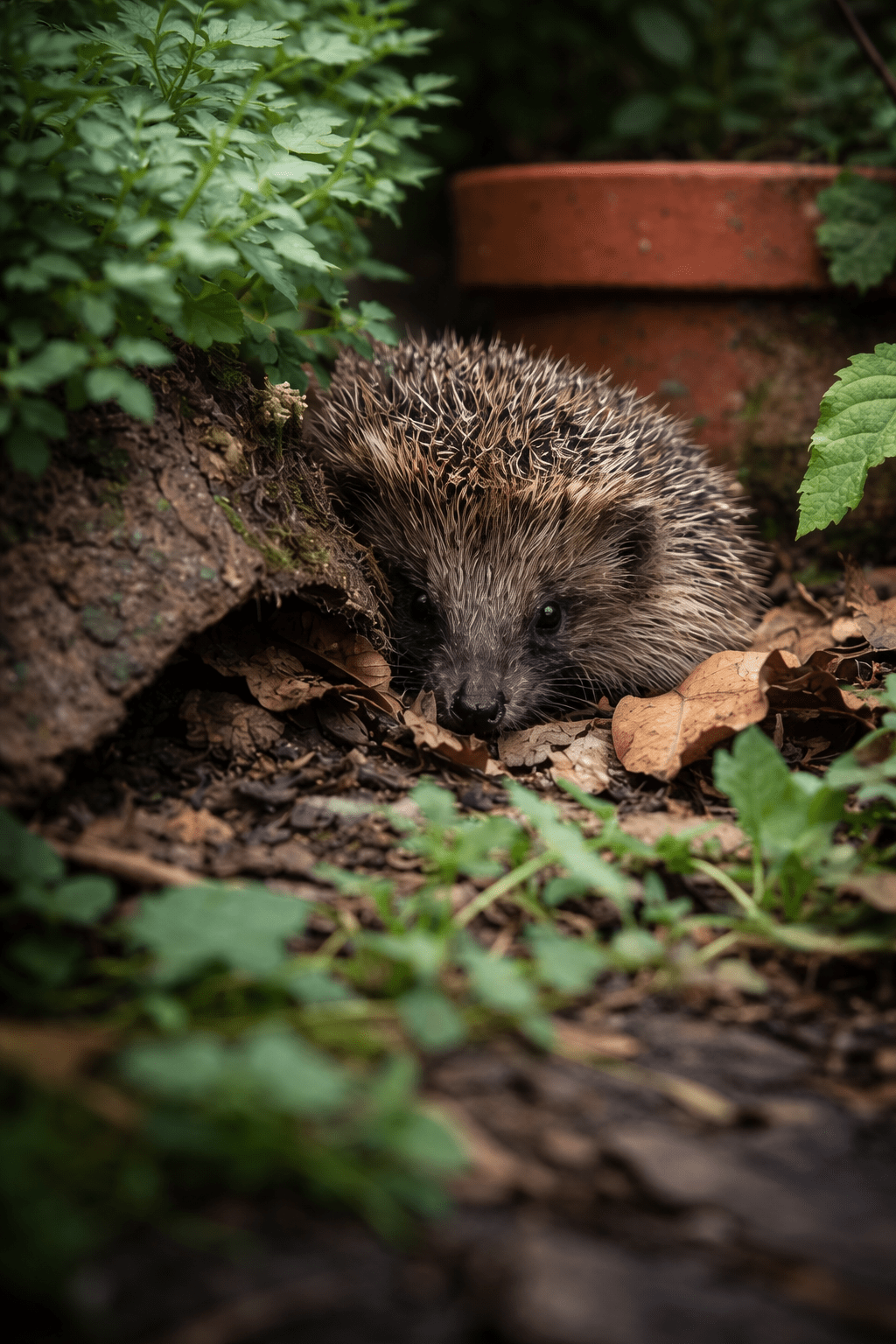
| There are certain moments in gardening when you realise the job is not really about plants at all. It’s about what moves through a space when you’re not there. What crosses a lawn at night? What hides under a hedge you didn’t quite finish cutting? What survives because someone chose not to tidy something away. Hedgehogs belong firmly in that category. You almost never see them when you’re “doing” the garden. They arrive after the tools are down, after the light has gone, after the human sense of completion has settled in. And yet, quietly, they’ve become one of the clearest indicators of what British gardens are now being asked to do. For a long time, we treated gardens as decorative buffers between houses and the “real” countryside. Somewhere to manage, improve, and neaten. Wildlife was a bonus, not a responsibility. But the countryside has changed faster than most people realise, and not in ways that favour small, slow, ground-moving animals. Fields are bigger, edges are sharper, roads are faster, margins are thinner. In that context, the suburban garden hasn’t just become helpful — it has become necessary. What strikes me most, working garden to garden, is how often hedgehog-friendly spaces arise accidentally. A pile of leaves was left because the rain came in. A log stack that was meant to be chopped but never quite was. A gap under a fence was created because replacing the panel slipped down the list. These are not grand conservation gestures. There are lapses in control. And those lapses matter. There’s a common online assumption that helping wildlife means doing more: feeding more, installing more, buying more things that claim to solve problems. Hedgehogs complicate that narrative. Yes, food draws them in — that much is obvious. But food alone doesn’t let an animal live a life. It doesn’t give it somewhere to breed, to hibernate, to move safely between places. A hedgehog that can eat but can’t travel or shelter is not thriving; it’s lingering. What gardens offer, at their best, is structure rather than provision. Soft edges. Interruptions. Continuity across boundaries. Hedgehogs don’t experience a single garden as a unit. They experience a chain of them — a stitched-together landscape made up of tolerances and permissions. One immaculate garden can be a dead end. Five slightly compromised ones can be a habitat. This is where the idea of “wild” needs recalibrating. Wild does not mean abandoned or chaotic. It means uneven. It means allowing different speeds of life to coexist. A hedge that’s cut once instead of three times. Leaf litter that’s left until spring because nothing urgent depends on its removal. A lawn edge that softens instead of being corrected. These choices don’t look dramatic. They don’t photograph well. But they completely change the nighttime map. There’s also a limit to what gardens can absorb, and it’s important to say that plainly. Hedgehogs appearing more often in gardens is not a simple success story; it’s a signal of pressure elsewhere. We shouldn’t romanticise that shift. A refuge is still a refuge, not a first choice. The goal isn’t to turn every back garden into a sanctuary because that feels nice to think about; it’s to recognise that gardens are currently carrying ecological weight they were never designed for. Another quiet misconception is that intervention is always benign. Bringing animals together around feeding points, however well-intentioned, alters behaviour and risk. Disease spreads differently when nature is concentrated. In the wild, hedgehogs are not especially social creatures. When we feed them, we ask them to share space in ways they didn’t evolve to manage. Care, here, means restraint as much as generosity. What I keep coming back to is this: hedgehogs respond more to attitude than to effort. Noticing rather than managing. Allowing rather than optimising. Accepting that a garden doesn’t need to justify itself through constant visible productivity. In a culture obsessed with improvement, that’s a quietly radical stance. The hedgehog’s survival in Britain may hinge less on big policy shifts — though those matter — and more on thousands of small, uncoordinated decisions made by people who will never think of themselves as conservationists. People who simply decide that not everything needs to be cleared, sealed, or perfected. People who leave a way through. In that sense, hedgehogs are not asking us to do something new. They’re asking us to stop doing quite so much. |
| Companion Fact Box — Hedgehogs & Gardens (Neutral Reference) Species status The European hedgehog (Erinaceus europaeus) is listed as vulnerable to extinction in the UK. Declines have been strongest in rural areas, with urban and suburban sightings becoming proportionally more important. Recent urban garden research Large-scale studies using motion-sensitive cameras have recorded hedgehogs in over half of the surveyed domestic gardens in some towns. Garden features linked to regular visits include: food availability garden connectivity presence of shelter and undisturbed areas Key habitat features Log piles, leaf litter, and dense planting provide nesting and hibernation opportunities. Gaps at ground level in fences (“hedgehog highways”) allow movement between gardens. Over-tidy, sealed, or fully enclosed gardens limit access and survival. Feeding considerations Hedgehogs are omnivorous insect-eaters; supplementary food may attract them, but does not replace habitat. Inappropriate food and poor hygiene can increase the risk of disease. Feeding concentrates animals that would normally be more dispersed. Daytime sightings Hedgehogs are nocturnal. Animals seen during the day, injured, or behaving in an unusual manner may require professional assessment. Further information (UK) British Hedgehog Preservation Society — species information and guidance Hedgehog Street — garden connectivity and urban conservation Hedgehog Helpline — advice on injured or vulnerable hedgehogs Nottingham Trent University — urban wildlife research Chester Zoo — conservation and research collaboration |
| About our writing & imagery Many of our articles are written by us, drawing on real experience, reflection, and practical work in gardens and places we know. Some pieces are developed with the assistance of AI, used as drafting and research tools rather than as a voice or authority. Featured images may include our own photography, original AI-generated imagery, or—where noted—images kindly shared by other creators and credited accordingly (for example, via Pixabay). All content is shaped, edited, and published by Earthly Comforts, and the views expressed are our own. |

