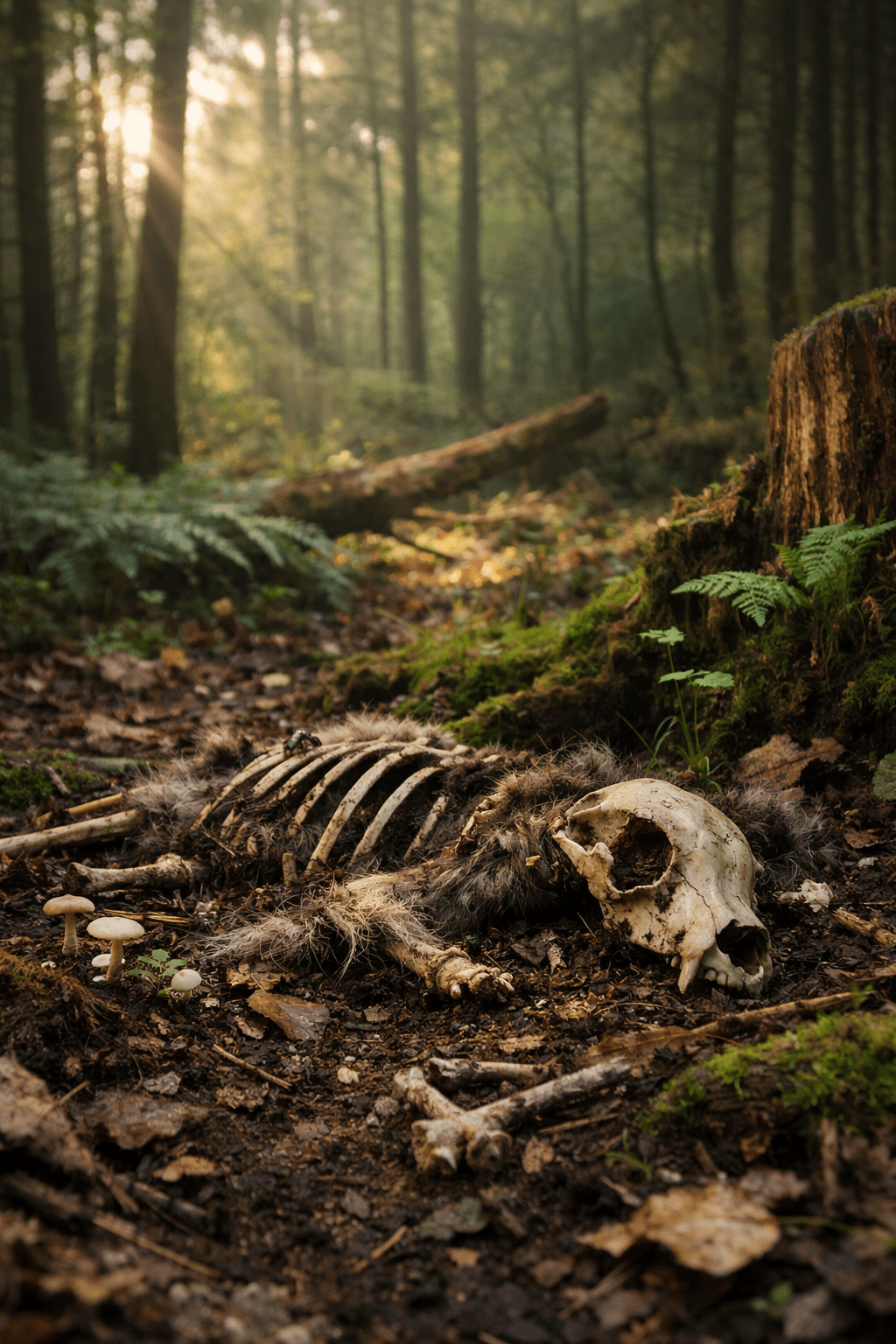
| Part 2 There’s a moment, usually unnoticed, when a body stops being a body and starts becoming ground. As a gardener, you don’t encounter it often in a dramatic sense. It’s more likely to be a pigeon under a hedge, a mouse caught in a shed corner, a fox you notice by smell before sight. Small, ordinary endings. But once you’ve seen enough soil at work, you begin to recognise what’s really happening. Not decay as an ending, but redistribution. We talk a lot about growth. Less about what makes growth possible. Decomposition sits quietly underneath everything we value in a landscape. It doesn’t announce itself. It doesn’t rush. It doesn’t perform. But without it, soil would thin, plants would weaken, and life would slowly choke on its own leftovers. Death, in a living system, is not waste. It’s a transfer. |
| The first shift When an animal dies, the change is immediate but invisible. The warmth drains, oxygen stops moving, and the body begins to turn inward on itself. Cells rupture. Fluids move. Bacteria that were once contained begin to roam. At this stage, nothing smells. Nothing looks different. But the process has already started. What follows isn’t chaos. It’s a sequence. Soft tissues begin to break down first. Organs collapse into liquid matter rich in nitrogen and salts. Blood and fluids seep downward, drawn by gravity and soil structure. If the ground beneath is alive — properly alive — microbes respond almost instantly. You can’t see them, but the soil warms. Activity spikes. Something has arrived worth feeding on. This is the first thing people often miss: decomposition doesn’t start in the body. It starts in the ground beneath it. What the soil receives Different parts of the body contribute different things to the soil at different timescales. Muscles and organs go quickly. They’re generous, wet, and full of energy. Nitrogen arrives early, fuelling bacterial growth. That bacterial bloom doesn’t last long, but it sets the tone. Fungi follow, feeding not just on the remains but on the bacteria themselves. This is where balance begins. Fat moves more slowly. It lingers. In cool or damp conditions, it can hang around for months, quietly feeding microbes steadily rather than in a rush. Fat is patient energy. Bones are something else entirely. They’re not drama. They’re banking. Long after everything else has gone, bones sit in the soil, releasing calcium and phosphorus in slow, almost stubborn increments. Fungal threads move in. They’re very good at this sort of thing — mining minerals, dissolving what looks solid, carrying nutrients away to roots you might never connect to the original body. Hair, fur, feathers — these are the last to go. Keratin resists decay. It belongs more to fungi than bacteria, and it breaks down on fungal time. Years, not weeks. What it leaves behind isn’t quick fertility but structure. Carbon that helps soil hold together, hold water, hold shape. Nothing arrives all at once. Nothing leaves cleanly. That’s the point. The patch you can’t quite explain. Gardeners notice patterns before they know reasons. You see a patch where plants grow darker, taller, slightly unruly. Leaves a deeper green. Stems thicker. You don’t remember feeding it differently, but it still behaves differently. Often, that’s where something died. A fox dragged a rabbit there years ago. A pheasant didn’t make it through winter. A cat left something half-buried and forgotten. The body is long gone, but the soil remembers. This is one of those things the internet rarely talks about properly. We like tidy explanations. Compost in, growth out. But soil doesn’t work on straight lines. It works on echoes. The ground beneath a decomposed body becomes richer not just in nutrients but in biology. Microbes diversify. Fungi spread. Roots follow opportunity. The effect softens over time, but it doesn’t disappear quickly. Death leaves a footprint. Woodland ground: movement and speed In woodland soil, everything moves faster. There’s air in the ground. Drainage, leaf litter, worm channels, fungal networks — all of it keeps oxygen moving. That oxygen changes everything. It allows decomposers to work efficiently, cleanly, and almost eagerly. Insects arrive early. Flies, beetles, ants. They break down tissue mechanically, spreading material outward as much as downward. Scavengers may remove pieces, redistributing nutrients across a wider area. What looks like loss is actually distribution. Fungi dominate here. Woodland soil is their home ground. They deal with complexity — lignin, keratin, bone minerals — things bacteria struggle with. They move nutrients both sideways and down, connecting death to roots often metres away from where the body lies. This is a fast system. Carbon doesn’t hang around for long. Much of it returns to the air. The rest becomes part of living soil, circulating rather than accumulating. Forests don’t store much. They reuse constantly. Wet ground: holding instead of releasing Wetlands tell a different story. When soil stays saturated, oxygen disappears. Without oxygen, decomposition slows, not because nothing is happening, but because everything is working at a disadvantage. The organisms that thrive here extract far less energy from their food. Insects are fewer. Scavengers struggle to access bodies. Fungi largely step back. What remains is a slow, partial breakdown. Material accumulates. An animal that would vanish in weeks in a woodland can linger for months or years in wet ground. Fat holds. Soft tissue resists. Bones remain stubbornly intact. Even plants decay differently here, stacking rather than dissolving. This is how peat forms. Not through abundance, but through incompletion. Wetlands don’t recycle aggressively. They archive. A common misunderstanding There’s a tendency online to describe wetlands as “nutrient-poor” as if that means lifeless. That’s not quite right. They’re not empty. They’re locked. Nutrients are present, but bound into organic matter that hasn’t fully broken down. Plants that live here have adapted accordingly. Some bring oxygen down into their roots. Some partners are closely associated with bacteria. Some sidestep the soil entirely and take nutrients from insects instead. Wetlands don’t lack death. They lack closure. That distinction matters, especially when people talk about draining land “to improve it”. When you add oxygen to a wet system, you don’t just dry it out. You unlock everything that was being held back. Centuries of stored material can burn through itself in a few decades. The ground remembers how you treat it. What gardening teaches you about this Working with soil changes how you see endings. You stop thinking in terms of clean removal. You start thinking about placement, timing, and context. What stays. What moves. What feeds what? One of the quiet skills gardening teaches is restraint — knowing when not to tidy. Leaving leaf litter. Letting something decompose where it fell. Accepting that not everything needs to be managed to be useful. Decomposition isn’t messy when you understand it. It’s just untidy on human timescales. And perhaps that’s the deeper discomfort. We like quick cycles. Growth we can see. Results we can measure by the season. Decomposition asks for patience. It works slowly, unevenly, and without asking permission. But it works. The longer view Woodlands and wetlands aren’t opposites. They’re partners. One specialises in movement — fast turnover, constant reuse, living in the present. The other specialises in memory — storage, accumulation, holding things back for later. Between them, they keep the ground fertile and the climate stable. Between them, nothing is truly lost. A body becomes soil. Soil becomes root. Root becomes leaf. Leaf becomes litter. And the cycle shifts again, quieter each time, but never finished. Once you’ve seen that clearly, it’s hard to think of death as absence. It’s just redistribution, happening below the surface, whether we’re paying attention or not. |
| About our writing & imagery Many of our articles are written by us, drawing on real experience, reflection, and practical work in gardens and places we know. Some pieces are developed with the assistance of AI, used as a drafting and research tool rather than a voice or authority. Featured images may include our own photography, original AI-generated imagery, or—where noted—images kindly shared by other creators and credited accordingly (for example, via Pixabay). All content is shaped, edited, and published by Earthly Comforts, and the views expressed are our own. |

