| A 5-Part Series |
| A curated exploration of Australia’s most iconic, curious, and ecologically important insects |
| Part 2 Butterflies & Moths: Movement and Migration Butterflies and moths bring motion to Australia’s insect world. Where ants build, and bees maintain, lepidopterans travel. They drift, glide, surge, and migrate across forests, coasts, deserts, and mountains, linking distant ecosystems through their movement. Australia’s butterflies and moths are shaped by vast distances and seasonal extremes. Many species rely on precise timing — emerging, feeding, breeding, and moving in rhythm with flowering cycles, rainfall, and temperature. Some are fleeting and delicate; others are powerful long-distance travellers. Together, they represent change, transformation, and continuity. This part of the series explores five species that reflect scale, colour, endurance, and cultural meaning. |
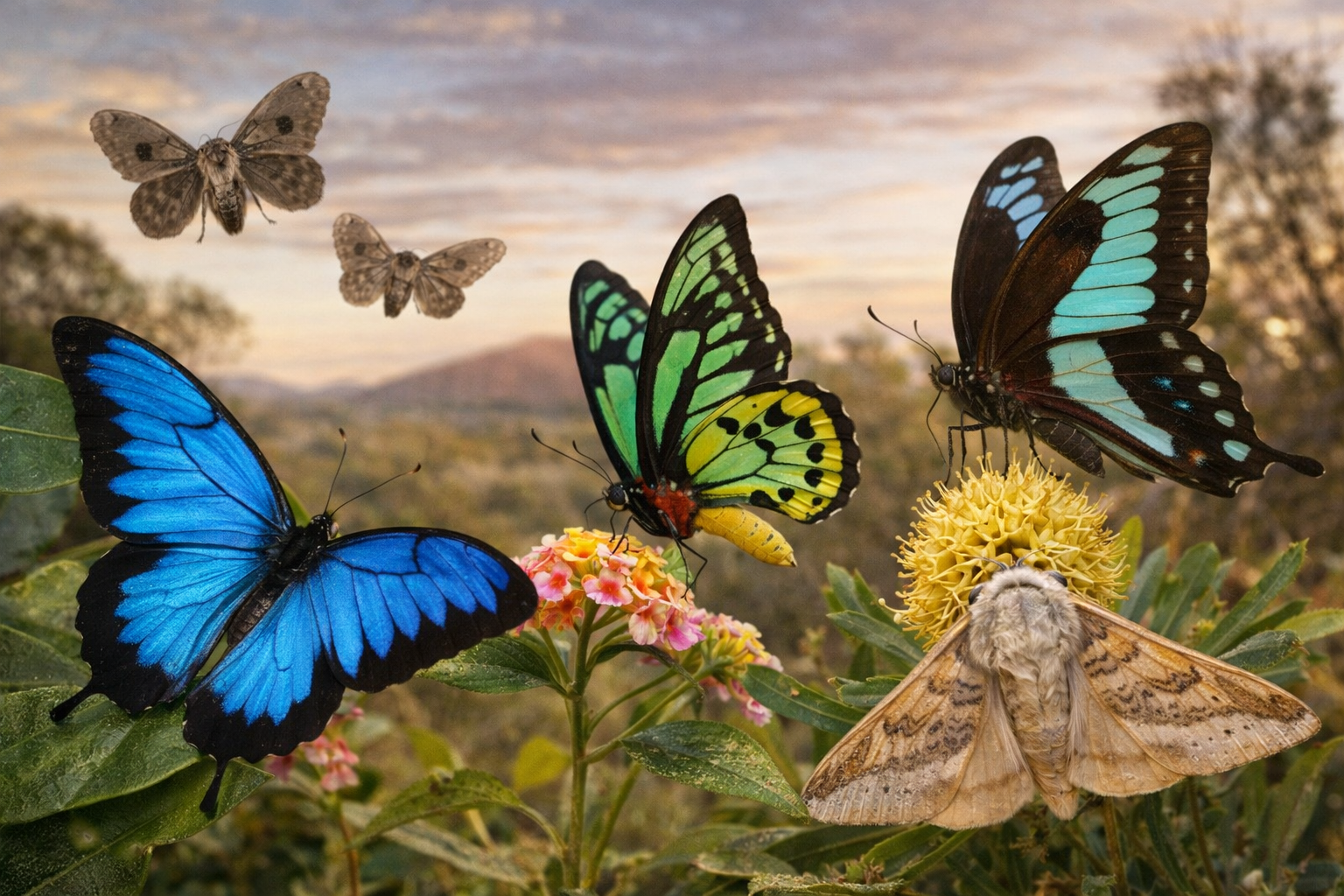
| Ulysses Butterfly The Ulysses butterfly is instantly recognisable, its electric blue wings flashing against rainforest greens like fragments of sky in motion. Found mainly in northern Queensland, this butterfly is not a weak flier — it moves with speed and intent, often patrolling territories rather than fluttering aimlessly. The vivid blue colouration is structural rather than pigmented, created by microscopic scales that reflect light. This brilliance serves multiple purposes: territorial signalling, mate attraction, and predator deterrence. In flight, the sudden flashes of blue followed by black create a disorienting effect that makes the butterfly difficult to track. Despite its bold appearance, the Ulysses butterfly depends on intact rainforest systems. Its presence often signals ecological health, making it both a visual icon and a quiet indicator of environmental stability. |
| Cairns Birdwing Butterfly The Cairns birdwing is Australia’s largest butterfly, a true giant among insects. Females can reach wingspans of up to sixteen centimetres, their broad wings moving with slow, powerful beats that resemble a bird more than an insect. Males are strikingly coloured, often displaying vibrant greens and golds, while females are larger, darker, and more subdued — a contrast shaped by evolutionary pressures around reproduction and survival. Their size allows them to travel long distances in search of food plants and mates, but also makes them highly visible in the landscape. Despite their strength, Cairn’s birdwings are vulnerable. They rely on specific host plants for their larvae, tying their survival closely to habitat preservation. Their continued presence reflects the delicate balance between grandeur and fragility in Australia’s insect life. |
| Blue Triangle Butterfly The blue triangle butterfly is a master of effortless movement. Common along Australia’s eastern coast, it is known not for speed or spectacle, but for its smooth, gliding flight. It often moves through open woodland and suburban gardens with calm precision, rarely in a hurry. Its wings display subtle blue and white markings, understated compared to more flamboyant species. This restraint is part of its success — the blue triangle avoids attention rather than courting it, relying on consistency and adaptability. Unlike many butterflies, it thrives in a range of environments, including urban areas. Its steady presence across generations makes it a familiar companion rather than a rare marvel, reminding us that endurance is sometimes quieter than brilliance. |
| Bogong Moth The Bogong moth represents one of Australia’s most extraordinary insect phenomena. Each year, billions of moths migrate from lowland breeding grounds to the cool alpine caves of southeastern Australia, travelling hundreds of kilometres with remarkable navigational accuracy. These migrations have occurred for thousands of years and hold deep cultural significance for First Nations peoples, who consider the Bogong moth a seasonal food source and a focal point of ceremonial gatherings and knowledge exchange. Within the alpine caves, the moths cluster in dense masses, entering a state of dormancy before returning to breed. This cycle links distant ecosystems — plains, valleys, and mountains — through a single species. The Bogong moth is not just an insect, but a living thread connecting ecology, climate, and human history. |
| Witchetty Moth The witchetty moth is best known not in its adult form, but through its larval stage — the witchetty grub — a traditional and highly nutritious bush food. The adult moth, however, plays an equally important ecological role. As a moth, it participates in nocturnal pollination and completes a life cycle rooted in transformation. Its relatively plain appearance contrasts with the cultural and nutritional importance of its larva, reminding us that significance is not always visual. The witchetty moth embodies continuity between land, food, and life cycles. Its story is one of transformation — from soil to air, from sustenance to pollinator — reflecting the deep interdependence between insects, people, and country. |
| Closing Reflection Butterflies and moths are the moving parts of Australia’s ecosystems. They connect places separated by distance, elevation, and season. Through migration, flight, and metamorphosis, they remind us that landscapes are not static — they are linked by motion. In the next part of this series, we turn to beetles: the armoured recyclers and ancient survivors that thrive where others cannot, breaking down the old to make way for the new. |
| Butterflies & Moths: Movement and Migration Australia’s lepidopterans are defined by scale, colour, and epic journeys. Ulysses butterfly Electric blue wings and strong flight make it one of Australia’s most recognisable butterflies. Cairns birdwing butterfly Australia’s largest butterfly, with females reaching a wingspan of up to 16 cm. Blue triangle butterfly Common in eastern Australia, it is known for its steady gliding flight. Bogong moth Famous for its mass migration to alpine caves and deep cultural significance to First Nations peoples. Witchetty moth The adult form of the witchetty grub is a traditional bush food. |
Unless stated, featured images are my own work, created independently or with the assistance of AI.


Great post full of interesting information. Fantastic species.
LikeLiked by 1 person
Thanks Michael
LikeLiked by 1 person
You’re welcome.
LikeLiked by 1 person