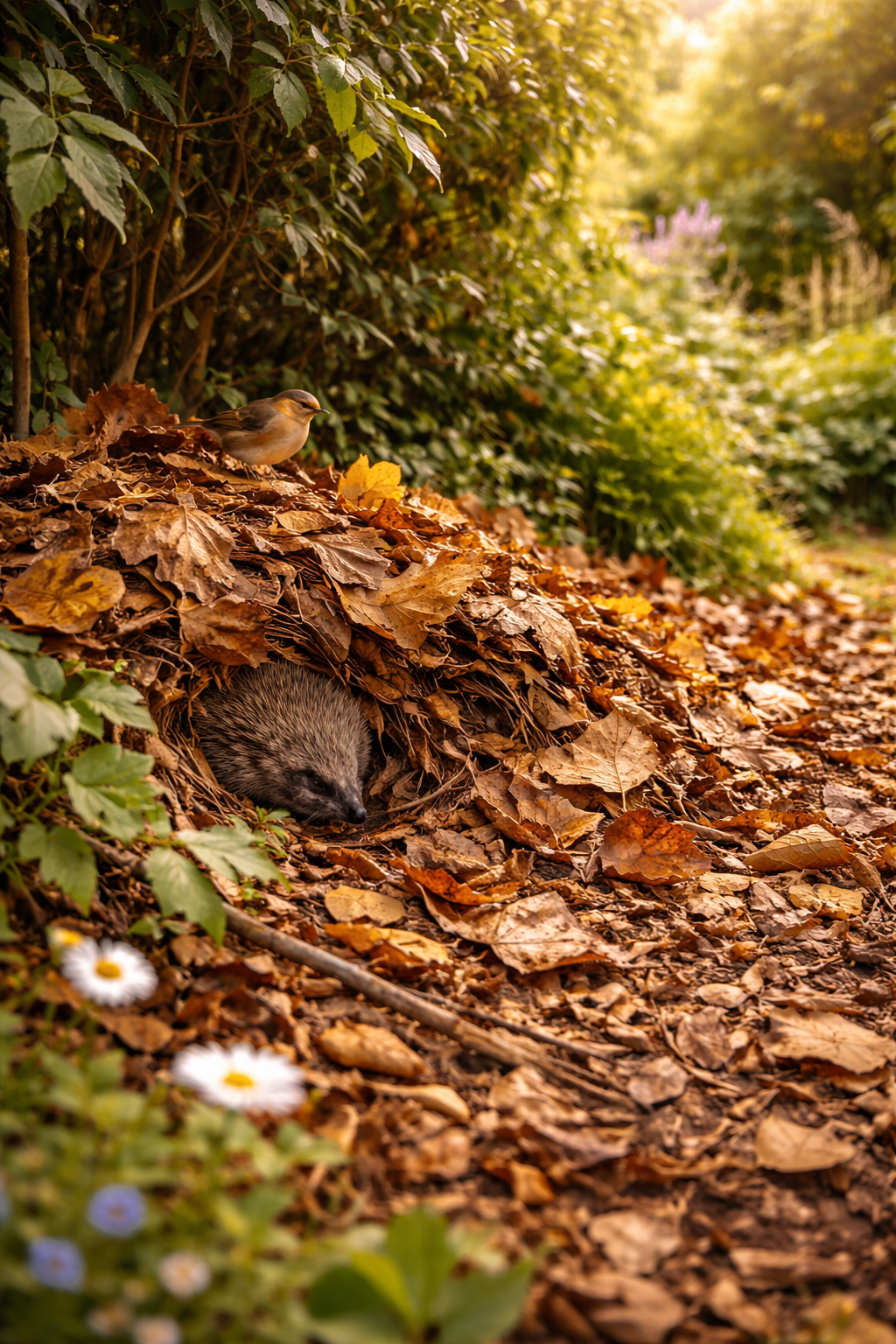
| Why what we leave behind matters — even in spring By spring, last autumn can feel like a distant chapter. The garden is greening again. Shoots push through the soil. Blossom replaces bare branches. And yet, in many gardens, traces of the previous season remain — caught beneath hedges, tucked into borders, gathered in corners where the rake never quite reached. Autumn leaves are often seen as something to be cleared away, finished with, forgotten. But in truth, their role in the garden does not end when winter passes. For many forms of life, those fallen leaves are not debris — they are shelter, food, and continuity. Understanding leaves as habitat rather than waste reframes how we see both autumn and spring. |
| What really happens to fallen leaves When leaves fall, they do not simply decay and disappear. They become part of a slow, layered process that supports life at multiple levels: Insects shelter within them. Larvae overwinter beneath them. Fungi and bacteria break them down. Nutrients are returned to the soil. Moisture is retained and moderated. This process unfolds over months, not weeks. By spring, many of the most important interactions are still underway — often hidden from view, but no less active. Removing leaf litter too thoroughly interrupts this cycle before it has finished its work. |
| Leaves as winter refuge, spring lifeline For many garden creatures, leaf litter is not optional. Insects overwinter as: Eggs Larvae Pupae Adults All of these stages rely on stable, insulated conditions. Leaves buffer temperature swings, protect against frost, and retain moisture. Without them, exposed soil and bare ground can become hostile environments just as life is preparing to re-emerge. By early spring, insects begin to stir within leaf layers. Clearing them away at this point removes shelter when it is most needed. |
| Soil health begins at the surface. Healthy soil is not created by digging alone. Leaf litter gradually feeds the soil, building structure and fertility from the top down. As leaves decompose, they: Improve soil texture Encourage earthworms Support fungal networks Reduce erosion and compaction. Gardens that retain organic matter tend to require less intervention over time. Plants establish more reliably. Moisture is better regulated. Growth becomes steadier rather than forced. In this sense, leaves are not mess — they are infrastructure. |
| Why “clean” gardens struggle more Gardens stripped back to bare soil may look orderly, but they are often more vulnerable. Without leaf cover: Soil dries out quickly. Temperature fluctuates more sharply. Insect populations drop Weed pressure can increase. Spring growth in these spaces may appear fast at first, but it is often less resilient. By contrast, gardens where some organic matter remains tend to feel calmer — slower to warm, slower to dry, and better able to cope with change. Nature rarely rushes, and gardens function best when allowed to follow that rhythm. |
| Choosing where leaves stay Keeping leaves does not mean leaving them everywhere. The most effective approach is selective: Under hedges In borders Around trees and shrubs In corners and along edges Paths, lawns, and high-use areas can still be cleared for safety and access. The key difference is recognising that leaves belong somewhere — not nowhere. Even small retained patches provide meaningful benefit. |
| Leaves and the quiet food web As leaves break down, they support a cascade of life. Microorganisms feed on decaying matter. Invertebrates feed on microorganisms. Larger insects feed on smaller ones. Birds, mammals, and amphibians feed on insects. This chain begins invisibly, but its effects ripple outward. When leaf litter is completely removed, this base layer collapses — and the absence is often felt much later, when birds fail to find enough food or when pests appear without predators to control them. |
| Spring cleaning with awareness Spring often brings an urge to refresh and reset. There is nothing wrong with tidying — but timing and scale matter. Clearing everything at once removes habitat wholesale. Working gradually, leaving some areas untouched, allows life to adjust and relocate. Gardens are more forgiving when change is staggered rather than sudden. Sometimes the most wildlife-friendly choice is not whether to tidy, but how much — and when. |
| A shift in mindset Seeing leaves as habitat requires a shift away from the idea that gardens must always look newly finished. It asks us to value: Process over appearance Function over neatness Continuity over control This does not diminish care. It deepens it. A garden that allows last year to support this year understands its own history. |
| What remains unseen still matters. By late spring, many of last autumn’s leaves will have broken down beyond recognition. They will no longer look like leaves. But they will be present — in richer soil, in healthier plants, in the quiet return of insects and birds. Their contribution is subtle, cumulative, and easily overlooked. But without it, much of what we value in gardens would struggle to appear at all. |
| Leaving space for the past Autumn leaves remind us that gardens are not seasonal silos. What happens in one season shapes the next. What we remove too quickly can never play its full role. And what we allow to remain often gives more than it seems. In spring, when growth surges and the garden feels eager to move forward, leaving traces of what came before is not laziness. It is understanding. |

