| A 5-Part Series |
| A curated exploration of Australia’s most iconic, curious, and ecologically important insects |
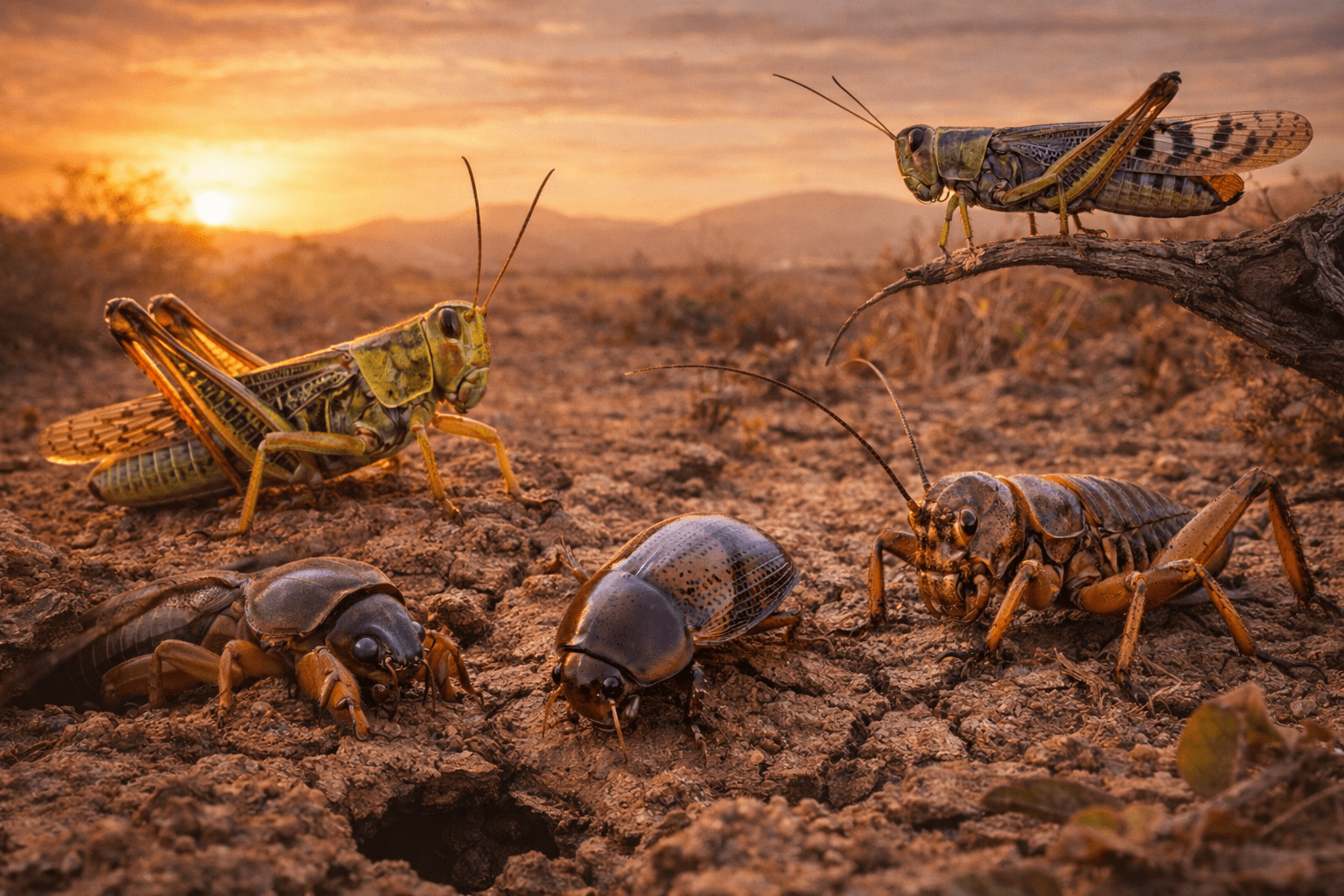
| Part 4 Grasshoppers, Crickets & Roaches: Survivors of Extremes Australia is a land of extremes — long droughts punctuated by sudden rain, scorching heat followed by rapid growth. Few insects are as closely tied to these boom-and-bust cycles as grasshoppers, crickets, and roaches. Where other insects specialise in stability or abundance, these groups specialise in survival. Built for endurance rather than elegance, they thrive in environments that fluctuate wildly. Some erupt into vast swarms when conditions allow; others live quietly underground or emerge only at night. Together, they represent adaptability, resilience, and persistence in the face of environmental uncertainty. This part of the series explores five insects that embody Australia’s capacity for sudden abundance and long survival. |
| Giant Grasshopper The giant grasshopper is among the largest in Australia, commanding attention with its sheer size and strength. With long, muscular hind legs and powerful wings, it can sustain flight across open landscapes. Unlike smaller species that rely solely on camouflage, the giant grasshopper combines visibility with mobility. When disturbed, it launches abruptly, covering large distances in a single flight. This ability allows it to escape predators and exploit scattered food sources in arid or semi-arid regions. Its life cycle is closely tied to rainfall. Populations expand rapidly when vegetation flourishes and contract just as quickly during dry periods, reflecting the rhythm of Au |
| Australian Plague Locust Few insects demonstrate the power of numbers as dramatically as the Australian plague locust. Under normal conditions, it lives unobtrusively, indistinguishable from other grasshoppers. Under the right environmental triggers, however, it transforms. When population density increases, behavioural and physiological changes occur, leading to mass swarming. These swarms can stretch for kilometres, consuming vast quantities of vegetation and exerting enormous pressure on agriculture. Despite their destructive reputation, plague locusts are not aberrations — they are natural responses to ecological opportunity. Their outbreaks reflect the land’s productivity, revealing how quickly life can surge when conditions align. |
| Mole Cricket The mole cricket lives largely unseen, spending most of its life beneath the soil. Its forelegs are broad and spade-like, adapted for digging through earth with remarkable efficiency. By burrowing, mole crickets aerate soil and influence drainage, indirectly benefiting plant growth. At night, males emerge to produce loud, resonant calls amplified by specially shaped burrows, turning the ground itself into an acoustic chamber. Though rarely noticed, mole crickets are engineers of the underground world, shaping soil structure while remaining hidden from view. |
| Bush Cockroach The bush cockroach challenges one of the most persistent misconceptions about insects. Unlike introduced household cockroaches, bush cockroaches are native, outdoor-dwelling species that play a valuable ecological role. They inhabit leaf litter, forests, and gardens, feeding on decaying organic material. In doing so, they contribute to decomposition and nutrient recycling, returning matter to the soil. Often mistaken for pests, bush cockroaches are in fact part of Australia’s natural cleaning system — quiet recyclers adapted to life outdoors rather than indoors. |
| King Cricket The king cricket is a formidable presence. Large, flightless, and nocturnal, it inhabits southern Australia, emerging at night to forage across the forest floor. With strong legs and powerful mandibles, king crickets are omnivorous scavengers, consuming plant matter, fungi, and smaller invertebrates. Their heavy bodies and lack of wings reflect a lifestyle built around strength rather than speed or flight. Ancient in appearance and behaviour, king crickets feel almost prehistoric — reminders of older insect lineages that persist through patience and durability rather than rapid change. |
| Closing Reflection Grasshoppers, crickets, and roaches are not refined specialists — they are survivors. They endure drought, capitalise on rain, hide underground, emerge at night, and multiply when opportunity arises. In a land defined by extremes, their success lies in flexibility. In the next part of this series, we turn to insects of precision and speed — predators whose lives are shaped by pursuit, ambush, and aerial mastery. |
| Grasshoppers, Crickets & Roaches: Survivors of Extremes Built for heat, drought, and boom-and-bust cycles. Giant grasshopper One of Australia’s largest grasshoppers, capable of long-distance flight. Australian plague locust Swarming species with enormous agricultural impact during outbreaks. Mole cricket Burrowing insects with shovel-like forelegs are active mostly underground. Bush cockroach Native, outdoor species — not a household pest. King cricket (added) Large, flightless, nocturnal insects found in southern Australia. |
Unless stated, featured images are my own work, created independently or with the assistance of AI.

