| A Matter of Timing, Trust, and Restraint |
| A question we are often asked is: When is the best time to cut salvias? It comes up year after year, usually just as the garden is beginning to stir but hasn’t quite committed to spring. There’s a sense that something should be done, that action is overdue. For my part, I tend to cut them back in mid to late April. This answer may sound simple, but it’s not just about a calendar date. It reflects a way of observing and interpreting the garden’s cues—salvias, especially, reward such attentiveness. |
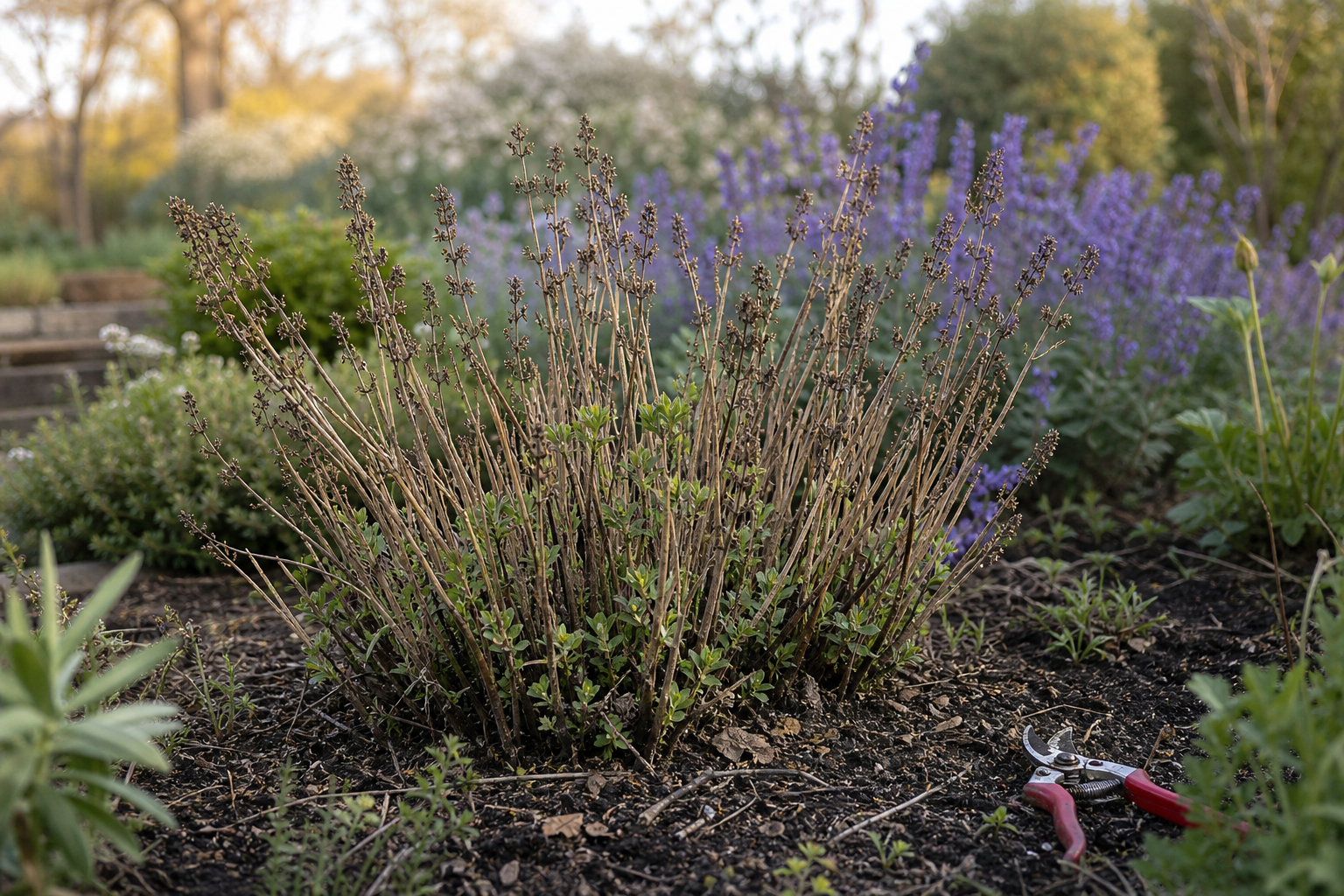
| The temptation to tidy too soon There is a particular moment in late winter when salvias begin to test a gardener’s patience. The borders are still quiet, the soil cold and holding its breath, and there they stand — grey, brittle, often untidy things, offering very little reassurance. Clients notice them. Passers-by notice them. Even gardeners, if they are honest, feel the faint urge to tidy, to intervene, to restore some sense of order before the season begins in earnest. And yet, this is precisely the moment where restraint matters most. Cutting back salvias for spring is not simply a question of timing. It is a question of understanding how plants endure, how they recover, and how much of gardening is about waiting for the right moment to act. It is also, quietly, a question of trust. Salvias are not one thing. Part of the confusion comes from the fact that “salvia” covers a broad range of plants that behave quite differently. Some are soft and shrubby, maintaining a woody framework year-round. Others are herbaceous, disappearing almost entirely and re-emerging from the ground. Then there are those who sit somewhere in between, never quite committing to one habit or the other, and who respond differently depending on the winter they are given. In practice, this matters less than it sounds. What matters is not so much knowing the Latin name, but learning to recognise how a plant behaves in your own conditions. In the sheltered corners of Sandwich, where frost is lighter, and the air carries a hint of the sea, salvias can behave generously, holding more structure through winter. A few miles inland, or in a more exposed plot, the same variety might collapse almost entirely. This is where experience begins to replace instruction. The plant in front of you becomes the guide, rather than the label it came with. The quiet work of winter There is a persistent idea, particularly among newer gardeners, that a clean garden in winter is a healthy one. Dead stems are removed, borders cleared down, and everything cut neatly to the ground in anticipation of spring growth. It feels efficient, even virtuous. But salvias do not particularly respond well to this kind of enthusiasm. In many gardens I work in, especially those exposed to wind or growing on slightly poorer soils, salvias left standing over winter will, by February, look as though they have given up entirely. The upper stems dry out. Leaves blacken or drop away. The structure loosens. It can feel as though the plant is half-dead. But appearances, at this time of year, are misleading. Those same stems, which look so untidy, are quietly performing a function. They are insulating the base of the plant, shielding it from frost, and slowing the rate of cooling. The crown — where new life will eventually push through — sits protected beneath this scruffy, unconvincing framework. Remove that protection too early, and you expose the plant at its most vulnerable moment. It is one of those situations where doing less is, quite literally, doing more. The moment to act There is no fixed date for cutting back salvias. Calendars are of limited use here. March might bring warmth one year and frost the next. April might be generous or reluctant. And this is where that mid-to-late April instinct comes from. By that point, the plant usually shows new growth at the base, which signals it is ready to be cut back. You will see it first at the base. Small, soft shoots emerging from what looked like lifeless wood. A faint greening of the crown. A suggestion, rather than a declaration, that the plant is waking. That is the moment. Not when the garden feels ready. Not when the weather improves. Not when there is a free afternoon. But when the plant itself signals that it can support the loss of its winter structure. Cutting back at this point feels less like an intervention and more like a collaboration. Cutting hard, and why it works. There is hesitation, particularly among careful gardeners, about cutting salvias back properly. The instinct is to be cautious — to remove only what is clearly dead, to leave a little extra “just in case.” But salvias, particularly the shrubby types, respond best to decisiveness. Once new growth is visible, cut back hard to a low framework of 10 to 20 centimetres. Use clean, sharp secateurs to trim stems above new shoots, encouraging a fresh, compact shape. What feels severe is often a kindness. Cutting back at the right time frees the plant from last year’s structure instead of damaging it. Cut too early, and the plant suffers; cut too late, and you risk damaging new shoots. Within that window, confidence matters more than precision. Herbaceous salvias and the illusion of choice. Herbaceous salvias offer a slightly different conversation, though it often appears more complicated than it is. These are the plants that die back more completely, leaving behind dry stems that stand through winter like the remains of a previous season. Traditionally, they are cut back in autumn. The logic is simple: remove the dead material, tidy the border, and prepare for spring. Partly, this is about structure. Also, from a practical perspective, leaving stems until late winter or early spring allows you to assess their condition before removal. When new shoots appear, cut back dead stems to ground level with secateurs. Partly, this is about structure. A garden stripped completely bare in winter loses something of its character. Those dry stems catch frost, hold light, and give a sense of continuity. But it is also about ecology. Even the most ordinary garden holds small life within it, and those stems provide shelter, however briefly. By the time spring approaches, the decision to cut becomes obvious. The plant either begins to move again, or the old stems have clearly reached the end of their usefulness. There is no need to rush the process. The borderline cases Then there are the salvias that never quite settle into certainty. In milder winters, they hold their structure well. In colder spells, they retreat. They test the gardener’s judgement more than any other type. With these, the principle remains the same: leave them until you see clear signs of new shoots or growth, then remove only dead or damaged stems, letting the plant itself guide your action. A plant that looks dead in February may surprise you in April. Equally, a plant that appears intact may reveal hidden damage once growth begins. The only reliable approach is patience, then observation, then action. It is not a precise science, and perhaps that is part of the point. Practical observations from the garden Working across a range of gardens, patterns begin to emerge, not as rules but as tendencies. First, salvias in well-drained soil tend to overwinter more successfully, holding stronger frameworks and responding more predictably to spring cutting. Those in heavier, wetter ground often retreat further and benefit from a lighter touch until growth is clearly established. Second, exposure matters as much as soil. A garden that catches the wind will strip a plant of its protection more quickly than frost alone. In these spaces, leaving stems standing becomes even more important. Third, there is a noticeable difference between plants cut back annually and those allowed to become leggy over time. Regular, confident pruning creates a rhythm — the plant expects it, responds to it, and builds upon it. Left unmanaged, salvias can become woody, open, and less generous in their flowering. And finally, there is the simple matter of timing visits. In a working garden round, you do not always arrive at the exact ideal moment. Sometimes you are early, sometimes slightly late. Learning to adjust — to read the plant quickly, to decide whether to act or return later — becomes part of the craft. Challenging the idea of control There is a broader, often unspoken, idea that a well-kept garden is one that is fully controlled. Every plant managed, every stem accounted for, every season anticipated. Salvias gently resist this idea. They ask gardeners to accept uncertainty, allow untidiness, and trust that apparent neglect is a different kind of care. This is not neglect. It is attentiveness of a quieter kind. The role of weather, and the limits of planning If there is one thing that unsettles even experienced gardeners, it is an unpredictable spring. A warm spell followed by a hard frost. Early growth checked abruptly. Plans undone. Salvias, like many plants, are vulnerable at the point of new growth. Cutting back too early can expose that growth just as conditions turn against it. Waiting too long can lead to awkward, leggy regrowth that is difficult to shape. There is no perfect solution here. Only an understanding that gardening exists within a wider system that cannot be fully predicted. In practical terms, this means erring slightly on the side of caution. Waiting for consistent signs of growth, rather than reacting to a brief improvement in the weather. Accepting that some years will not align neatly with intention. A quiet kind of confidence Over time, working with salvias builds a certain confidence. Not the confidence of certainty, but of familiarity. You begin to recognise the signs more easily. The difference between truly dead wood and something that is simply resting. The subtle shift in colour at the base of the plant. The way a particular variety responds in a particular corner of a particular garden. And with that familiarity comes a softer approach. Less urgency, fewer unnecessary interventions, a greater willingness to let the plant lead. It is a small example of a broader gardening principle. The more you observe, the less you feel the need to force. Closing reflection Cutting back salvias for spring is not a difficult task in itself. A pair of secateurs, a clear moment, a decisive cut. But the timing of that task entails decisions that extend beyond the plant. It asks the gardener to consider protection and exposure, action and restraint, control and trust. It reveals how easily we are drawn towards tidiness at the expense of resilience, and how often the garden benefits from a slightly slower hand. In the end, the best time to cut back salvias isn’t written in a calendar. It is written in the plant itself, in the quiet movement at its base, in the return of growth after a period of stillness. Mid to late April often proves to be that meeting point — where the plant is ready, the risk has softened, and the gardener can step in with confidence. And if you are willing to wait for that signal, the plant will meet you halfway. |


| About our writing & imagery Most articles reflect our real gardening experience and reflection. Some use AI in drafting or research, but never for voice or authority. Featured images may show our photos, original AI-generated visuals, or, where stated, credited images shared by others. All content is shaped and edited by Earthly Comforts, expressing our own views. |

