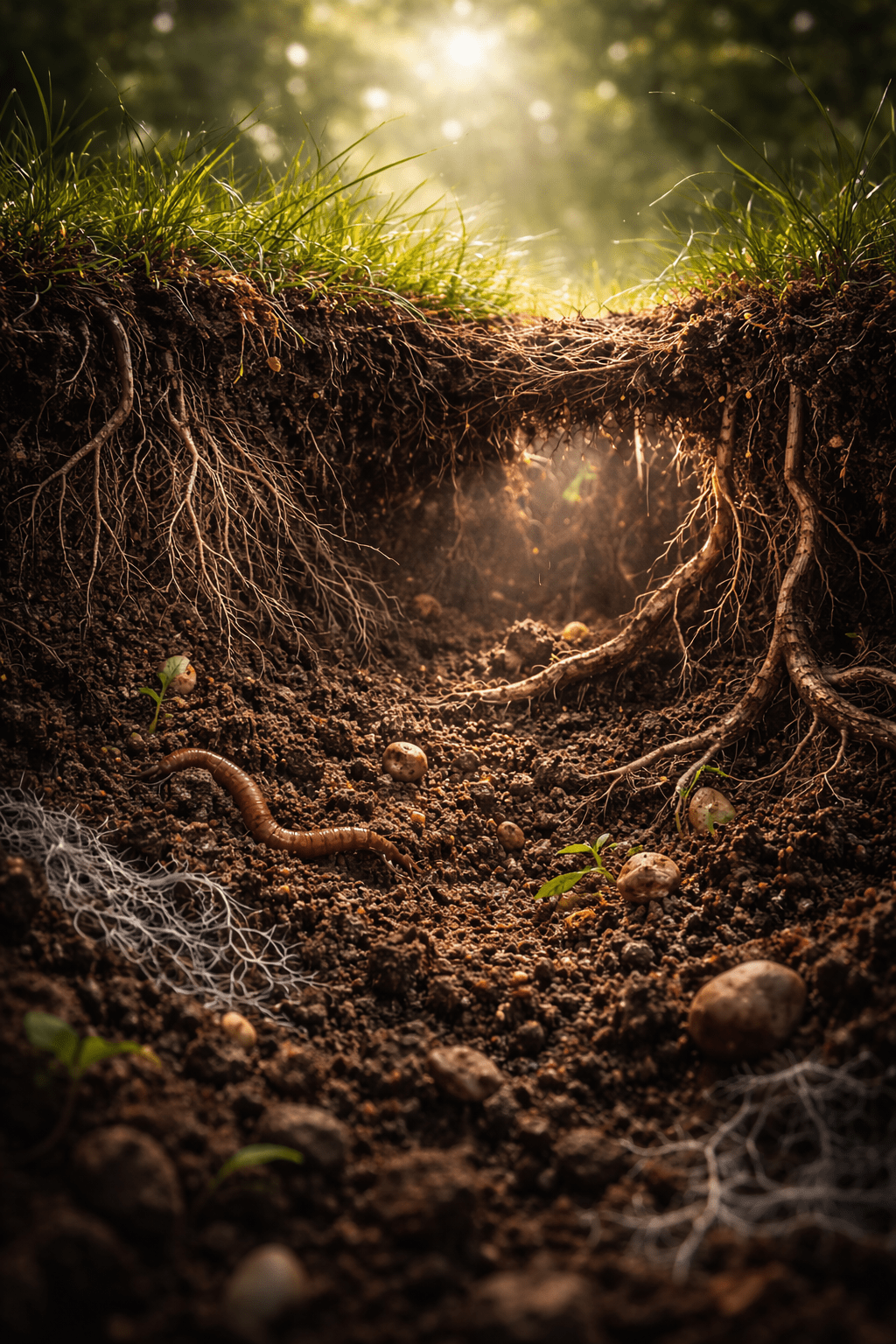
| Episode 2 Deep Soil: Memory, Exchange, and the Future Underground If the deep ocean is continuity without attention, deep soil is continuity with memory. It remembers everything. Every cut, every compaction, every season of neglect or care leaves a trace that outlives the gardener who caused it. Working with soil teaches humility quickly. You can lie to yourself about plants for a while — blame weather, pests, seed quality — but soil eventually tells the truth. It does so slowly, which is why we miss the lesson so often. A persistent myth suggests soil is just dirt: an inert medium to hold roots in place. That idea could only arise in a culture obsessed with surfaces. Soil is a negotiation, not a container. Sugars flow downward from leaves. Minerals and water move upward. Fungi broker trades. Bacteria unlock nutrients that plants cannot access on their own. Nothing happens in isolation. What matters most is not what we add, but what we disturb. Compaction, for example, is rarely visible at the moment it occurs. A machine passes. A path forms. A season continues. The damage shows up years later, when water refuses to drain, roots fail to explore, and growth plateaus for reasons that feel mysterious unless you remember. Deep soil operates on longer timelines than human planning allows for. Carbon stored there does not cycle quickly. Recovery from damage is possible, but not immediate. This is why collapse narratives that imagine rapid healing miss the point. Soil does not bounce back. It rebuilds — if given time and restraint. In a future where control weakens, deep soil becomes decisive. It determines which landscapes can still feed people, which can be reforested, and which are at risk of erosion. You cannot manage that from above. You have to work with what already exists below. Gardening, at its best, is an act of listening. Deep soil rewards that habit. It teaches that the future is not built where we look, but where we kneel. |
| About our writing & imagery Many of our articles are written by us, drawing on real experience, reflection, and practical work in gardens and places we know. Some pieces are developed with the assistance of AI, used as a drafting and research tool rather than a voice or authority. Featured images may include our own photography, original AI-generated imagery, or—where noted—images kindly shared by other creators and credited accordingly (for example, via Pixabay). All content is shaped, edited, and published by Earthly Comforts, and the views expressed are our own. |

