| Notes from the Other Side of the Question |
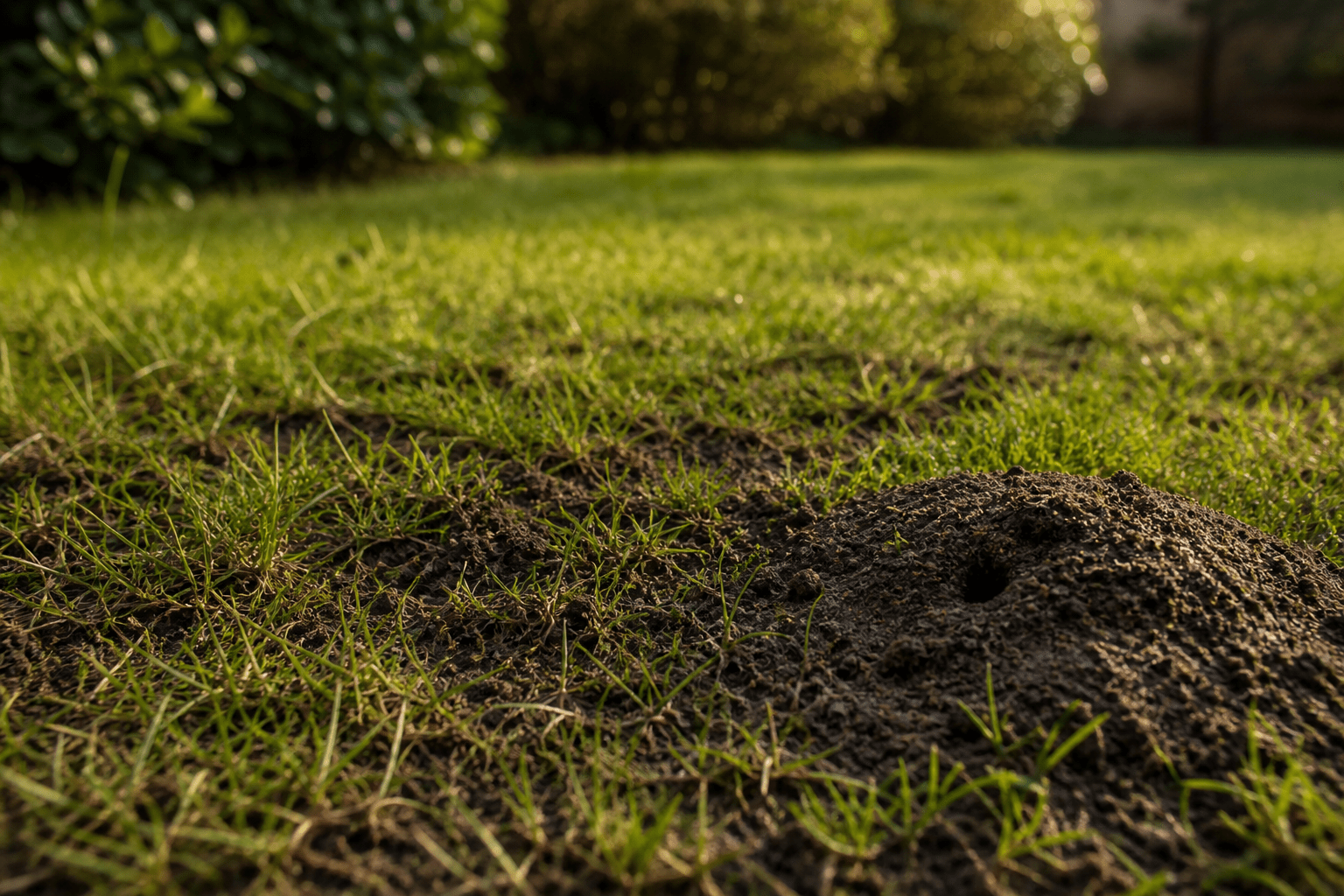
| We have noticed a shift in client conversations. Previously, discussions focused on hedges, borders, or tidying. Now, clients more often mention lawns. The concern is typically observational: thinning grass, loose surfaces, uneven colour, and a sense that something no longer holds together. Often, ants are mentioned. Not always as the primary concern, but as a visible sign that something has changed. Small mounds appear, the soil feels dry, and the lawn begins to look unsettled. It is easy and understandable to assume that the ants are the cause. In reality, they are more often a response to conditions that already exist. When we are asked to help, the problem is rarely single. It is cumulative. The lawn has not failed overnight; it has gradually lost structure, resilience, and its connection to the soil. Clients are asking, directly or not, for restoration, not just treatment. How the problem is usually described Clients describe lawns by feel or appearance, not process. They note that grass feels loose, that dry patches persist after rain, or that feeding has little effect. Often, they think a simple product or technique offers a quick fix. It is also common for clients to have already tried to correct the problem. Lawn feeds, weed treatments, or combined products are frequently applied in good faith. Occasionally, there is an attempt to deal with ants directly. These efforts are not misguided; they simply do not address the lawn’s underlying structure. A compacted, disconnected lawn cannot recover with surface treatment alone. Addressing ants without changing their environment rarely yields lasting results. Eventually, appearance concerns become functional issues. What lies beneath the surface When we assess a lawn in this condition, the focus is not immediately on what is visible. The presence of ants, moss, or patchiness is noted, but the more important question is how the soil is behaving. Compaction is nearly always present. It develops gradually from regular use and settling, limiting air, water, and root movement. Grass thins rather than fails, creating space prone to dryness and instability. These are the conditions in which ants thrive. They are drawn to soils that are already dry and open, where their tunnels remain stable. Their activity can worsen the surface condition, but it is rarely the original cause. Understanding this distinction is important because it changes how the problem is approached. Why quick fixes rarely hold There is a strong temptation to look for direct solutions. Modern lawn care is often presented in that way, with products designed to address multiple issues at once. While these can have a place, they are limited when the lawn’s underlying structure has deteriorated. Feeding a lawn that cannot absorb nutrients will not restore it. Removing ants without changing their environment brings only temporary relief. Seeding without soil preparation yields little establishment. What is required instead is a sequence of actions that rebuilds the lawn from the bottom up. This does not need to be complicated, but it does need to be deliberate. Beginning again: clearing and opening the lawn. The process often begins with dethatching, particularly where a layer of thatch has built up over time. This step can be visually unsettling. The lawn appears stripped back, and areas of soil are exposed. It is not uncommon for clients to question whether it has been made worse. Short-term, dethatching visually strips the lawn and exposes soil, causing concern. Long-term, it enables recovery by allowing water, air, and seed to reach the soil and revealing the lawn’s true condition. Once this layer is cleared, aeration becomes the next step. This is where the soil is physically opened, either with hollow tines or a fork. The aim is not simply to introduce air, but to break the compacted structure that has developed. This allows roots to extend, water to penetrate, and the soil to regain some flexibility. Aeration also has a secondary effect. Disturbing the ground disrupts the stable conditions that ants rely on. Colonies often move on naturally when the soil becomes less predictable. This is a more effective and measured approach than attempting to eliminate them directly. Restoring structure with topdressing After aeration, the lawn is open but not yet stable. The introduction of a topdressing layer helps to rebuild that stability. Typically, a blend of screened topsoil and compost or organic matter is brushed into the surface to integrate with the existing soil. This step is sometimes viewed as cosmetic, but its function is structural. It fills voids, binds loose areas, and improves soil texture. In doing so, it reduces the dry, dusty conditions that favour ants and provides a more suitable environment for grass to establish. Applied correctly, the topdressing does not sit on top of the lawn. It becomes part of it, supporting both existing roots and new growth. Reintroducing grass through overseeding Seeding marks are visible for recovery but depend on prior preparation. Seed on unprepared ground struggles; seed on a stable surface thrives. The aim is to achieve good contact between the seed and the soil. This often involves lightly working the seed into the topdressed surface and gently firming it in. Without this contact, the seed is easily lost to birds, wind, or dryness. There is sometimes a suggestion to cover newly seeded areas, often with plastic sheeting, to protect and accelerate growth. While the intention is understandable, this approach tends to create more problems than it solves. In open garden conditions, plastic can trap heat and moisture, restrict airflow, and lead to poor or uneven germination. If protection is needed, use netting to deter birds without changing growing conditions. Good preparation often makes extra protection unnecessary. Watering with restraint and consistency Watering is a critical part of the process, but it is often over-applied. The instinct to provide as much water as possible can lead to conditions less favourable to establishment. In the early stages, the goal is to maintain consistent surface moisture. This supports germination without displacing the seed or saturating the soil. Once seedlings begin to emerge, watering should become less frequent but more thorough, encouraging deeper root development. A lawn kept shallowly moist remains weak. Deep-rooted lawns are more resilient. The role of ants revisited As the lawn begins to recover, the prominence of ants tends to diminish. They may still be present, but their activity is less disruptive. The soil is no longer as dry or loose, and the conditions that allowed them to dominate have changed. Complete ant removal is unnecessary. In balance, ants are unobtrusive and play a role in the ecosystem. The aim is proportion, not eradication. Allowing the lawn to re-establish Final recovery requires patience. Growth is slow and uneven. Some areas respond quickly; others lag, creating an incomplete appearance. Early intervention hinders progress. Let the lawn settle and knit together, then cut lightly once the grass is at a suitable height to encourage thickening without stressing new growth. Gradually, the lawn stabilises. Improvements are slow but cumulative, leading to a cohesive surface that responds well to continued care. What clients are ultimately seeking Clients rarely seek single solutions. They want consistency, reliability, and a lawn that recovers with reasonable maintenance. Achieving this involves more than applying treatments. It requires an understanding of how the lawn functions as a system and a willingness to address the underlying conditions rather than just the visible symptoms. Closing reflection Lawn care, approached this way, focuses on restoration. It means recognising weak structure, rebuilding, and allowing time for results. Client concerns are shifting, away from quick fixes to a more thoughtful process that values results over immediacy. In the end, a healthy lawn is not the result of a single action, but of a sequence carried out with care and understanding. That is where lasting improvement is found. |
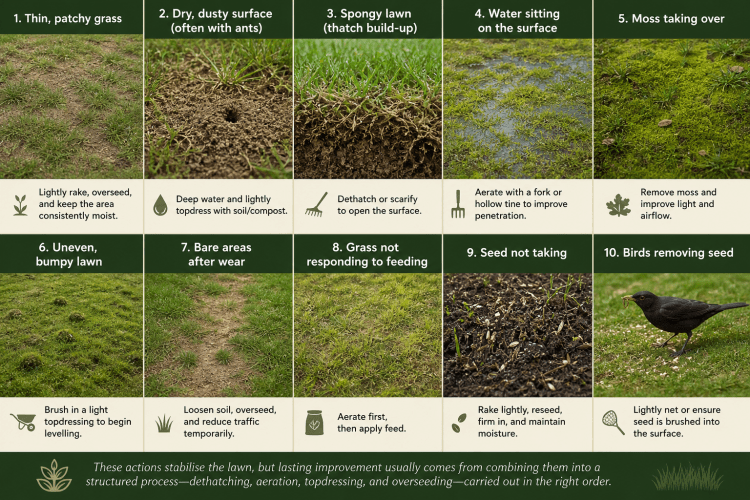
| Lawn Problem | What’s Happening | Immediate Action |
|---|
| Thin, patchy grass | Compaction, wear, or poor soil contact weakening growth | Lightly rake, overseed, and keep the area consistently moist |
| Dry, dusty surface (often with ants) | Poor soil structure and low moisture retention | Deep water and lightly topdress with soil/compost |
| Spongy lawn (thatch build-up) | Excess dead material blocking water and nutrients | Dethatch or scarify to open the surface |
| Water sitting on the surface | Compacted soil preventing drainage | Aerate with a fork or hollow tine to improve penetration |
| Moss taking over | Weak grass due to shade, compaction, or poor conditions | Remove moss and improve light and airflow |
| Uneven, bumpy lawn | Soil movement, worm casts, or past disturbance | Brush in a light topdressing to begin levelling |
| Bare areas after wear | Repeated traffic breaking down the surface | Loosen soil, overseed, and reduce traffic temporarily |
| Grass not responding to feeding | Nutrients not reaching roots due to compaction | Aerate first, then apply feed |
| Seed not taking | Poor seed-to-soil contact or drying out | Rake lightly, reseed, firm in, and maintain moisture |
| Birds removing seed | Exposed seed easily accessible | Lightly net or ensure seed is brushed into the surface |
| About our writing & imagery Most articles reflect our real gardening experience and reflection. Some use AI in drafting or research, but never for voice or authority. Featured images may show our photos, original AI-generated visuals, or, where stated, credited images shared by others. All content is shaped and edited by Earthly Comforts, expressing our own views. |

