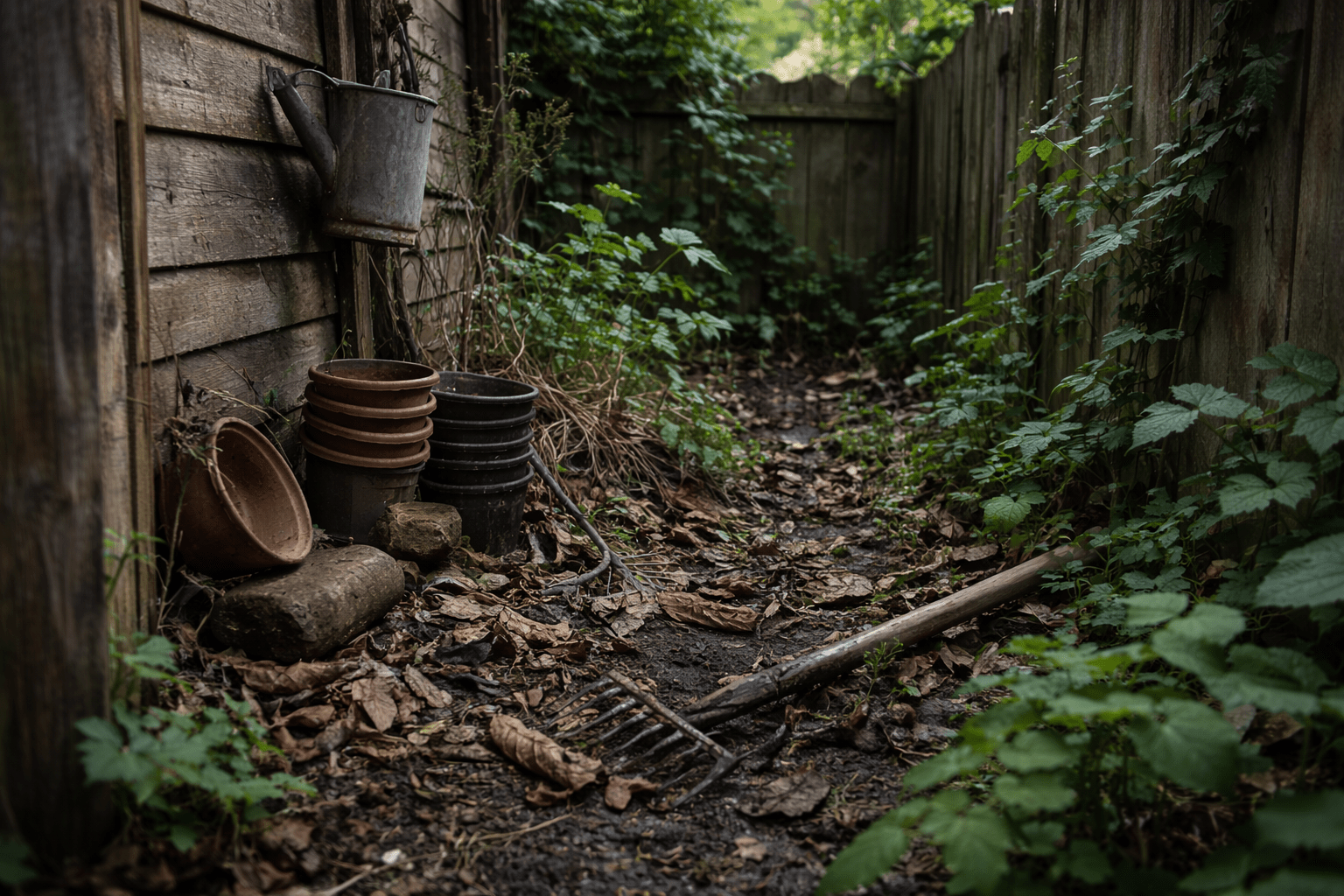
| … in the Average Garden Every garden has one. It’s rarely the bit people argue about, redesign, or photograph. It isn’t the lawn, or the border nearest the house, or the plant someone saved up for. It’s the strip behind the shed. The narrow run along the fence. The awkward corner where nothing quite fits and nothing seems worth resolving. Most gardeners don’t consciously choose to neglect this square metre. It happens slowly, through habit, convenience, and the quiet logic of prioritising what’s visible. Over time, that small decision accumulates. How neglect creeps in unnoticed The neglected square metre usually begins as a practical compromise. Access is awkward. The light is poor. The ground is compacted from years of foot traffic, storage, or builders’ boots. A fence went in, or a shed arrived, and the space behind it slipped out of mind. Gardening is time-bound work. People deal first with what they see and use. Borders by doors get attention because you pass them daily. Lawns get mown because they announce themselves. The back strip behind a structure doesn’t demand anything, so it receives nothing. Neglect here is not laziness. It’s selective attention. What’s interesting is how consistently this pattern repeats across gardens of all sizes and budgets. The most polished spaces often hide the most forgotten metre. The difference is not whether neglect exists, but whether it is acknowledged. What these spaces quietly become Left alone, these areas don’t remain neutral. Soil compacts, especially along fence lines, where rainfall is uneven, and roots compete aggressively. Debris collects. Weeds establish themselves not because they are “bad”, but because they are the only plants adapted to the conditions provided. Moisture behaves differently, pooling or running off in ways that don’t match the rest of the garden. From a gardener’s point of view, these metres tell the truth. They show drainage issues more clearly than planted beds. They reveal how shade actually moves across the garden. They expose where boundaries block airflow, trap frost, or hold heat longer than expected. I’ve often learned more about a garden by looking behind a shed than by studying the main borders. That forgotten strip carries fewer disguises. Human habits are written into the soil These neglected spaces also reveal something quieter: how people live with their gardens rather than how they imagine them. The spot where green waste is temporarily dumped and then forgotten. The place tools are leaned “for now”. The corner where pots gather, cracked and empty, because throwing them away feels wasteful, but reusing them requires a decision that never quite comes. Gardens record routines. The neglected square metre becomes a holding area for unresolved intentions. Not quite storage, not quite growing space, not quite wild. Over time, that ambiguity hardens into inertia. People often tell me they “don’t know what to do” with these areas. In truth, the difficulty isn’t design — it’s permission. Permission to simplify, to stop forcing productivity, or to allow a space to serve a quieter function. The myth that everything must be productive One of the most persistent assumptions in gardening is that every part of a garden should be actively doing something: flowering, feeding, entertaining, impressing. The neglected square metre challenges this idea by existing without justification. Ironically, when approached gently rather than corrected aggressively, these spaces often become the most resilient parts of the garden. Groundcovers settle. Leaf litter accumulates. Moisture levels stabilise. Wildlife finds cover. Maintenance drops rather than increases. The problem is rarely neglected itself — it’s neglect combined with guilt. Guilt leads to overreaction: stripping, spraying, overplanting, or paving. The cycle resets, and the square metre becomes neglected again, only now with poorer soil and fewer options. What happens when you pay quiet attention instead The most effective changes I’ve seen in these spaces are usually modest. Clearing accumulated debris without sterilising the ground. Relieving compaction in small sections rather than all at once. Choosing plants that tolerate conditions rather than attempting to remake them. Or sometimes doing almost nothing, aside from deciding that the space is allowed to be what it is. Behind sheds, along fences, and in narrow borders, success is often measured in stability rather than appearance. Less collapse. Fewer interventions. A sense that the space has settled into itself. These areas rarely become showpieces. But they often become anchors — places where the garden rests rather than performs. What the neglected metre teaches Every garden has limits. Physical, seasonal, human. The most neglected square metre is where those limits become visible. It shows where attention runs out, where design assumptions break down, and where a garden resists being turned into something it isn’t. Learning to read that space — rather than erase it — changes how people garden everywhere else. It encourages restraint. It shifts expectations. It makes maintenance more realistic and less anxious. And perhaps most importantly, it reminds us that not every part of a garden needs to be resolved to be healthy. Some spaces simply need to be understood. |
| About our writing & imagery Many of our articles are written by us, drawing on real experience, reflection, and practical work in gardens and places we know. Some pieces are developed with the assistance of AI, used as drafting and research tools rather than as a voice or authority. Featured images may include our own photography, original AI-generated imagery, or—where noted—images kindly shared by other creators and credited accordingly (for example, via Pixabay). All content is shaped, edited, and published by Earthly Comforts, and the views expressed are our own. |

